
Light
Bright Indirect Light
Requires abundant bright, indirect sunlight; protect from intense midday summer sun.
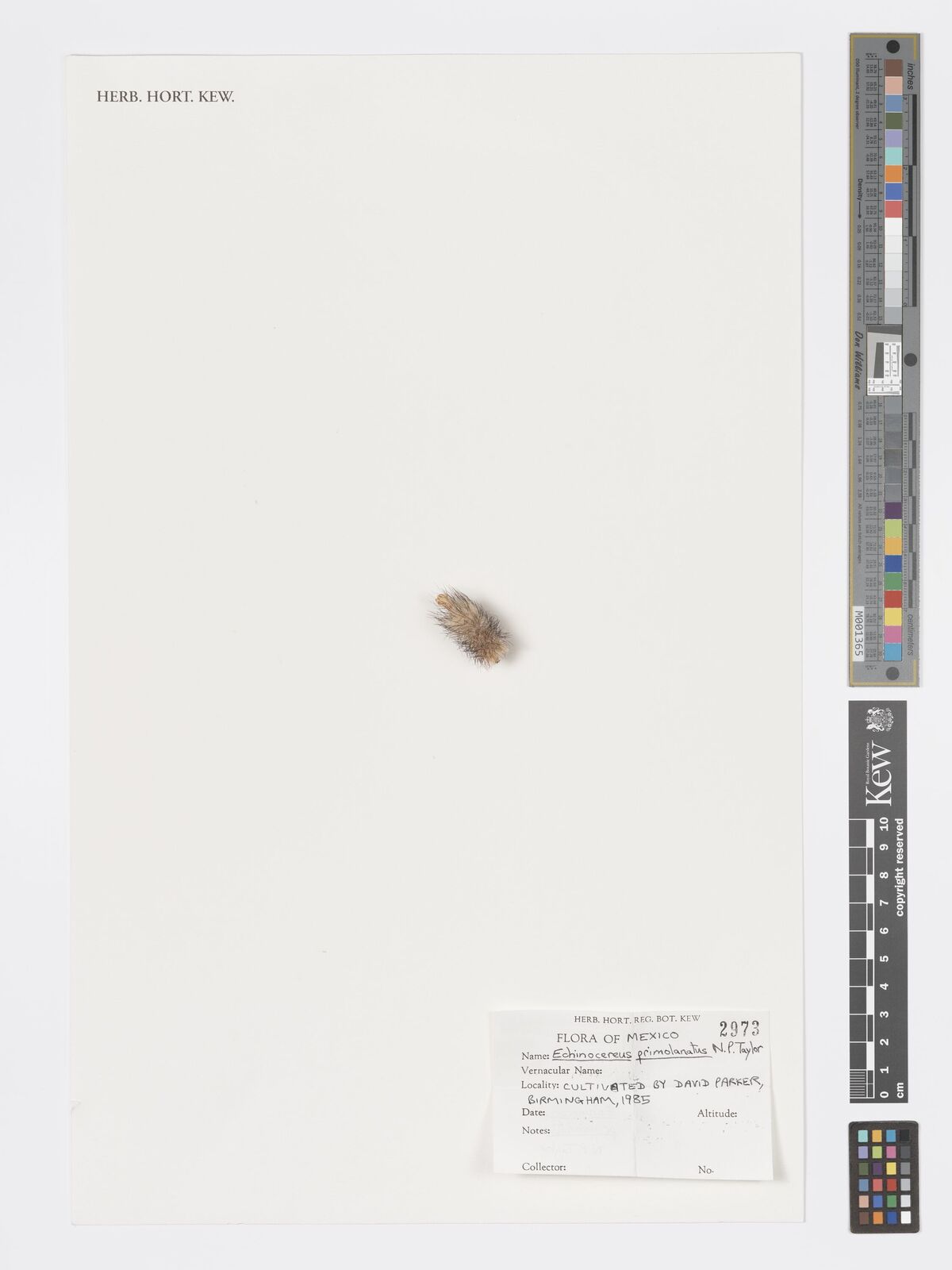 Reference image
Early Woolly Hedgehog Cactus
Echinocereus primolanatus is a highly sought-after, small-bodied cactus species renowned for its intricate pectinate spine structure and dense, woolly areoles 1. Recognized as a succulent subshrub in desert ecosystems, this species captivates collectors with its stunningly large, vibrant pink to magenta flowers that erupt in early spring.
Belonging to the family Cactaceae, genus Echinocereus, the species was named to highlight its distinct morphology. The specific epithet "primolanatus" derives from Latin roots meaning "first" or "early" (primo) and "woolly" (lanatus), referring to the dense, silky wool covering the newly formed areoles and apex during growth 2.
This species is native to the arid regions of northern Mexico, particularly in the states of Coahuila, Durango, and Zacatecas 1. It thrives primarily on limestone hills, rocky slopes, and semi-arid desert shrublands, growing in highly porous, mineral-rich substrates that allow fast drainage.
The stems are cylindrical, usually solitary or clustering sparsely at the base, and covered with 16 to 26 shallow ribs. The areoles are set closely together, featuring gray-white, pectinate spines that lie flat against the stem. The flowers are remarkably large compared to the plant's overall size, displaying vivid pink hues with bright green stigmas 2.
In cultivation, it requires bright, filtered sunlight to retain its tight, woolly spine formation. Free-draining mineral soil with high pumice or grit content is mandatory. Watering should follow a strict soak-and-dry method during spring and summer, while winter demands a completely dry resting period to prevent root decline.
The most prevalent error is overwatering during low-temperature periods. Clay-dominant soils that retain moisture will inevitably cause fungal root rot. Lack of adequate ventilation in indoor spaces also invites spider mites and mealybugs.
Requires abundant bright, indirect sunlight; protect from intense midday summer sun.
Allow soil to dry out completely between waterings; keep bone-dry during winter.
Requires extremely gritty, low-organic mineral soil with superior drainage.
Spines are sharp and pectinate but non-toxic; safe to grow around domestic pets.
Moderate; highly sensitive to excess moisture and requires strict watering discipline.
Naturally distributed across the arid limestone formations of the Chihuahuan Desert in northern Mexico, thriving in highly mineralized soil pockets among gravelly slopes.
