
Light
Direct Sun
Requires at least 6 hours of direct sunlight daily to maintain its shape and spines.
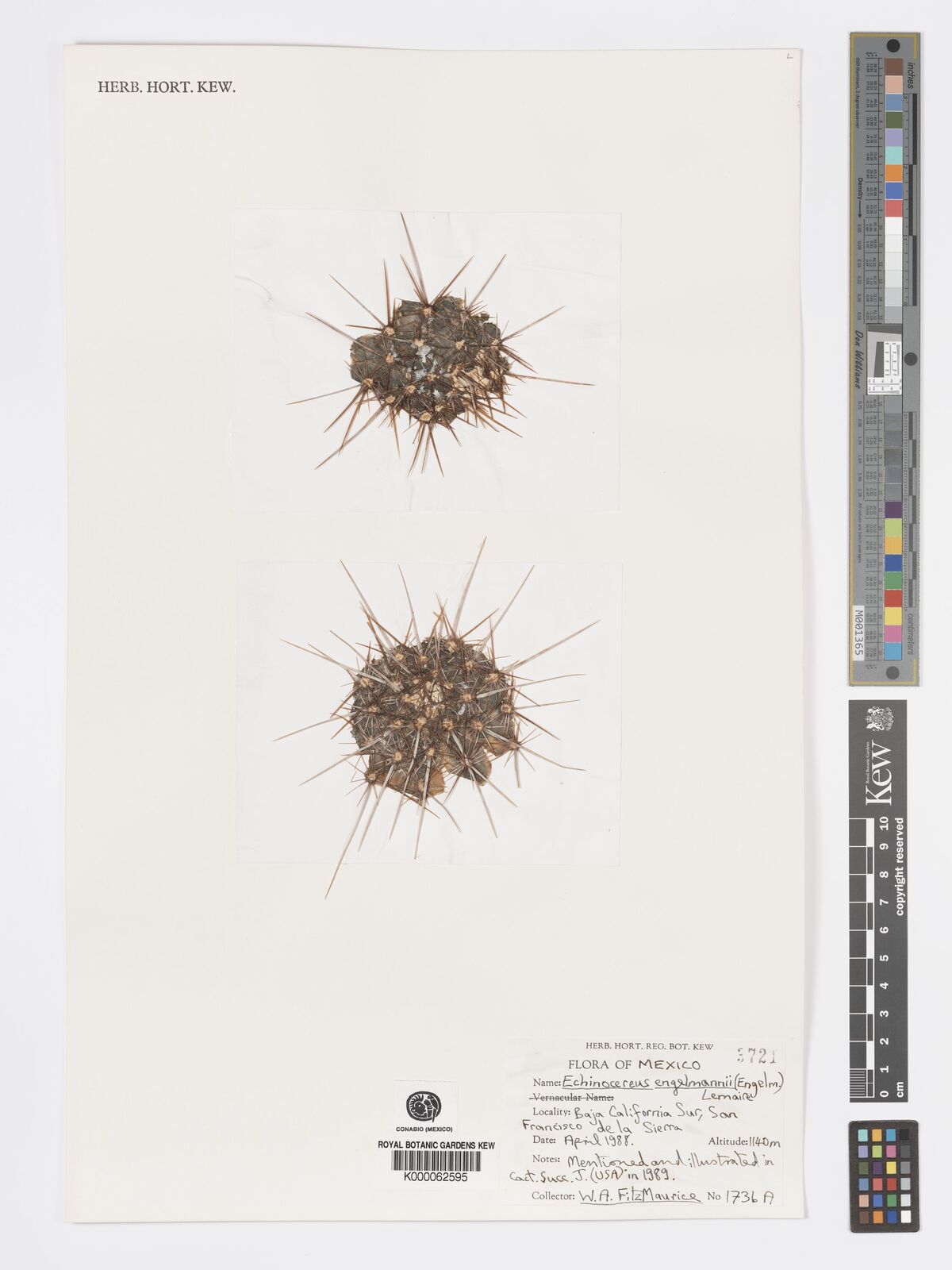 Reference image
Rebman's Hedgehog Cactus
Echinocereus rebmanii is a distinctive, slow-growing succulent subshrub belonging to the Cactaceae family. Highly adapted to arid desert conditions, this species is cherished by succulent collectors for its robust spination and spectacular, colorful funnel-shaped flowers.
The genus name Echinocereus is derived from the Greek 'echinos' (hedgehog) and Latin 'cereus' (candle). The specific epithet honors Dr. Jon P. Rebman, an esteemed botanist renowned for his extensive floristic research on the Baja California peninsula 1.
This species is native to the arid desert regions and dry shrublands of Baja California, Mexico 2. It thrives in gravelly soils, rocky outcrops, and mineral-rich terrains where drainage is exceptionally rapid and sun exposure is intense.
Echinocereus rebmanii features cylindrical, green to grayish-green stems that tend to branch from the base, forming small clumps over time. The ribs are prominent, lined with closely spaced areoles that produce sharp, pale to grayish-brown spines. During late spring to early summer, it produces large, striking pinkish-magenta flowers near the stem tips.
In cultivation, it requires maximum direct sunlight and a very porous, mineral-based potting medium. Water should be applied thoroughly only when the soil has completely dried out. Keeping the plant dry and in a cool environment during winter promotes a healthy dormancy period and encourages abundant flowering in spring.
The most frequent issues include overwatering, which leads to fatal root rot, and insufficient light levels, which causes the stems to stretch, pale, and lose their natural compact form.
Requires at least 6 hours of direct sunlight daily to maintain its shape and spines.
Water only when the soil is bone dry. Drastically reduce watering in winter.
Extremely well-draining cactus mix high in pumice, grit, and coarse sand.
Equipped with sharp spines that can puncture skin. Handle with thick gloves.
Very easy to care for as long as it is not overwatered and gets ample light.
Endemic to the arid coastal deserts and stony slopes of the Baja California peninsula in Mexico, thriving under harsh solar radiation and in nutrient-poor mineral soils.
