
Light
Full Sun
Requires at least 6-8 hours of direct sunlight daily; full sun is crucial for optimal growth and flowering.
 Reference image
Claret Cup Cactus
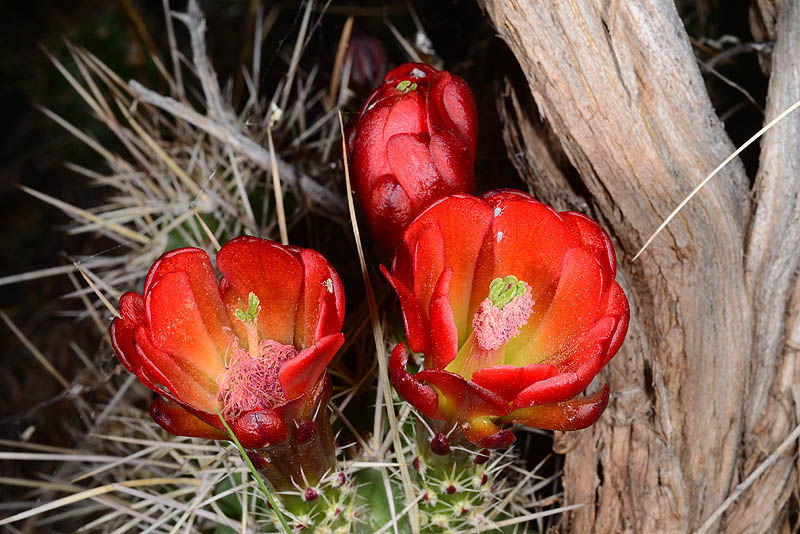
Echinocereus triglochidiatus, commonly known as the claret cup cactus or kingcup cactus, is a highly cold-tolerant and visually spectacular member of the Cactaceae family 1. This succulent subshrub is renowned for its brilliant scarlet, cup-shaped blooms that appear in late spring, making it a highly prized specimen for xeric gardens and rockeries 2.
Described in 1848 by the botanist George Engelmann, the specific epithet triglochidiatus is derived from Greek, meaning "three-barbed" or "three-spined," referring to the typical arrangement of its spines 1. The genus name Echinocereus combines the Greek "echinos" (hedgehog) with the Latin "cereus" (wax candle).
This species is native to the Southwestern United States—ranging from Utah and Nevada to New Mexico and California—and Northern Mexico 2. It thrives in arid deserts, rocky slopes, and pinyon-juniper woodlands, often at high elevations up to 3,000 meters, showing outstanding adaptability.
The plant forms dense, mounding clumps of cylindrical stems that reach 10–30 cm in height. The stems feature pronounced ribs lined with aeroles bearing sharp, rigid spines. Its striking, hummingbird-pollinated claret-red flowers are funnelform and remain open both day and night.
In cultivation, Echinocereus triglochidiatus requires full sun exposure and an exceptionally well-draining, mineral-dominant potting substrate. Watering should follow a soak-and-dry cycle during spring and summer, tapering off completely during the cold winter dormancy 3. It is extremely frost-hardy, tolerating temperatures down to -23°C if kept dry.
The most prevalent issue in cultivation is overwatering, especially during winter dormancy, which quickly induces root rot 3. Insufficient light exposure leads to etiolation (stretching) of the stems and severely limits the plant's ability to produce its signature vibrant blooms.
Requires at least 6-8 hours of direct sunlight daily; full sun is crucial for optimal growth and flowering.
Water deeply only when soil is bone dry in summer; suspend watering completely throughout winter.
Use an ultra-draining, highly mineralized soil mix rich in pumice, gravel, and coarse sand.
Non-toxic to pets, but possesses sharp, rigid spines that can cause physical injury; handle with care.
Extremely cold-hardy and drought-tolerant, making it a very low-maintenance and easy-to-grow desert cactus.
Naturally distributed across the arid mountainous regions, rocky slopes, and pinyon-juniper woodlands of Utah, Nevada, New Mexico, California, and Northern Mexico.
