
Light
Bright Indirect Light
Bright indirect light; protect from scorching midday summer sun.
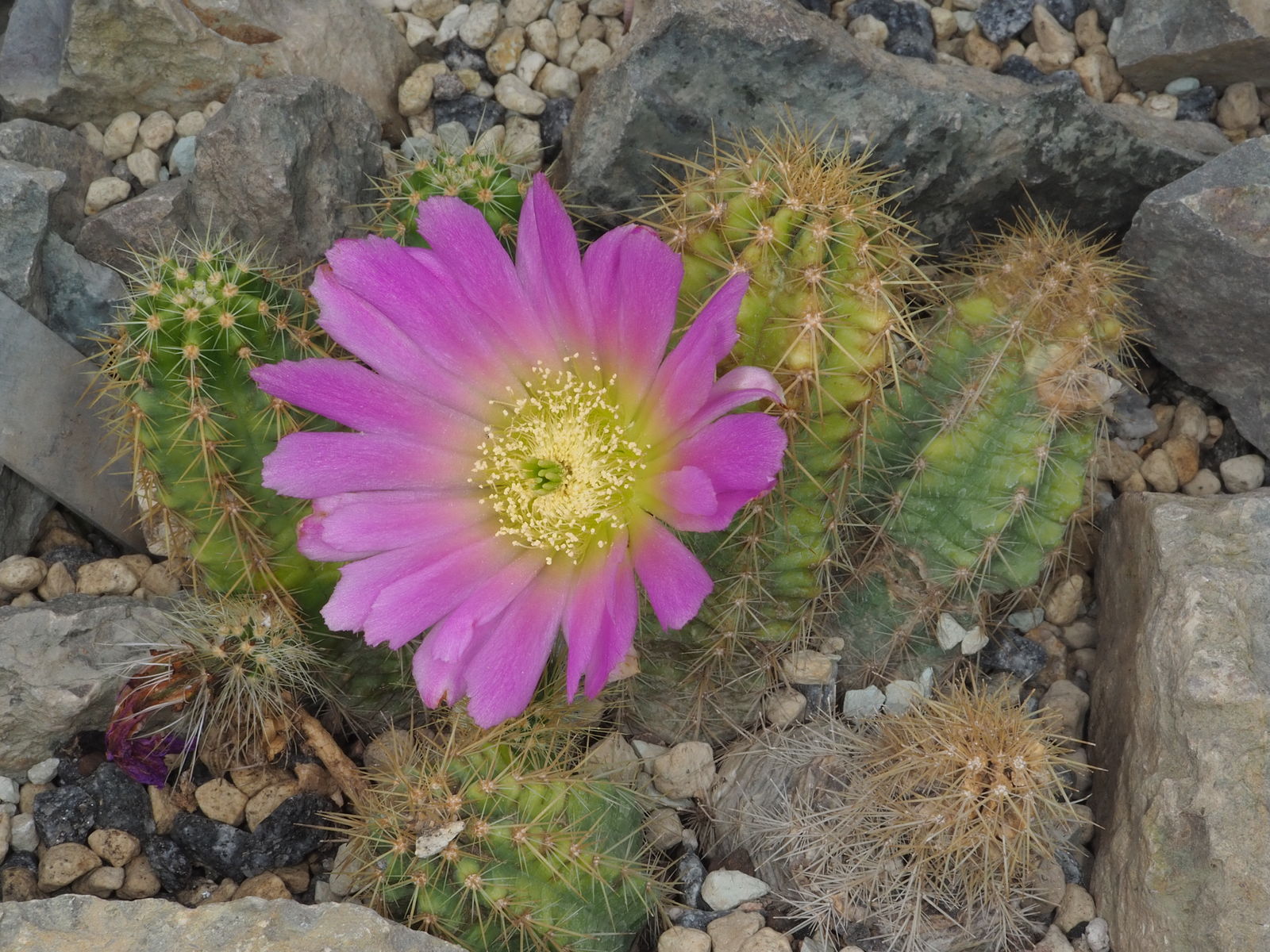 Reference image
Viereck's Hedgehog Cactus
Echinocereus viereckii is a clustering, semi-prostrate cactus species belonging to the Cactaceae family 1. It is highly prized among succulent enthusiasts for its soft green stems and spectacular, large magenta-purple flowers that bloom in late spring.
Classified under the genus Echinocereus, the specific epithet "viereckii" honors the German plant collector Hans Wilhelm Viereck 2. It has several recognized subspecies and varieties, most notably Echinocereus viereckii subsp. morricalii, which is famous for being nearly spineless.
Native to northeastern and central Mexico, its range spans across Tamaulipas, Nuevo León, and San Luis Potosí 1. It typically thrives in semi-arid environments, dry shrublands, and desert biomes, often growing on rocky limestone slopes and nesting under the shade of nurse bushes.
The stems are cylindrical, bright green, and branching from the base to form dense clumps. They usually feature 6 to 9 ribs. Depending on the subspecies, the spines can range from small and needle-like to completely absent. The flowers are funnelform, reaching up to 10 cm in diameter, presenting vivid magenta hues with greenish throats.
In cultivation, it requires bright, filtered sunlight and very porous, mineral-based soil. Water thoroughly during the active growing season only when the soil is completely dry, and maintain a strict dry period during winter to encourage spring blooms.
Overwatering, especially during the cold winter dormancy, is the most common cause of root and stem rot 2. Lack of adequate sunlight causes etiolation, leading to weak, pale, and stretched stems.
Bright indirect light; protect from scorching midday summer sun.
Water only when soil is bone dry; keep completely dry in winter.
Extremely porous, mineral-rich potting mix with pumice.
Non-toxic to pets, but handle spiny varieties with care to avoid irritation.
Very easy for beginners if overwatering is avoided.
Found naturally on rocky limestone cliffs and dry plains of northeastern Mexico, particularly within Tamaulipas and Nuevo León, adapting perfectly to arid and hot microclimates.
