
Light
Bright Indirect Light
Thrives in full sun or bright south-facing windows. Low light causes weak, thin growth.
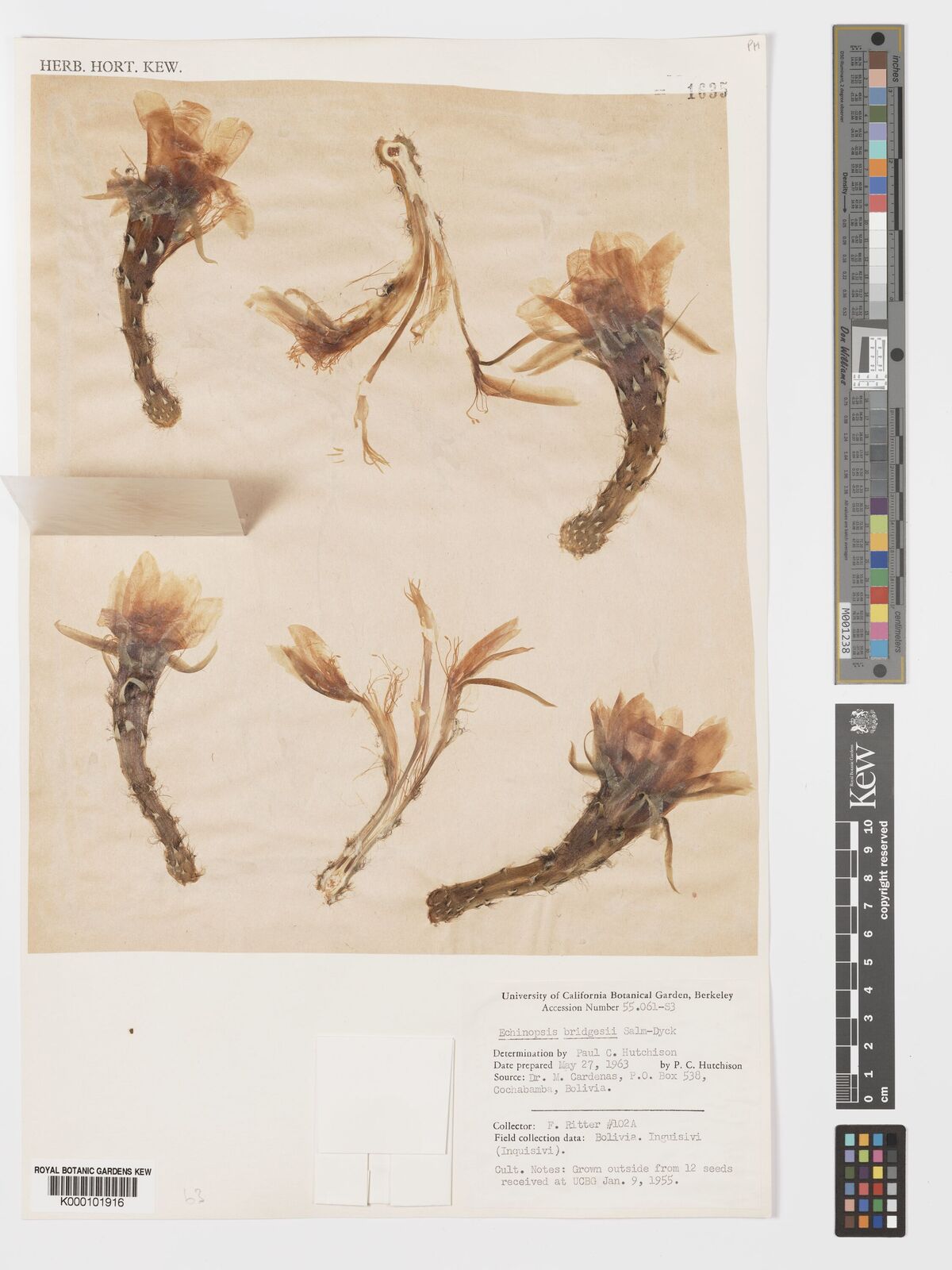 Reference image
Echinopsis bridgesii is a columnar, perennial cactus species belonging to the family Cactaceae, native to the arid valleys of Bolivia. Growing as a succulent subshrub in its natural habitat, it is highly favored by indoor and outdoor collectors for its resilience and spectacular, fragrant nocturnal blooms 1.
Originally described by the botanist Salm-Dyck, the species exhibits classic morphological traits of the genus Echinopsis. Although historically and horticulturally referred to under the synonym Trichocereus bridgesii, modern botanical consensus (POWO) recognizes Echinopsis bridgesii as the accepted name 2. The specific epithet honors Thomas Bridges, a prominent 19th-century botanical collector.
Echinopsis bridgesii is endemic to Bolivia, primarily inhabiting the dry valleys and slopes of the Andes mountains at elevations ranging from 2,000 to 3,000 meters 1. It thrives in gravelly, fast-draining, mineral-rich soils exposed to intense solar radiation.
This species forms multi-branched, light green to bluish-green columnar stems. Each stem features 4 to 8 deep ribs adorned with large areoles. Spines are yellowish-brown, needle-like, and variable in length. During mid-summer, it produces large, funnel-shaped, white flowers that open at night and emit a sweet, pleasant fragrance.
In cultivation, it requires excellent drainage and a mineral-rich potting medium. Water thoroughly during the active growing season (spring and summer) only when the substrate has completely dried. In winter, maintain a dry regime and keep the plant in a cool environment (5-10°C) to induce dormancy 2.
The most prevalent error is overwatering during winter dormancy or using heavy, clay-rich soil, both of which cause rapid root rot. Insufficient light exposure leads to etiolation, wherein the stems become thin, weak, and lose their typical color.
Thrives in full sun or bright south-facing windows. Low light causes weak, thin growth.
Drench thoroughly, then allow soil to dry completely. Keep nearly bone-dry in winter.
Use a porous mineral mix with high amounts of pumice, perlite, and coarse sand.
Sharp spines can cause injury. Keep out of reach of children and companion pets.
Easy to care for; highly drought-tolerant and forgiving of occasional neglect.
Native to the high-altitude arid shrublands and rocky slopes of the Bolivian Andes.
