
Light
Bright Indirect Light
Requires bright indirect light or partial direct sun for optimal growth and flowering.
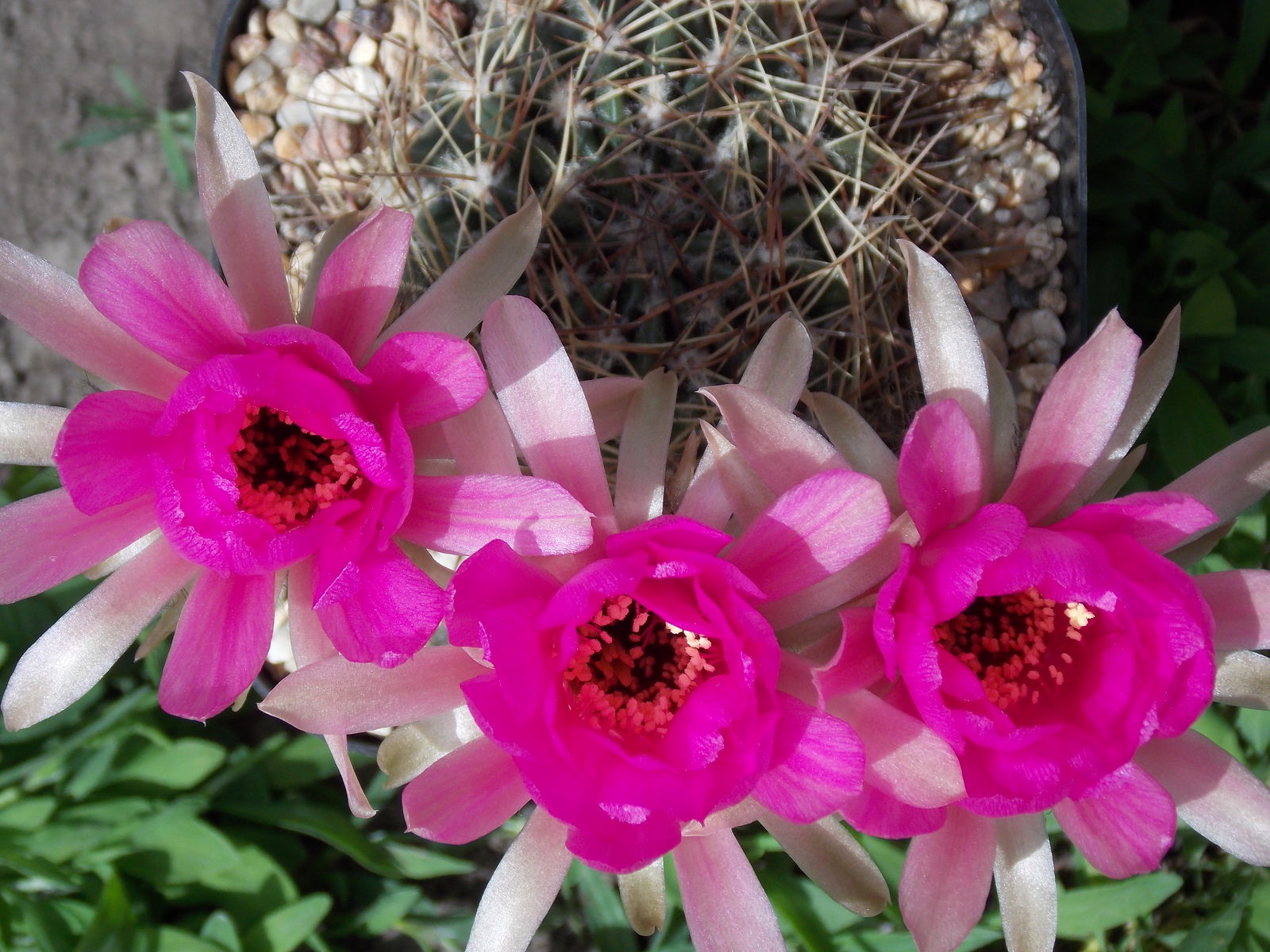 Reference image
Red-flowered Echinopsis
Echinopsis calorubra is a spectacular succulent subshrub belonging to the Cactaceae family, highly praised for its large, intensely colored red-orange blossoms and robust growth habit. It is a favored specimen among succulent collectors and desert gardening enthusiasts.
This species was formally described by the Bolivian botanist Martín Cárdenas in 1957 1. The specific epithet calorubra derives from the Latin "calor" (warmth/heat) and "rubra" (red), referencing the fiery red coloration of its majestic flowers. In some alternative classifications, it is assigned to the genus Lobivia 2.
Endemic to the inter-Andean valleys of Bolivia, particularly within the departments of Santa Cruz and Cochabamba 2. It typically populates dry, rocky slopes and deciduous dry shrublands at elevations ranging between 1,500 and 2,500 meters above sea level, surviving in nutrient-poor soils.
The plant body is globose to short cylindrical, presenting a bright green epidermis with distinct, rib-like structures. Areoles are felted and bear sharp, needle-like spines that vary from straw-colored to dark brown. The large funnelform, vibrant orange-red flowers emerge laterally during the warm summer months.
It thrives in bright light to partial direct sun and requires a potting medium with superb drainage capabilities. Watering should be thorough but infrequent, adhering strictly to the 'soak and dry' method, especially during its active vegetative period.
Overwatering is the primary cause of cultivation failure, rapidly leading to root rot. Insufficient light exposure will result in etiolation, causing the stem to stretch weakly and discouraging the production of flowers.
Requires bright indirect light or partial direct sun for optimal growth and flowering.
Allow the potting substrate to dry out completely between waterings.
Highly porous, mineral-rich cactus mix with added pumice, gravel, or coarse sand.
Non-toxic to pets, but features sharp spines that can cause physical injury.
Very easy to care for as long as it is not overwatered and is allowed a dry winter rest.
Indigenous to the high-altitude valleys and rocky slopes of Bolivia, thriving in arid shrublands and mountainous regions with low rainfall.
