
Light
Full Sun
Place in south or west-facing windows to receive at least 6 hours of direct daily sunlight.
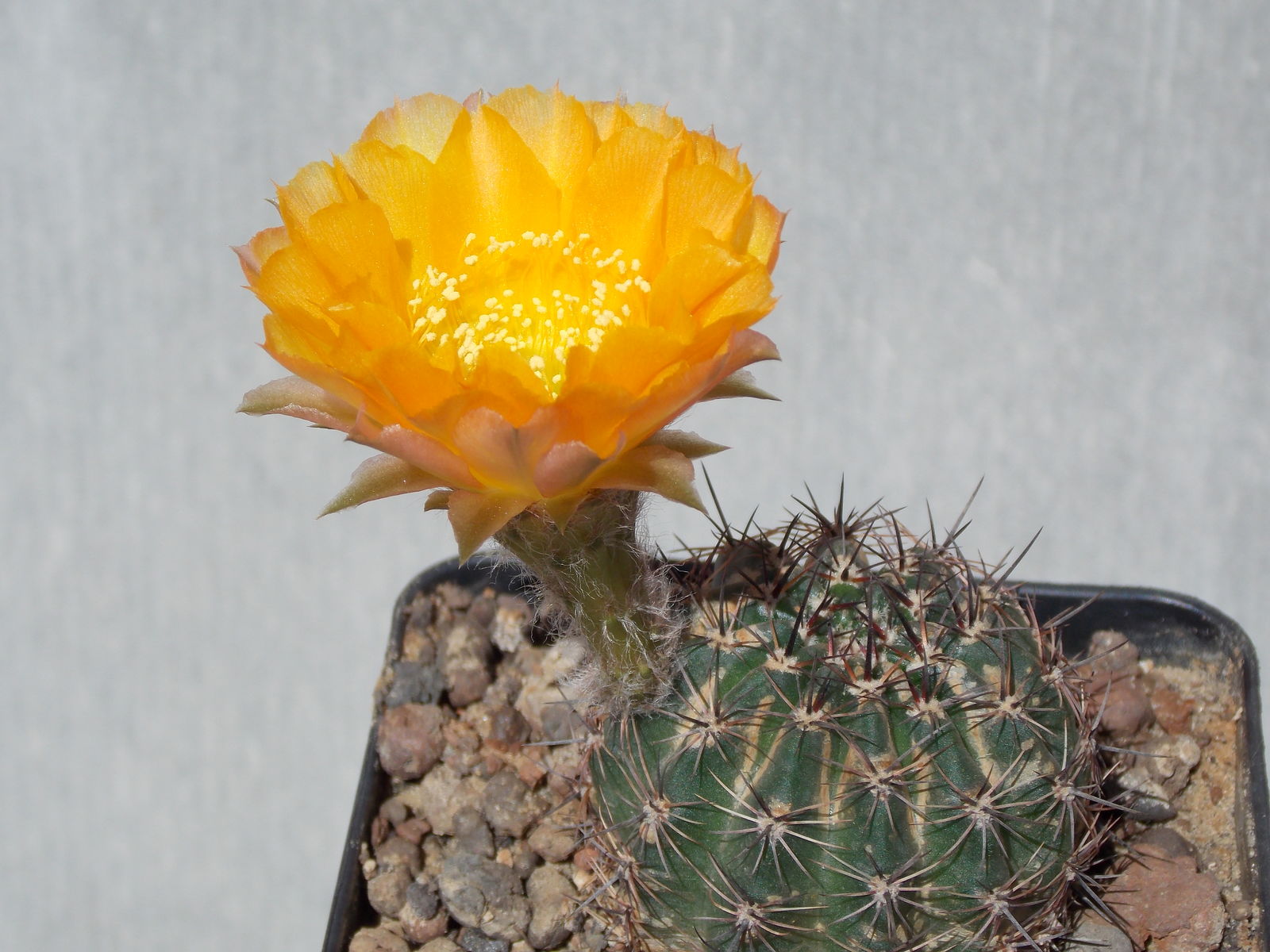 Reference image
Golden Urchin Cactus
Echinopsis chrysantha (synonym Acanthocalycium chrysanthanum) is a striking globose to cylindrical cactus species in the Cactaceae family, highly prized for its brilliant golden-yellow flowers 1. It grows as a succulent subshrub in its natural habitat.
The specific epithet "chrysantha" derives from the Greek words "chrysos" (gold) and "anthos" (flower). Throughout botanical history, it has been classified under Lobivia and Acanthocalycium 2. Currently accepted under Echinopsis, it represents the diverse flora of the high-altitude Andes.
This species is native to northwestern Argentina, specifically in provinces like Salta, Jujuy, Catamarca, and Tucumán 1. It thrives in arid, rocky slopes and dry shrublands at elevations between 1,000 and 3,000 meters above sea level, where soils are extremely well-drained.
The stem is usually solitary, occasionally offsetting with age, presenting a dark greyish-green to bluish-green color. It features prominent, deeply notched ribs lined with sharp, dark spines that fade to grey over time. Its main attraction is the bright, funnel-shaped golden-yellow to orange flowers that bloom from the crown in spring 2.
In cultivation, Echinopsis chrysantha requires full sun to maintain its compact shape and spine density. A mineral-rich, highly porous cactus soil mix is critical. Watering should follow a soak-and-dry cycle during the growing season, and dry dormancy in winter 1.
Overwatering and heavy, clay-rich soils are the leading causes of root rot. Lack of sufficient sunlight leads to etiolation (stretching) and a complete failure to produce its signature vibrant blooms 2.
Place in south or west-facing windows to receive at least 6 hours of direct daily sunlight.
Always let the soil dry out fully between waterings. Suspend watering entirely during winter.
Use specialized cactus soil enriched with generous amounts of pumice, perlite, and coarse sand.
Keep away from children and pets due to its sharp, stiff spines.
Very easy to maintain as long as you avoid overwatering and provide ample sunlight.
Grows wild along the high-altitude, arid, rocky slopes of the Andes in Argentine provinces like Salta and Jujuy.
