
Light
Bright Indirect Light
Requires bright, direct or slightly filtered sunlight for dense wool growth.
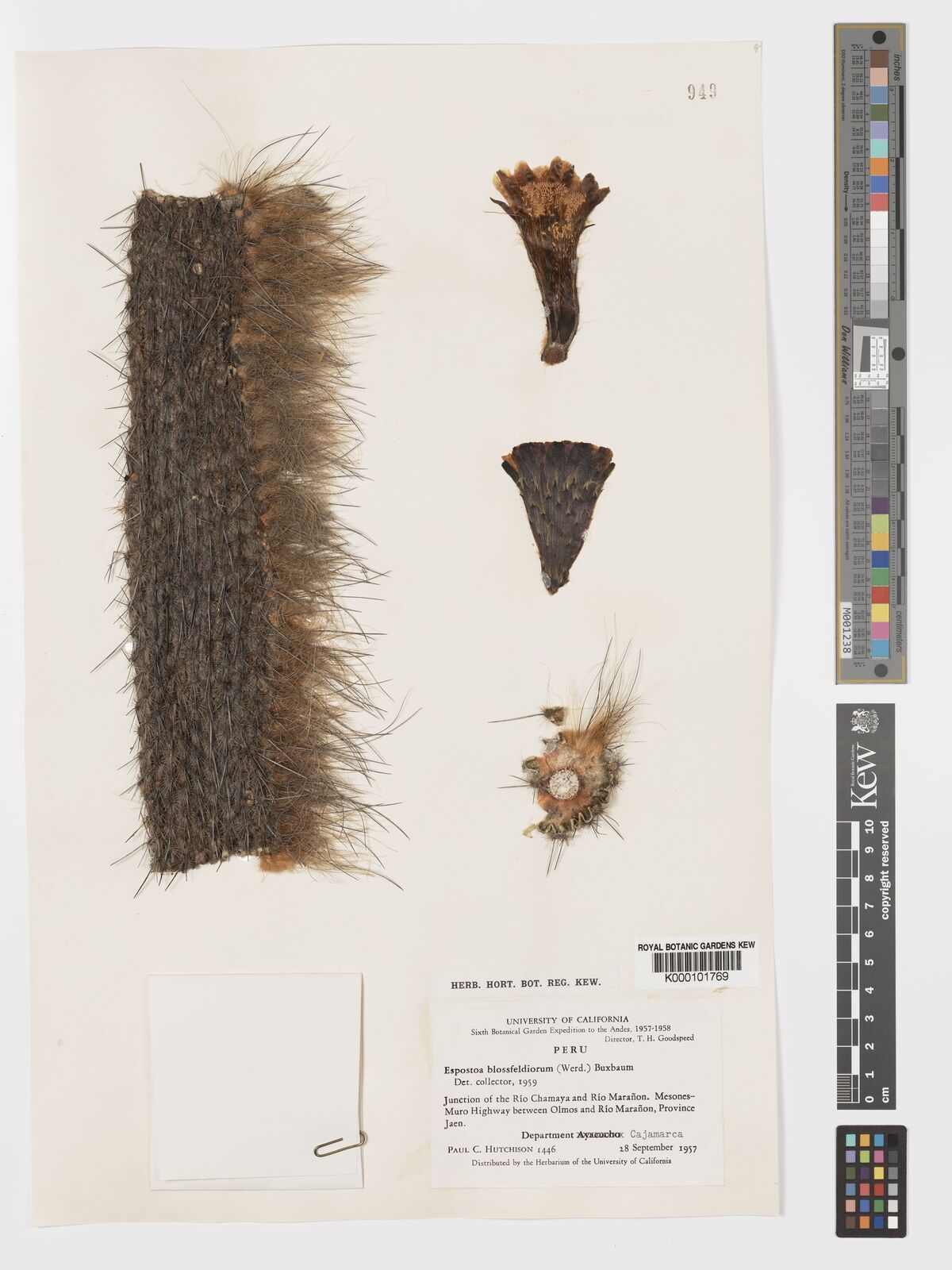 Reference image
Blossfelds' Espostoa
Espostoa blossfeldiorum is an elegant, columnar cactus belonging to the family Cactaceae. Known for its dense covering of woolly white hairs, this species is highly prized among succulent enthusiasts for its striking, bearded appearance.
The species was formally described by the German botanist Curt Backeberg. The genus Espostoa honors Nicolas E. Esposto, a prominent Peruvian botanist 1. The specific epithet blossfeldiorum honors the famous German plant collector and nurseryman Harry Blossfeld and his family.
This species is endemic to northern Peru, specifically occurring in the dry valley of the Marañón River at elevations of 500 to 1,000 meters 2. It grows on steep, rocky limestone cliffs under arid and sunny conditions.
Espostoa blossfeldiorum forms columnar stems that branch primarily from the base. It features 18 to 25 low ribs obscured by a dense layer of off-white, silky hairs arising from the closely set areoles. Sharp, golden-brown central spines push through the wool. Mature plants develop a lateral pseudocephalium from which nocturnal, yellowish-white flowers emerge.
In cultivation, it requires a very bright position with partial to full sun. It thrives in well-aerated, highly mineral soil mixes with excellent drainage 3. Water thoroughly during the active growing season but only when the substrate is completely dry, and maintain dry conditions during winter.
Overwatering and poor ventilation are the primary causes of root rot and stem decay. Insufficient light leads to etiolation, causing the stems to grow thin and weak while reducing the density of its signature white wool.
Requires bright, direct or slightly filtered sunlight for dense wool growth.
Allow soil to dry fully between waterings. Keep dry in winter.
Coarse, mineral-heavy soil mix with high pumice or perlite content.
Sharp spines are hidden beneath the woolly coat. Keep away from pets and handle with thick gloves.
Moderate. Easy if drainage is perfect and winter watering is avoided.
Endemic to the arid slopes of the northern Peruvian Andes, particularly along the dry valley of the Marañón River, growing on rocky outcrops under intense sunlight.
