
Light
Direct Sun
Requires full sun, ideally at least 6 hours of direct sunlight daily.
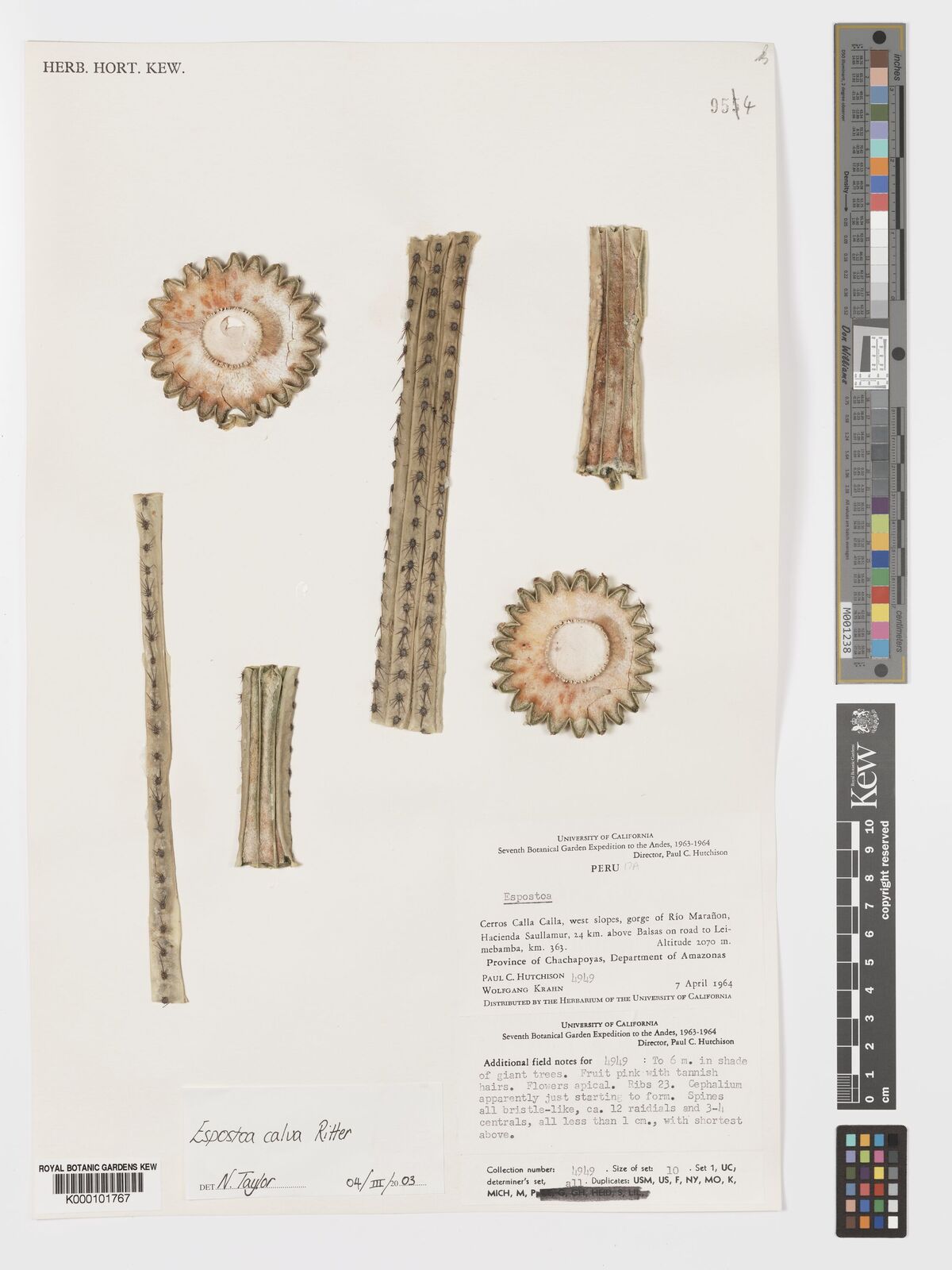 Reference image
Peru Old Man Cactus
Espostoa calva is a columnar, shrubby succulent species belonging to the Cactaceae (cactus) family. Notable for the dense, white woolly hairs covering its stems, this species is a distinctive element of arid ecosystems, adapted to extreme solar radiation and dry conditions 1.
Classified under the genus Espostoa, this species was historically documented by botanists studying the rich cactus flora of Peru. The specific epithet calva refers to the somewhat bald or less woolly appearance of certain stem sections or cephalium parts as the plant matures compared to other fully woolly congeners 2.
Native to Western South America, Espostoa calva is endemic to Peru, where it thrives in dry river valleys and on rocky slopes. It is typically found at elevations between 900 and 1500 meters, growing in desert or dry shrubland biomes where soils are rocky, poor, and highly drained 1.
This succulent shrub features branched, erect green stems with numerous vertical ribs. The ribs are covered with areoles that produce fine, white, hair-like spines. This woolly coat serves to reflect intense UV rays and trap a layer of air to reduce moisture loss. Mature specimens develop a lateral woolly cephalium from which nocturnal, white flowers emerge 2.
In cultivation, Espostoa calva requires a very bright position with maximum direct sunlight. Watering should follow a 'soak and dry' method, allowing the substrate to dry completely between applications. During the winter dormancy, water must be withheld. Standard mineral-heavy cactus mixes with excellent drainage are crucial 3.
Overwatering and the use of dense, organic-rich soils are the primary causes of root rot. Lack of sufficient airflow combined with high humidity or low winter temperatures can promote devastating fungal infections and disfigure the delicate woolly coat 3.
Requires full sun, ideally at least 6 hours of direct sunlight daily.
Water only when the soil is dry. Keep almost completely dry in winter.
Use highly porous, mineral-based soil containing pumice, sand, and grit.
The soft-looking white wool hides sharp spines. Handle with care using gloves. Non-toxic.
Moderate. Easy if overwatering is avoided and proper winter dormancy is provided.
Indigenous to the dry, rocky slopes and valleys of Peru, adapting to high elevations and intense sunlight.
