
Light
Full Sun
Requires full sun; the dense white hair naturally protects it from intense sunburn.
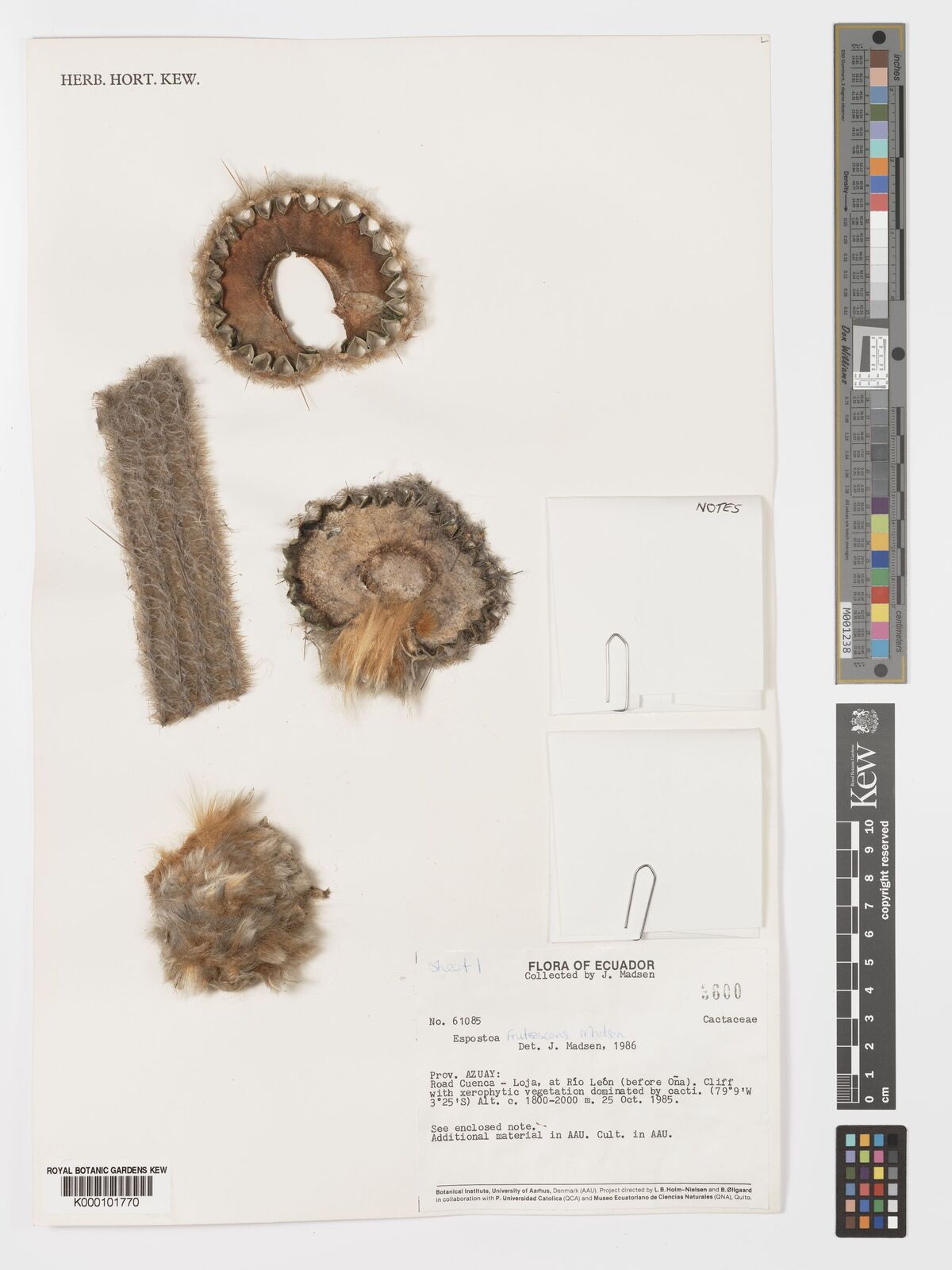 Reference image
Ecuadorian Woolly Cactus
Espostoa frutescens is a striking, shrubby cactus of the family Cactaceae, renowned for the dense, woolly white hairs that coat its stems. This fibrous, cotton-like covering serves as a natural shield, protecting the plant from intense solar radiation and high diurnal temperature swings in its high-altitude native habitat 1.
Belonging to the genus Espostoa, this species is well-documented within the South American cactus flora. The specific epithet 'frutescens' translates from Latin to 'shrubby' or 'becoming bushy', referencing its growth habit of branching from the base, which distinguishes it from some of its more strictly columnar relatives 2.
This species is native to Western South America, particularly restricted to the dry valleys and arid shrublands of Ecuador 1. It thrives on steep rocky slopes and well-draining soils where rainfall is scarce but sunlight is highly intense.
Espostoa frutescens develops into a multi-stemmed, woolly shrub. The green stems are hidden beneath a dense mesh of white, silky hairs, from which sharp, needle-like spines emerge. When mature, it produces a lateral cephalium from which nocturnal, tubular white to cream-colored flowers bloom during the summer months 2.
In cultivation, it requires a position that receives full sun to maintain its dense woolly growth. A highly porous, mineral-based cactus mix is crucial to prevent moisture retention. Water thoroughly only when the substrate is completely dry, and suspend watering during the cold winter dormancy.
The most prevalent errors are overwatering, which quickly leads to root rot, and low-light conditions, which cause the plant to stretch (etiolate) and grow weak, sparse hair 1. Applying water directly onto the woolly stems can also trap moisture and trigger fungal infections.
Requires full sun; the dense white hair naturally protects it from intense sunburn.
Allow soil to dry out completely between waterings; keep bone dry in winter.
Use an ultra-porous mineral mix with high sand and pumice content.
Sharp hidden spines lurk beneath the soft-looking wool; handle with care and keep away from pets.
Very easy to care for, provided it is not overwatered or kept in dark corners.
Indigenous to the dry mountain valleys and rocky slopes of Ecuador, where it thrives under high solar intensity and low relative humidity.
