
Light
Bright Indirect Light
Prefers bright, indirect or filtered sunlight. Protect from intense, direct midday sun.
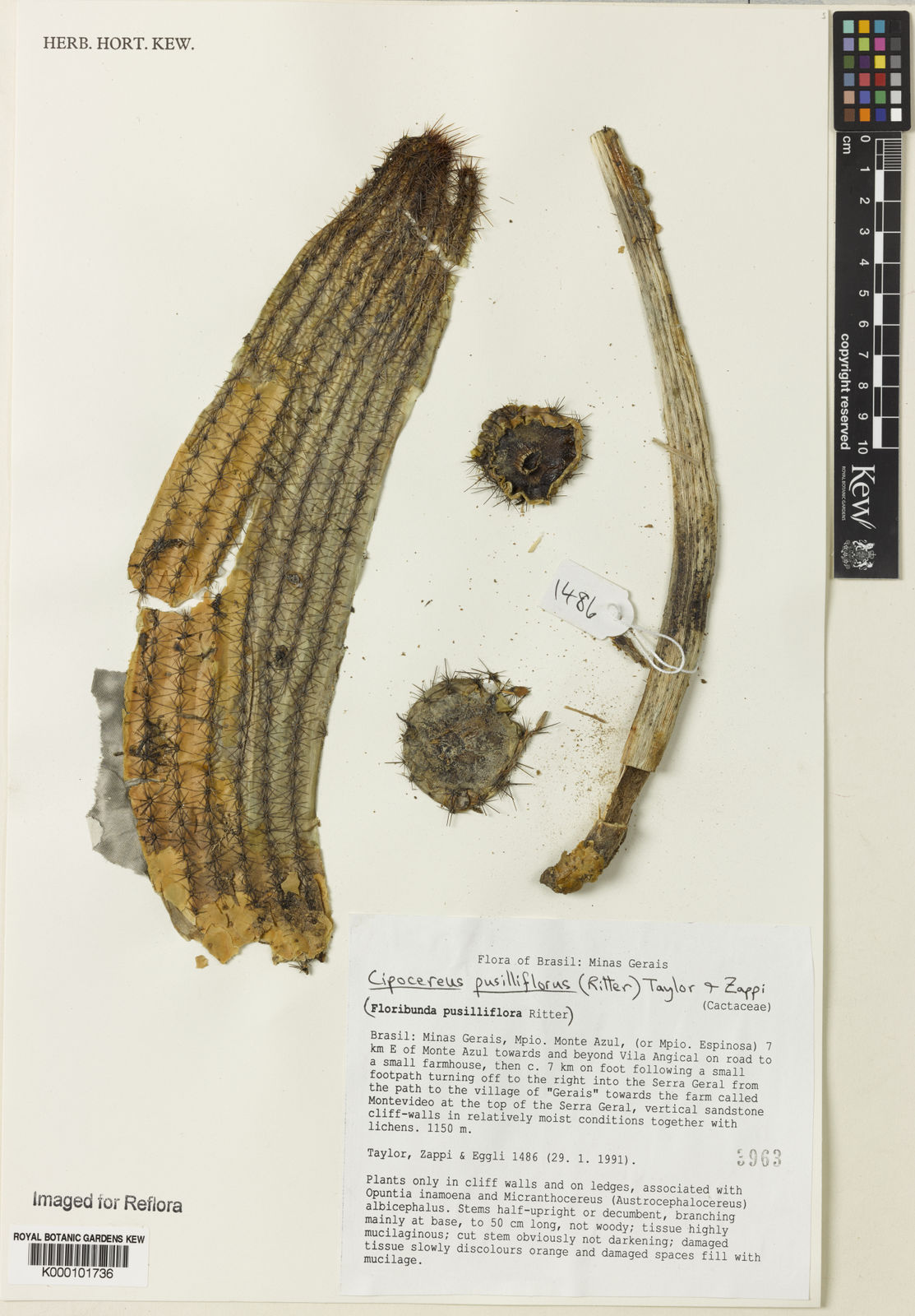 Reference image
Floribunda Pusilliflora
Floribunda pusilliflora is a rare, shrubby succulent species belonging to the Cactaceae (Cactus) family. Unlike typical globose or columnar cacti, it forms a branched, woody-shrubby structure and is highly prized by collectors for its unique growth habit and delicate miniature flowers 1.
Classified within the genus Floribunda, its botanical name is derived from the Latin words 'floribunda' (abundantly flowering) and 'pusilliflora' (having very small flowers) 2. It represents an evolutionary branch of shrubby, branching cacti adapted to specific dry forest ecosystems.
This species is endemic to Brazil, specifically occurring in the southeastern regions including Espírito Santo, Rio de Janeiro, Minas Gerais, and São Paulo. It thrives in seasonally dry tropical biomes, often found growing on rocky outcrops, shallow soils, and transitional caatinga shrublands 1.
The plant features slender, cylindrical green stems with small areoles bearing thin spines. It produces tiny, tubular flowers near the stem tips. The blossoms are typically pale pink, white, or cream-colored, offering a beautiful contrast to the green, spiny branches during its blooming season.
In cultivation, Floribunda pusilliflora requires bright, indirect sunlight and protection from harsh afternoon sun. It demands highly porous, mineral-rich soil that drains rapidly. Water only when the potting medium is fully dry, and reduce watering significantly during the winter dormancy period 2.
The most frequent issue is root rot caused by overwatering or dense, water-retaining soils. Insufficient light leads to etiolation, where the branches stretch out and become weak and pale.
Prefers bright, indirect or filtered sunlight. Protect from intense, direct midday sun.
Water thoroughly only after the soil is completely dry. Minimize watering in winter.
Requires extremely well-draining, gritty cactus soil mixed with pumice and coarse sand.
Contains fine spines; handle with care. Keep out of reach of curious pets.
Moderate care difficulty. Requires strict watering discipline and frost protection.
Endemic to the seasonally dry tropical zones of southeastern Brazil, where it grows on rocky slopes and transitional shrublands.
