
Light
Bright Indirect Light
Bright filtered sun or bright indirect light. Protect from harsh afternoon sun.
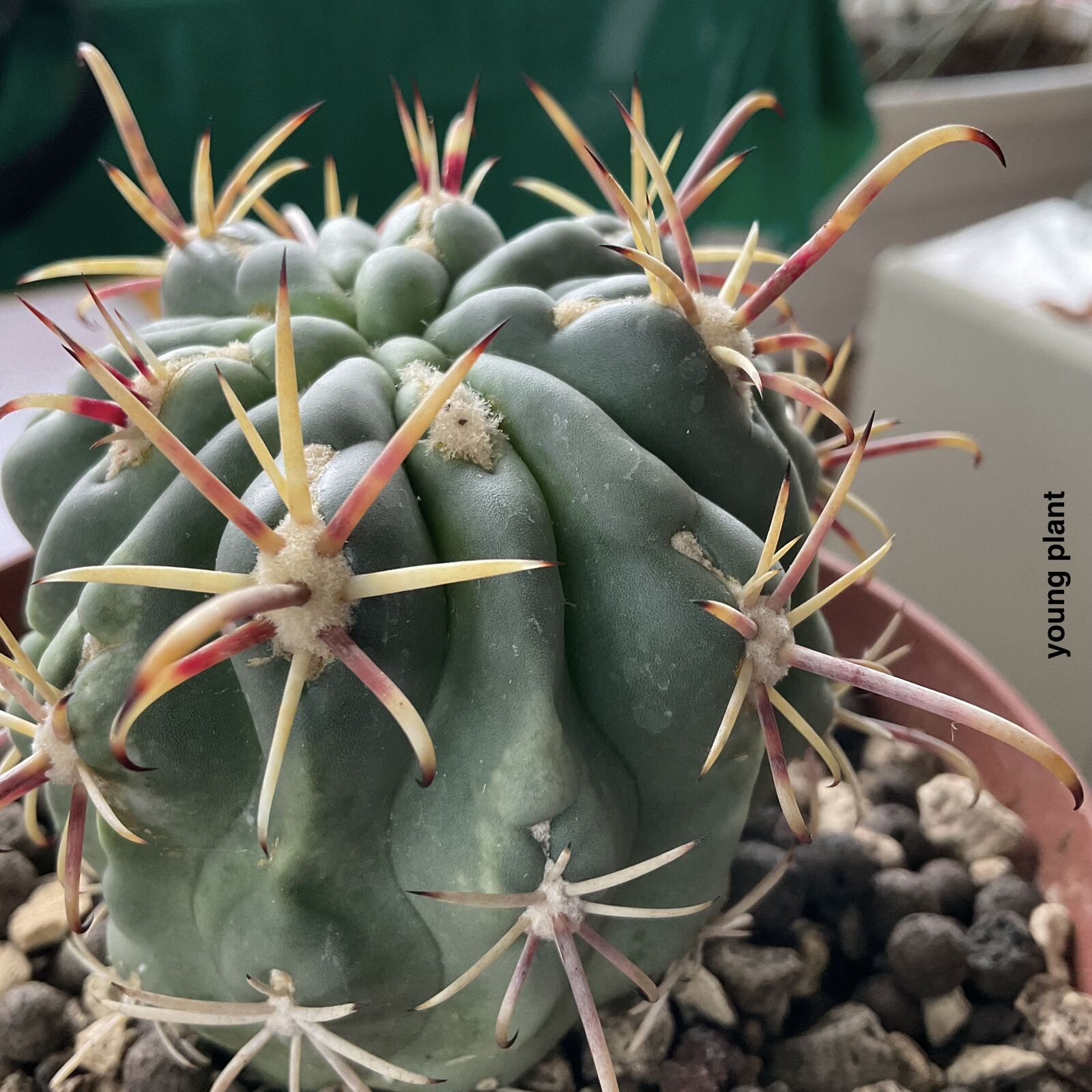 Reference image
Glandulicactus mathssonii is a slow-growing, globose to cylindrical succulent subshrub belonging to the family Cactaceae 1. Known for its dramatically hooked spines and dark, wine-red blossoms, it is a highly prized species among collectors of desert flora.
This taxon is often referenced under synonyms such as Sclerocactus uncinatus subsp. mathssonii or Ancistrocactus mathssonii 2. It is classified within the genus Glandulicactus, characterized by its glandular areoles and strongly hooked central spines.
Native to the arid and semi-arid regions of central and northern Mexico, including states such as Guanajuato, San Luis Potosí, Hidalgo, and Nuevo León 1. It thrives on limestone hillsides, dry shrublands, and rocky slopes where drainage is exceptional.
The stem is solitary, deep green, with prominent wavy ribs. The areoles bear fierce, long, hooked central spines that are straw-colored to reddish-brown. In late spring, it produces funnelform flowers near the apex, displaying deep brownish-red to maroon hues.
In cultivation, it requires bright filtered sunlight and excellent air circulation 2. The potting medium must be highly porous and mineral-rich. It has a high tolerance for cold during winter if kept completely dry, surviving short drops down to -5°C.
Overwatering during the winter dormancy period is the most common cause of failure, quickly leading to root and stem rot. Insufficient light will cause the plant to lose its compact shape and produce weak, pale growth.
Bright filtered sun or bright indirect light. Protect from harsh afternoon sun.
Allow soil to dry out completely between waterings. Keep nearly dry in winter.
Highly mineralized, free-draining soil with plenty of pumice and grit.
Non-toxic to pets, but the extremely sharp, hooked spines require cautious handling.
Moderate; success depends heavily on strict watering discipline.
Endemic to the arid highlands of central and northern Mexico, where it grows in limestone-rich soils amongst desert scrub vegetation.
