
Light
Full Sun
Requires full, direct sun all year round. Indoors, place it on the sunniest south-facing windowsill.
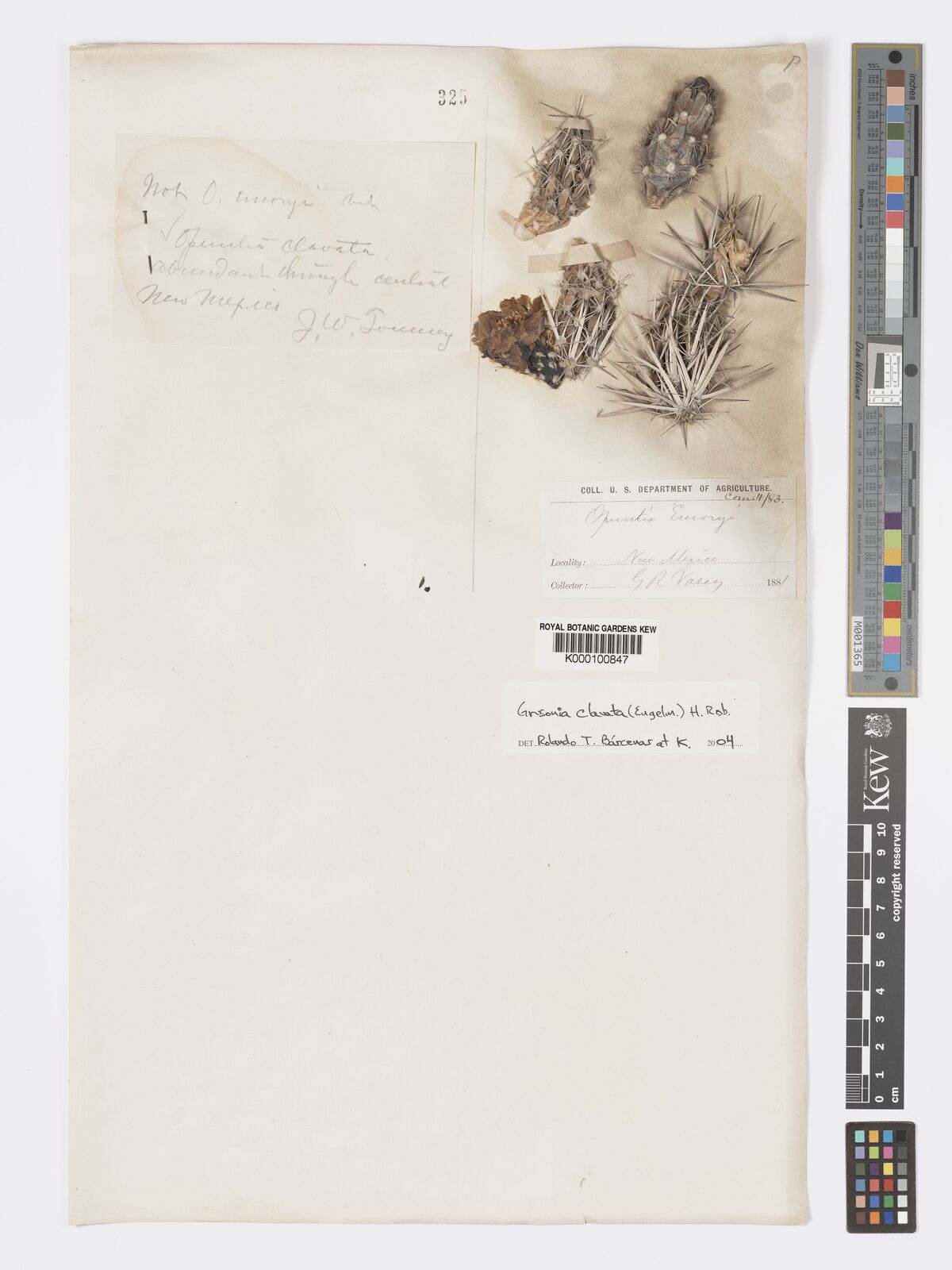 Reference image
Club Cholla
Grusonia clavata, commonly known as the Club Cholla or Dagger Cholla, is a low-growing, mat-forming succulent subshrub belonging to the Cactaceae family 1. Characterized by its club-shaped stem segments and fierce, flattened spines, this species is highly adapted to arid and semi-arid environments.
Originally described by George Engelmann in 1856 as Opuntia clavata, the species was later classified under the genus Grusonia (or sometimes Corynopuntia) based on modern phylogenetic insights 2. The specific epithet clavata derives from Latin, meaning "club-shaped," which directly references the distinct clavate shape of its jointed stems.
This resilient cactus is native to North America, specifically spanning the south-central United States (primarily New Mexico and parts of Texas) and northern Mexico (the Chihuahuan Desert) 3. It thrives in gravelly plains, dry grasslands, and alluvial flats at elevations ranging between 1200 and 2200 meters, where it endures harsh sun and freezing winter temperatures.
The plant forms dense, low colonies rarely exceeding 15 cm in height but spreading up to 2 meters wide. Its segments are obovate or club-shaped, 3-7 cm long. The aeroles bear strong, flattened, dagger-like spines that are white to grayish. In late spring and summer, it produces showy, pale yellow, cup-shaped flowers, followed by spiny, bright yellow, cylindrical fruits.
Grusonia clavata requires full, direct sun and outstanding drainage. Pots must feature plenty of drainage holes, and the potting medium should consist largely of mineral substrates like pumice and coarse grit. Watering must be infrequent, allowing the soil to dry out completely. Winter dormancy demands cold and dry conditions.
The most prevalent issue is overwatering, which quickly causes root and stem rot. Placing the plant in low-light indoor spaces or areas without adequate airflow will lead to etiolation and fungal infections.
Requires full, direct sun all year round. Indoors, place it on the sunniest south-facing windowsill.
Water thoroughly only after the soil has completely dried out. Keep almost dry in winter.
Needs a mineral-heavy potting mix with high amounts of pumice, coarse sand, and gravel.
Features extremely sharp, dagger-like spines. Keep away from curious pets and children.
Moderate difficulty. Extremely hardy as long as soil is perfectly drained and overwatering is avoided.
Native to New Mexico, Texas, and the Chihuahuan Desert. It populates high-altitude arid grasslands and gravelly plains, easily tolerating both scorching summers and sub-zero winter temperatures.
