
Light
Full Sun
Requires full sun; direct sunlight is essential for strong spine growth.
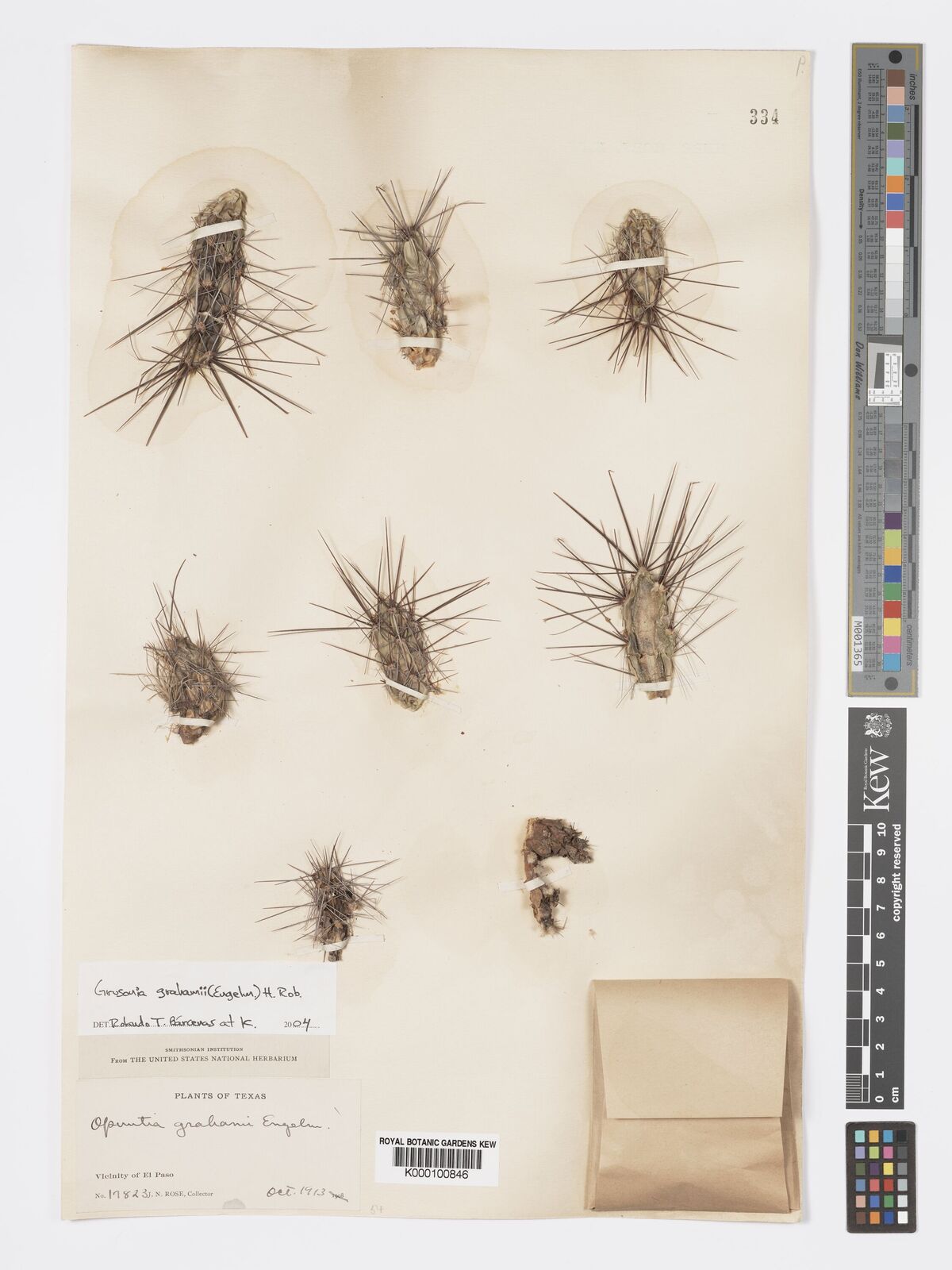 Reference image
Graham's Dog Cholla
Grusonia grahamii, commonly known as Graham's dog cholla or mounded cholla, is a low-growing, heavily spined succulent subshrub belonging to the Cactaceae family. This species forms dense, spreading mats on dry soils, perfectly adapted to extreme desert environments 1.
Originally described by George Engelmann in 1856 as Opuntia grahamii, this species was later reassigned to the genus Grusonia. It is often referred to under its synonym Corynopuntia grahamii in horticultural and botanical trade 2.
Native to the Chihuahuan Desert, its range spans the southwestern United States (Texas, New Mexico) and northern Mexico (Chihuahua, Coahuila, Durango, Nuevo León). It typically thrives on limestone slopes, gravelly flats, and desert shrublands at elevations between 800 and 1500 meters 1.
The plant features club-shaped, cylindrical segments (3–7 cm long) forming compact mats. The areoles carry numerous formidable, flattened, yellowish-brown spines. In late spring to summer, it produces striking, bright yellow flowers at the stem tips, followed by spiny, fleshy green fruits 2.
Grusonia grahamii requires full, unfiltered sun and exceptionally well-draining mineral soil. It is cold hardy down to approximately -10°C, provided the soil is kept completely dry during winter dormancy. Propagation is easily achieved by detaching stem segments.
Overwatering is the primary cause of failure, quickly leading to root and stem rot. Placing the plant in low-light indoor conditions leads to weak, elongated growth (etiolation) and lack of spine development.
Requires full sun; direct sunlight is essential for strong spine growth.
Water only when the substrate is fully dry. Keep completely dry in winter.
Highly porous mineral mix rich in pumice, coarse sand, and fine gravel.
Features extremely sharp, barbed spines. Handle with caution; keep away from pets.
Moderate. Extremely drought-tolerant but sensitive to stagnant moisture.
Native to the arid Chihuahuan Desert, specifically across Texas, New Mexico, and northern Mexican states, where it populates rocky limestone slopes and dry alluvial plains.
