
Light
Full Sun
Requires at least 6 hours of direct sunlight daily; low light weakens spine growth.
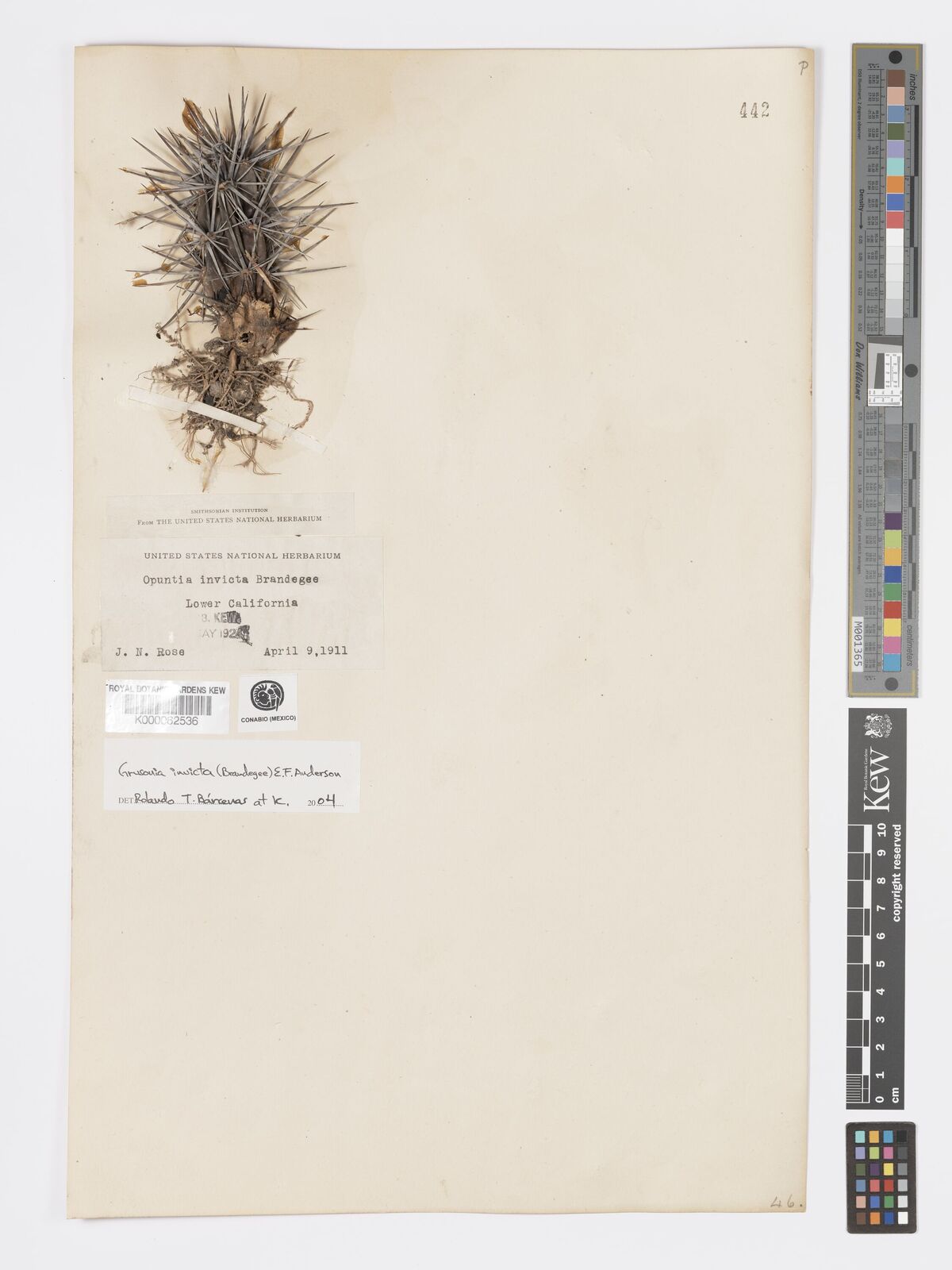 Reference image
Dagger Cholla
Grusonia invicta (synonym: Corynopuntia invicta), commonly known as the dagger cholla, is a low-growing, heavily armed succulent subshrub belonging to the Cactaceae family. It forms dense, formidable mats in its native arid habitats 1.
Originally described in 1889 by Townshend Brandegee as Opuntia invicta, it was later combined into Corynopuntia and Grusonia. The epithet invicta means "unconquered" or "invincible," referring to its fearsome spines 2.
This species is endemic to Mexico, specifically distributed throughout the Baja California Peninsula and parts of Sonora. It thrives in hyper-arid plains, gravelly slopes, and coastal desert scrublands 1.
It grows in low sprawling clumps up to 20-50 cm tall. The stem segments are dark green, club-shaped, and deeply ribbed. They are heavily covered in thick, flattened, dagger-like spines that emerge bright red-brown and mature to a chalky grey. Showy yellow flowers appear at the stem tips in late spring 2.
In cultivation, Grusonia invicta requires full sun and exceptionally free-draining mineral soil. Water only when the substrate is bone dry, and suspend watering almost completely during the winter dormancy 1.
The most prevalent mistake is overwatering in poorly draining soil, which quickly leads to root rot. Insufficient sunlight will cause the stems to etiolate and lose their characteristic dense spination.
Requires at least 6 hours of direct sunlight daily; low light weakens spine growth.
Water only when the soil is completely dry, and suspend watering during winter dormancy.
Avoid clay; use a highly porous mix of pumice, coarse sand, and minimal peat.
Spines are incredibly sharp and painful. Keep far away from children and pets.
Requires moderate experience due to strict watering needs and physical spine hazards.
Native to the arid plains and coastal deserts of the Baja California Peninsula and parts of Sonora in Mexico, thriving in highly porous, sandy, and gravelly desert soils.
