
Light
Bright Indirect Light
Thrives in bright, filtered sunlight; protect from harsh, direct midday summer sun.
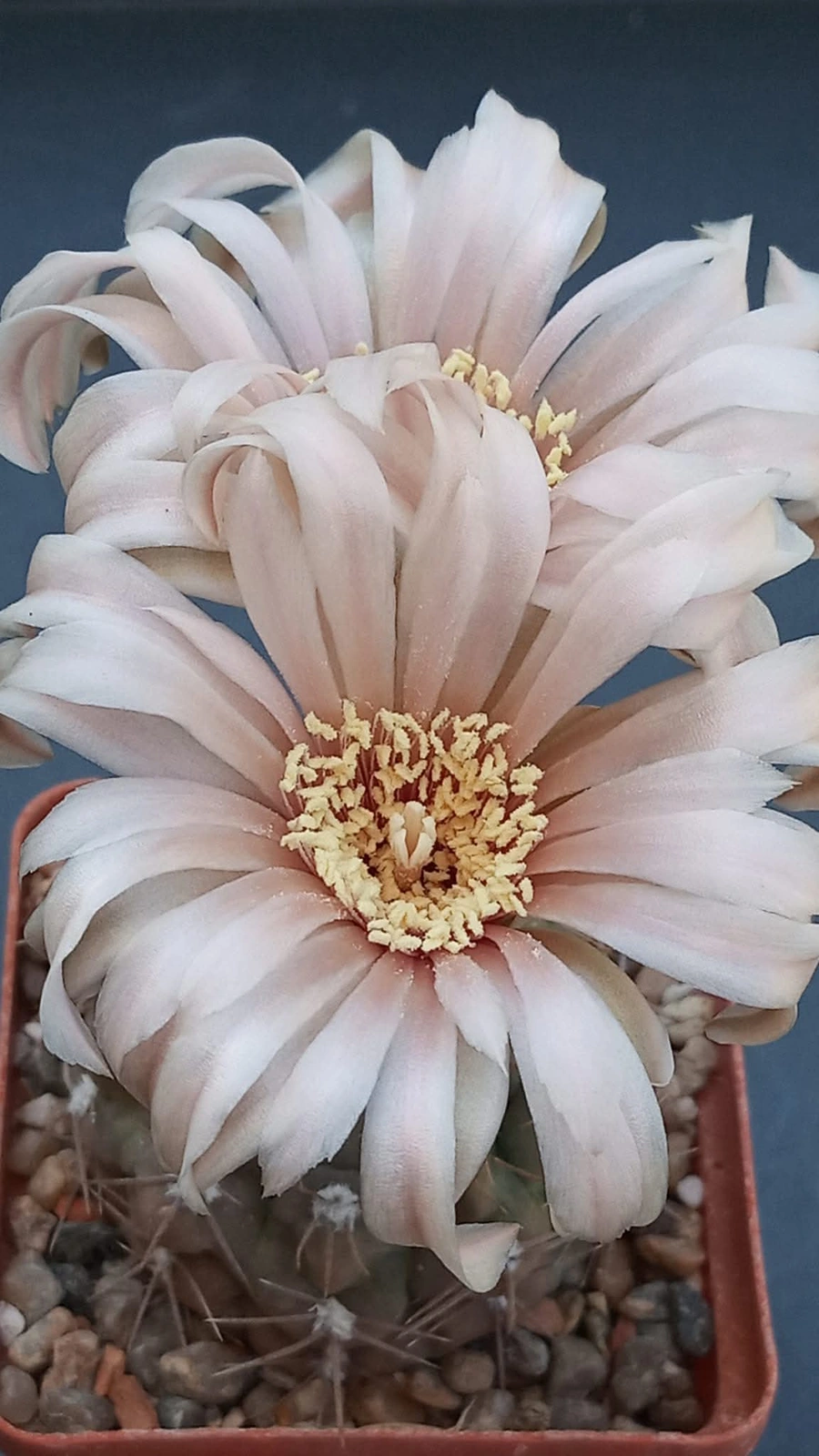 Reference image
San Luis Chin Cactus
Gymnocalycium sanluisense is a small, globose cactus species belonging to the Cactaceae family. Highly appreciated by succulent collectors, it exhibits the characteristic chin-like tubercles below the areoles that define the Gymnocalycium genus 1.
Classified under the genus Gymnocalycium in the family Cactaceae, the specific epithet 'sanluisense' refers directly to its native province of San Luis in Argentina. Taxonomists rely on its distinct rib formation and floral morphology to distinguish it from related complex taxa 2.
This species is native to the subtropical regions of Southern South America, specifically endemic to the San Luis province of Argentina. It thrives on rocky slopes, nestled under the shade of sparse bushes, growing in mineral-rich, gravelly, and sandy soils 1.
The stem is solitary, flattened-globular, and ranges from dark grey-green to brownish-green. It features distinct ribs with prominent tubercles. The areoles bear slightly curved, greyish spines. The funnel-shaped flowers are borne at the crown and are typically white to pale pink.
It prefers bright, indirect sunlight and well-draining, mineral-heavy soil mixes. Watering should be thorough but only allowed once the substrate has dried out completely. During winter dormancy, keeping the plant cool and dry is essential to promote spring blooming.
Overwatering and using heavy, organic-rich soil mixes are the leading causes of root rot. Inadequate light results in etiolation, while keeping the plant too warm in winter prevents successful flowering.
Thrives in bright, filtered sunlight; protect from harsh, direct midday summer sun.
Allow the potting medium to dry out 100% between waterings. Keep dry in winter.
Requires an extremely porous, grit-based substrate with low organic matter.
Non-toxic, but features sharp spines that require careful handling away from pets.
Very easy to care for, making it ideal for beginners who can resist the urge to overwater.
Naturally distributed in the rocky subtropical hillsides of San Luis, Argentina, where it grows in gravelly soils shaded by larger shrubs and grasses.
