
Light
Full Sun
Thrives in full, direct sunlight; ideal for south-facing windows or outdoor sunny spots.
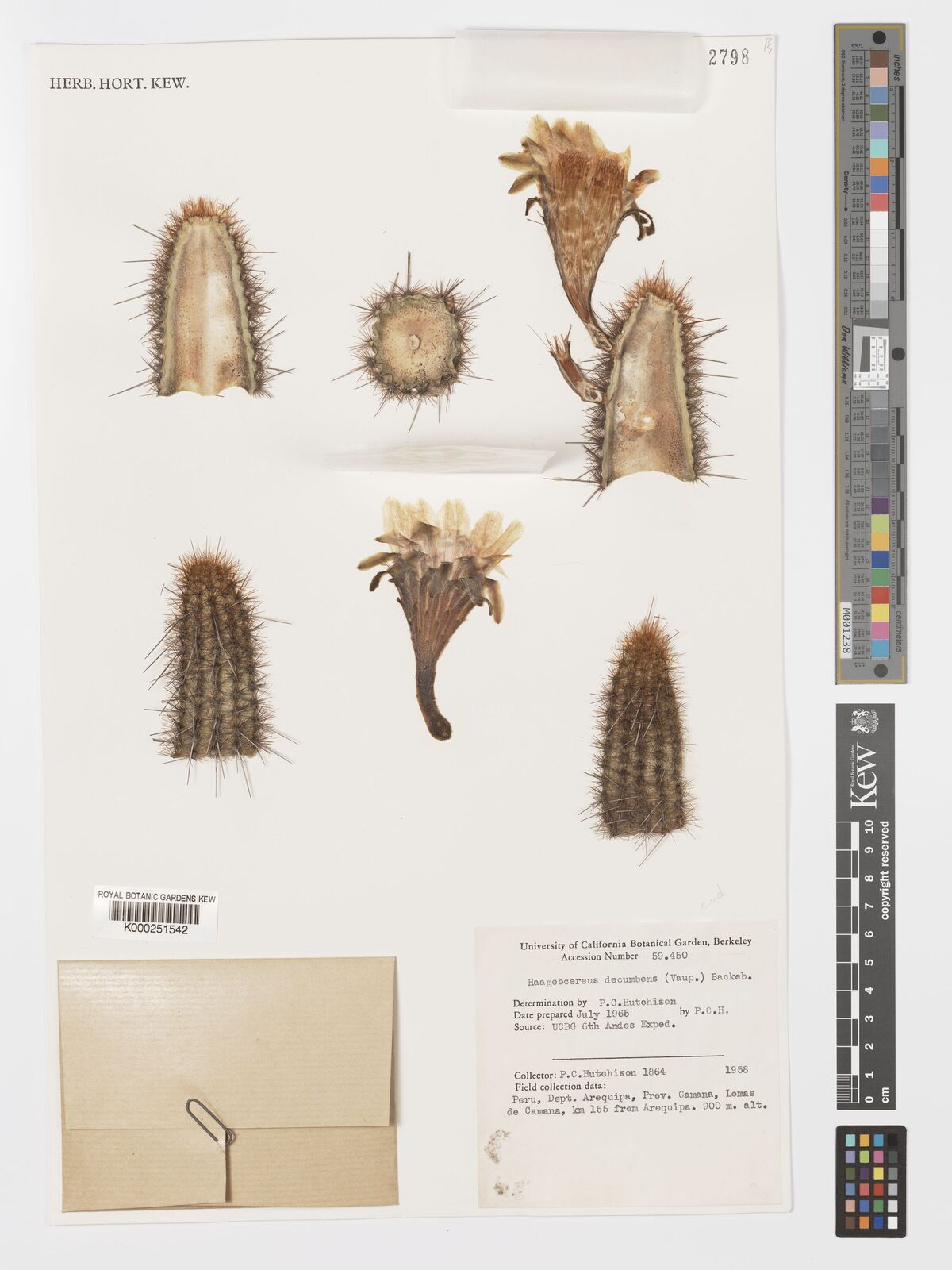 Reference image
Decumbent Columnar Cactus
Haageocereus decumbens is a perennial succulent subshrub belonging to the family Cactaceae. Known for its distinct sprawling or decumbent growth habit, this species is highly adapted to hyper-arid desert conditions and is appreciated by collectors for its dense spination and unique prostrate form 1.
Originally described and integrated into the genus Haageocereus, the specific epithet decumbens derives from Latin, meaning 'lying down' or 'prostrate', which accurately describes the plant's tendency to grow horizontally along the ground 2.
This cactus is native to the coastal deserts and rocky hillsides of southern Peru. It thrives in hyper-arid habitats, often surviving in the coastal fog zones (Lomas) where it absorbs moisture directly from the dense atmospheric mist 1.
The stems are cylindrical, typically 3 to 5 cm in diameter, branching from the base and sprawling horizontally. They are heavily armed with dense, needle-like spines that vary from golden-yellow to greyish-brown. It produces nocturnal, funnel-shaped flowers that are white to pale cream.
In cultivation, Haageocereus decumbens requires maximum light intensity and excellent air circulation. It should be grown in a mineral-heavy substrate with minimal organic matter. Water thoroughly only when the soil is completely dry, and suspend watering almost entirely during winter.
The most prevalent issue is root rot triggered by overwatering or poorly draining soil. Insufficient light exposure leads to etiolation, where the stems stretch unnaturally, lose their dense spine coverage, and become susceptible to pests 2.
Thrives in full, direct sunlight; ideal for south-facing windows or outdoor sunny spots.
Allow substrate to dry out fully before watering. Keep dry during the winter season.
Requires excellent drainage; use a soil mix rich in pumice, coarse sand, and perlite.
Features sharp, dense spines. Keep out of reach of children and domestic pets.
Moderate difficulty; success depends largely on preventing overwatering and providing strong light.
Naturally distributed along the dry, rocky coastal hillsides of southern Peru, where it adapts to extreme drought by utilizing atmospheric moisture from dense coastal fogs.
