
Light
Full Sun
Thrives in full sun; requires bright, direct light for optimal spine development.
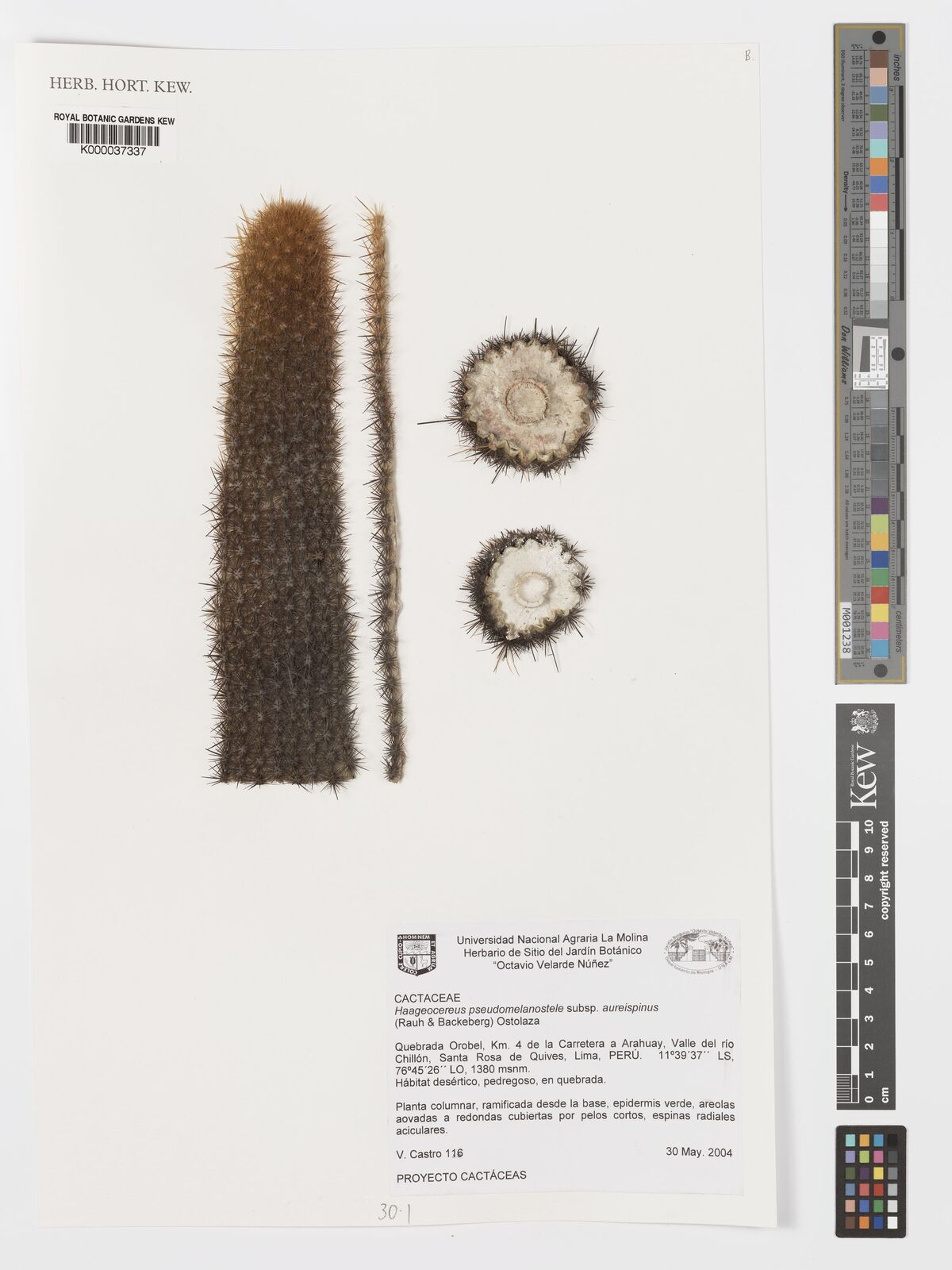 Reference image
Haageocereus pseudomelanostele is an upright, columnar cactus belonging to the family Cactaceae. Known for its dense, golden-yellow to brownish spines, it is a highly prized ornamental species adapted to harsh desert environments 1.
Originally described by Curt Backeberg, this species belongs to the genus Haageocereus, which comprises several columnar cacti native to South America 2. Its specific epithet, "pseudomelanostele", translates to "false black column", pointing to its visual resemblance to other dark-spined columnar species.
This species is native to the coastal deserts of western Peru, growing on rocky slopes and dry valleys at elevations from sea level up to 1000 meters 1. It thrives in hyper-arid conditions where moisture is often primarily received from coastal fogs rather than rainfall.
It forms clumped groups of columnar stems that can reach up to 1.5 meters in height. The stems are densely covered in a mesh of fine, golden-yellow, white, and brown spines that shield the plant from intense solar radiation. Nocturnal, funnel-shaped flowers are white or pale green 2.
In cultivation, it requires maximum sunlight exposure and highly porous, mineral-rich soil. Water thoroughly during the growing season only when the soil has dried out completely. Keep virtually dry in winter and protect from freezing temperatures.
Overwatering and placing the plant in poorly draining soil are the leading causes of root rot. Inadequate light exposure leads to etiolation, causing the stems to grow thin, weak, and lose their vibrant spination.
Thrives in full sun; requires bright, direct light for optimal spine development.
Allow soil to dry out completely between waterings. Keep nearly dry in winter.
Mineral-rich, sandy soil with plenty of pumice or perlite for aeration.
Equipped with dense, sharp spines. Keep away from pets and children. Non-toxic.
Very easy to maintain if given enough light and not overwatered.
Occurs naturally along the arid Pacific slopes of Peru, inhabiting sandy and rocky coastal deserts where coastal fogs provide minimal atmospheric moisture.
