
Light
Full Sun
Requires full, direct sun for at least 6 hours daily to maintain its dense, colorful spine growth.
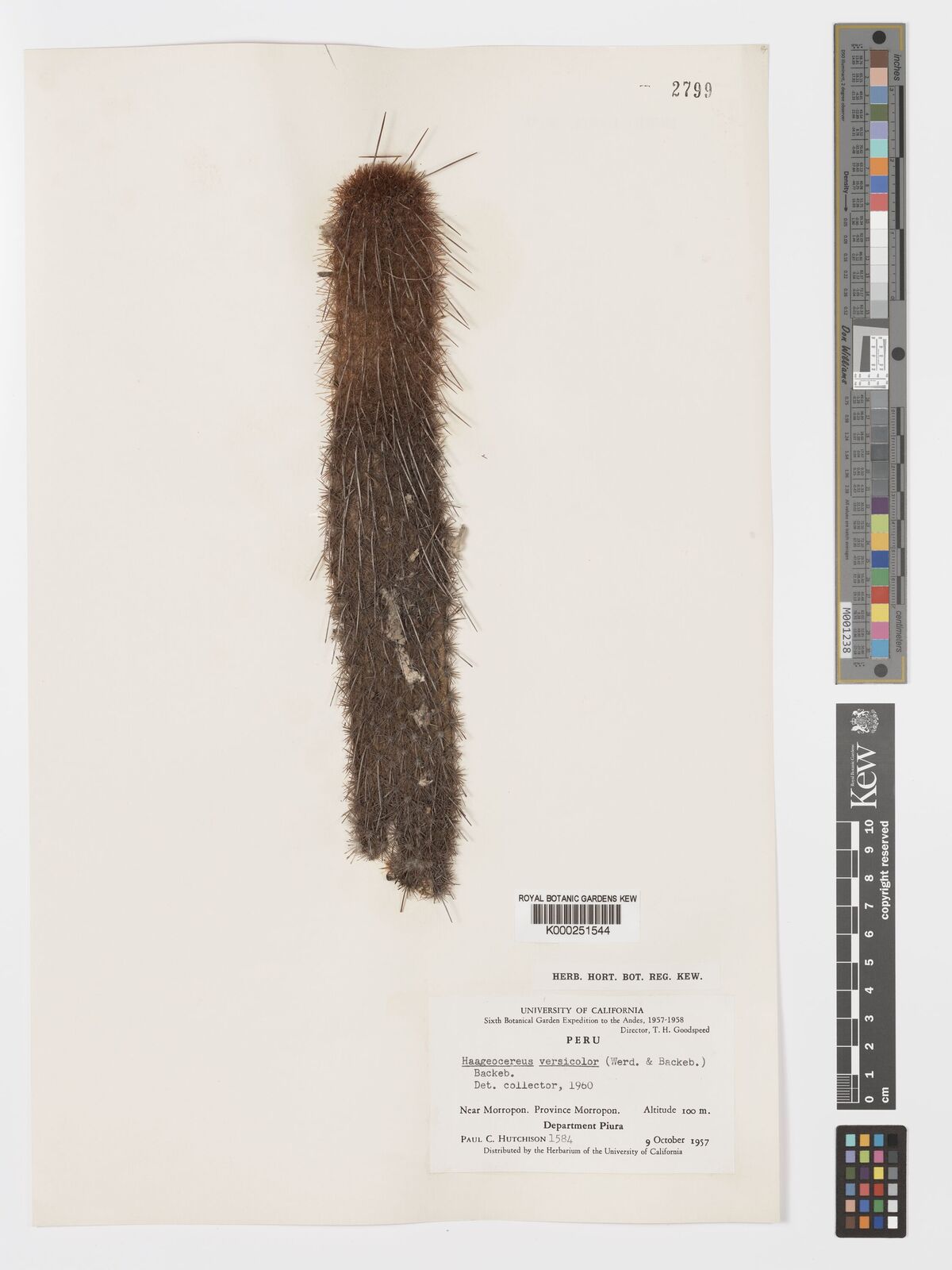 Reference image
Haageocereus versicolor is an upright columnar cactus native to the arid coastal regions of Peru, highly valued for its striking, multi-colored golden-brown spination 1. The dense spine cover acts as a natural sun screen against harsh desert rays.
Belonging to the family Cactaceae, the genus Haageocereus is known for its shrubby to columnar growth habit. The specific epithet versicolor refers to the variable and changing colors of its spines, which range from bright yellow to reddish-brown 2.
This species is native to Western South America, particularly in Peru's seasonally dry tropical biomes 1. It thrives on rocky slopes and coastal hillsides where rainfall is scarce but coastal fogs sometimes provide humidity.
The cylindrical stems can grow up to 1.5 meters tall, featuring 15 to 22 ribs. The dense areoles are packed with colorful, needle-like spines. It produces beautiful nocturnal, funnel-shaped white to cream flowers during the summer months.
In cultivation, it requires full sun exposure and an exceptionally well-draining mineral soil mix. Water thoroughly only when the soil has completely dried out. Keep almost entirely dry during winter dormancy to prevent rot.
The most common mistakes are overwatering and inadequate light, which lead to root rot and etiolation (pale, stretched, and weakened growth).
Requires full, direct sun for at least 6 hours daily to maintain its dense, colorful spine growth.
Allow soil to dry 100% between waterings; practice strict dry winter dormancy.
Thrives in a highly porous mineral substrate rich in pumice, gravel, and coarse sand.
Non-toxic, but the sharp and dense spines pose a physical hazard to children and pets.
Moderate difficulty; very easy if you can provide adequate direct sunlight and avoid overwatering.
Native to the arid coastal valleys and dry rocky hillsides of Peru, adapted to seasonally dry tropical desert climates.
