
Light
Bright Indirect Light
Requires bright indirect light or filtered sun; avoid harsh midday sun.
 Reference image
Fragrant Applecactus
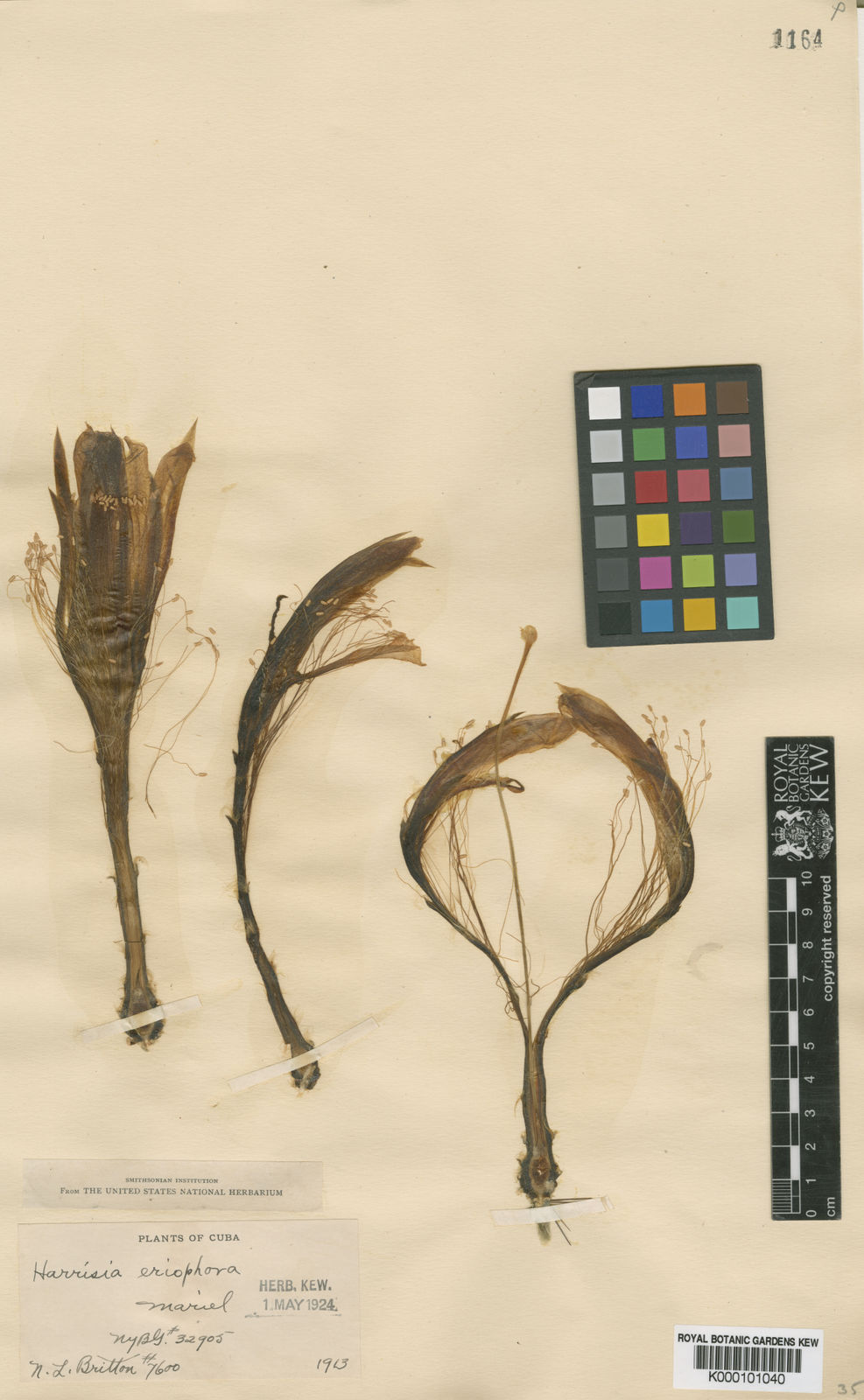
Harrisia eriophora, commonly known as the fragrant applecactus, is a striking night-blooming columnar cactus belonging to the family Cactaceae. Highly prized for its nocturnal, large, white, and aromatic flowers, it makes a dramatic statement in succulent collections and arid landscapes.
The species belongs to the genus Harrisia 1. The specific epithet eriophora derives from Greek, meaning 'wool-bearing', referring to the characteristic woolly scales found on the flower buds and floral tubes. It was historically described under the synonym Cereus eriophorus.
Native to Cuba (CUB, CUB_OO) and parts of the Caribbean, this species thrives in seasonally dry tropical biomes 2. It is typically found in coastal thickets, dry shrublands, and limestone hillsides, where it adapts well to rocky, nutrient-poor substrates.
Harrisia eriophora is a succulent subshrub that displays a semi-erect or sprawling habit, growing up to 3-5 meters tall. The cylindrical green stems feature 8 to 11 deep ribs lined with greyish areoles and sharp spines. The nocturnal flowers are massive, measuring 15-20 cm in length, with a woolly exterior tube and pure white inner petals. It produces globose, edible yellow fruits when pollinated.
This cactus prefers a fast-draining, mineral-rich gritty soil with some limestone components. During the active growing season, it benefits from bright, filtered sunlight and deep but infrequent watering. It requires warm temperatures and must be protected from freezing conditions.
The most frequent mistake is overwatering during the winter dormancy, which easily triggers root rot. Additionally, keeping the plant in deep shade results in weak, spindly stem growth (etiolation) and prevents the development of its spectacular blooms.
Requires bright indirect light or filtered sun; avoid harsh midday sun.
Water thoroughly only when the soil is dry. Keep almost dry in winter.
Requires a highly porous, gritty cactus soil mix with excellent drainage.
Features sharp spines along the stems. Non-toxic to pets, but handle with care.
Very easy to care for, provided it is not overwatered and is kept warm.
Originates from the dry tropical forests, rocky limestone outcrops, and coastal shrublands of Cuba and adjacent Caribbean areas.
