
Light
Full Sun
Requires full, unfiltered sun for at least 6-8 hours daily. Avoid shady indoor placements.
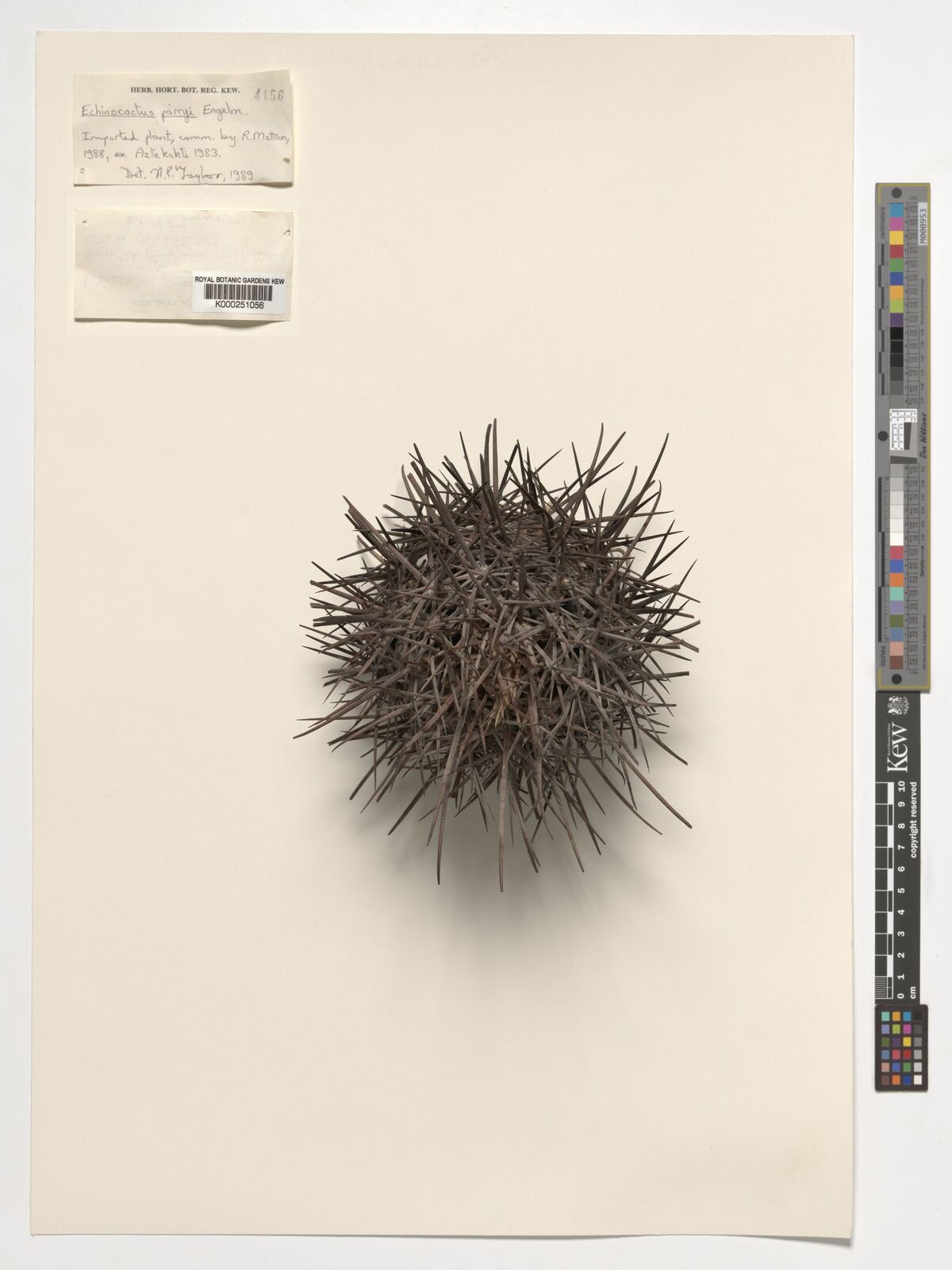 Reference image
Parry's Eagle Claw Cactus
Homalocephala parryi (syn. Echinocactus parryi), commonly known as Parry's Eagle Claw, is a slow-growing, solitary, globose cactus highly prized among collectors for its formidable, curved, and heavy spine armor. It is adapted to extreme desert conditions and is considered one of the most challenging cacti to maintain in cultivation 1.
This species was originally described by George Engelmann. Modern molecular studies have resurrected the genus Homalocephala, moving this species out of Echinocactus 2. The specific epithet "parryi" honors Dr. Charles Christopher Parry, a distinguished 19th-century botanist and plant collector who documented the US-Mexico boundary flora.
Homalocephala parryi is native to the northern dry regions of Mexico, including Chihuahua, Durango, and parts of Coahuila, extending to adjacent areas in the southwestern United States 1. It thrives on limestone hills, gravelly slopes, and arid desert shrublands exposed to intense solar radiation.
The stem is depressed-globose to short-cylindrical, grayish-green, with prominent vertical ribs. The areoles bear thick, rigid, flattened, and recurved spines that range from pinkish-red to ash-grey. During late spring to summer, it produces funnel-shaped, yellow to reddish-tinged flowers at the plant's apex 2.
In culture, this species is notoriously susceptible to root rot due to its sensitive root system. It requires an exceptionally porous, mineral-only medium and strict watering discipline. It must receive full, direct sunlight throughout the year to maintain its compact shape and robust spination.
The most frequent failure is using organic, peat-rich soil and overwatering, which quickly triggers rot. Inadequate light causes etiolation, leading to weak, thin stems and poor spine development.
Requires full, unfiltered sun for at least 6-8 hours daily. Avoid shady indoor placements.
Water thoroughly only when the soil is bone-dry. Stop watering entirely during winter.
Requires 90% mineral-based substrate. Avoid organic peat mixes to prevent lethal root rot.
Equipped with extremely sharp, rigid, and heavy spines. Handle with thick leather gloves and keep away from pets.
Hard. Not recommended for beginners due to high sensitivity to excess moisture and root damage.
Native to the high-elevation, sun-drenched gravel plains and limestone hillsides of the Chihuahuan Desert.
