
Light
Full Sun
Maximum sunlight; requires at least 6 hours of direct sun daily.
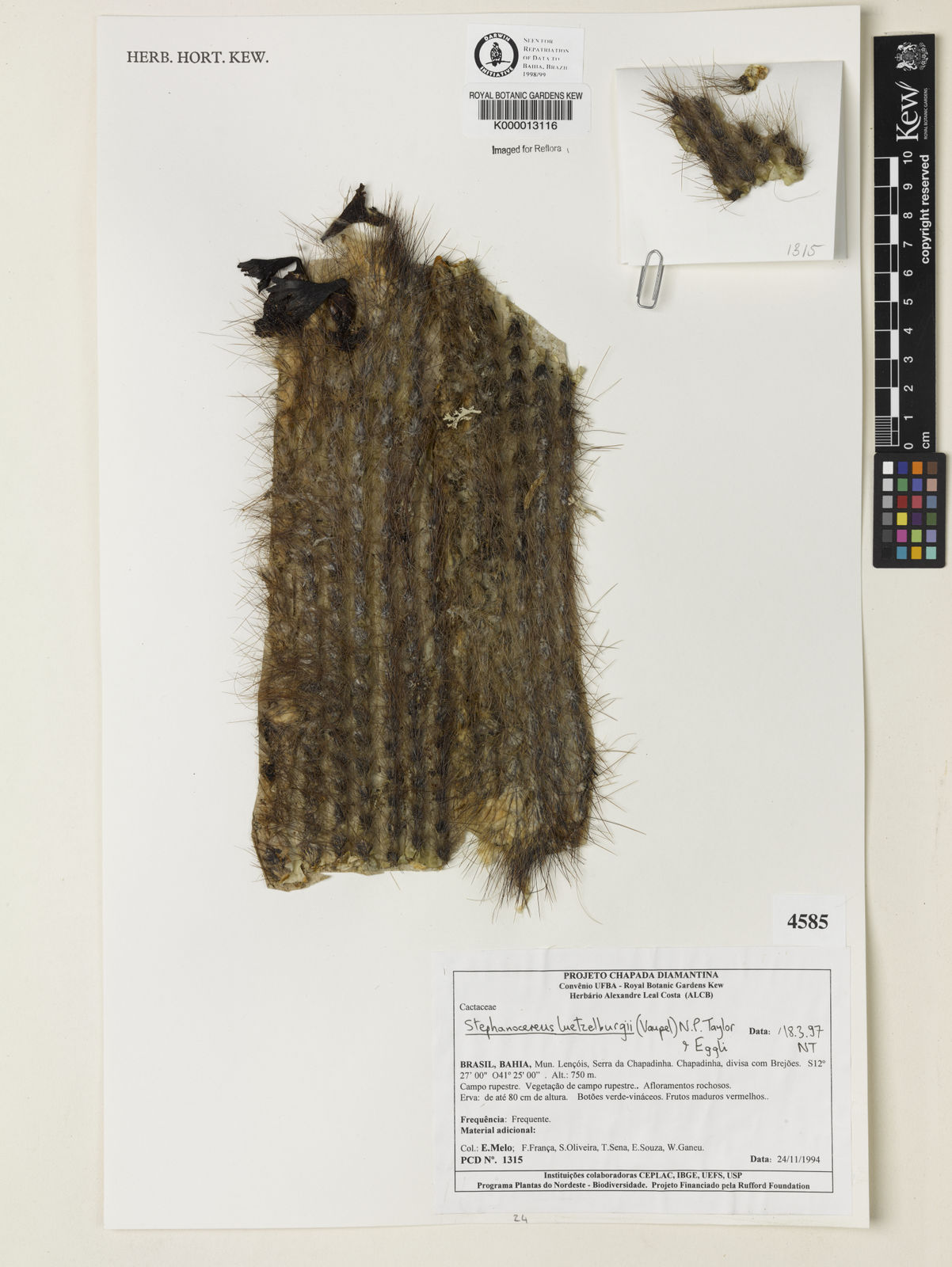 Reference image
Bottle Cactus
Lagenosocereus luetzelburgii (synonym: Stephanocereus luetzelburgii), belonging to the Cactaceae family, is a unique columnar cactus species highly sought after by collectors. Known colloquially as the "bottle cactus" or "garrafa" in its native Brazil, it is famous for its swollen, flask-like basal stem 1.
Originally described as Cereus luetzelburgii, the species has experienced various taxonomic placements under Stephanocereus and Coleocephalocereus. Modern cladistic and morphological studies place it in the distinct genus Lagenosocereus due to its unique flowering cephalium structure 2.
This species is endemic to the semi-arid Caatinga ecoregion of northeastern Brazil, occurring across Bahia, Ceará, and neighbouring states. It is mostly found growing on rocky outcrops, quartzitic gravel, and thin sandy soils where it tolerates extreme drought and high solar radiation 1.
Initially globose, the stem becomes columnar with age, developing a distinctive swollen base resembling a bottle. It features close-set ribs armed with golden-yellow to brownish spines. Mature plants produce a apical woolly structure called a terminal cephalium, from which nocturnal, tubular white flowers emerge 2.
In cultivation, Lagenosocereus luetzelburgii requires specialized care. It demands maximum sunlight and highly porous, mineral-based soil mixes. During the spring and summer, it should be watered only after the substrate has completely dried out. In winter, watering must be suspended almost entirely, keeping the temperature above 8°C.
The most common mistake is overwatering or using organic-rich, heavy soils, which quickly lead to root rot. Insufficient sunlight will result in etiolation, causing the cactus to stretch unnaturally, lose its characteristic bottle shape, and weaken its immunity.
Maximum sunlight; requires at least 6 hours of direct sun daily.
Water only when the soil is completely dry. Keep almost dry in winter.
Very porous cactus soil rich in pumice, grit, and coarse sand.
Has sharp spines; handle with care and keep away from pets and children.
Moderate to hard; highly sensitive to overwatering and low light.
Native to the arid Caatinga region of Brazil, thriving in rocky crevices and poor mineral soils under intense heat.
