
Light
Bright Indirect Light
Requires filtered or bright indirect light; direct sun can scorch the delicate segments.
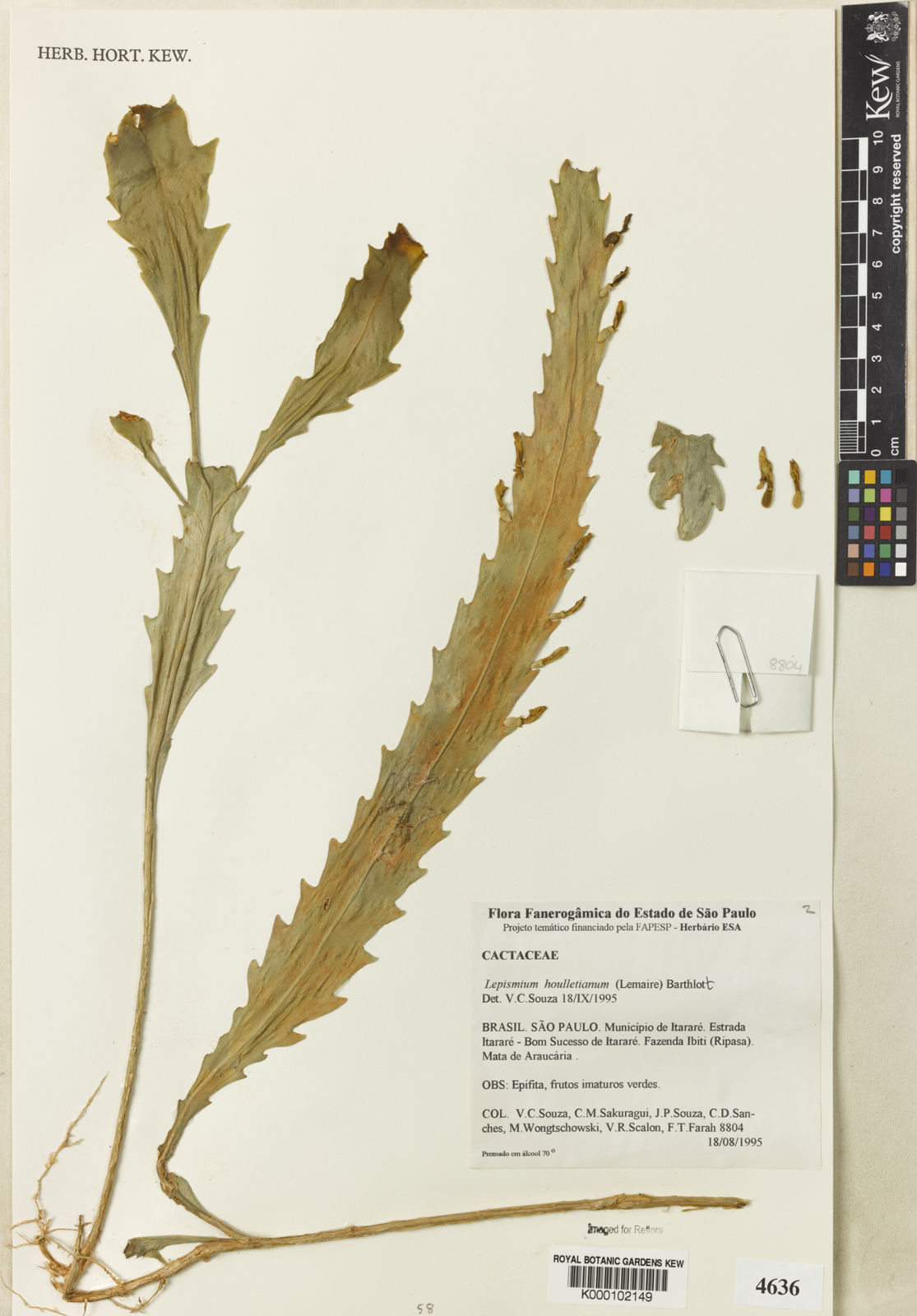 Reference image
Snowflake Cactus
Lepismium houlletianum, commonly known as the 'snowflake cactus', is a highly attractive and distinct epiphytic cactus with weeping, flattened stems and delicate cream-colored flowers. Unlike typical desert cacti, this plant is adapted to moist, humid forest canopies, making it an exceptional trailing specimen for indoor hanging baskets 1.
This species belongs to the tribe Rhipsalideae within the Cactaceae family. The specific epithet houlletianum honors the French horticulturist Jean-Baptiste Houllet. It has historically been classified under various genera, most notably as Rhipsalis houlletiana, with which it is still frequently synonymous in horticultural trade 1.
Lepismium houlletianum is native to South America, predominantly found in the Atlantic Forest region of southern and southeastern Brazil (including Rio de Janeiro, São Paulo, and Rio Grande do Sul) as well as northeastern Argentina. It thrives in humid, wet tropical biomes, growing as an epiphyte on trees or occasionally as a lithophyte on rocks 2.
The plant features elongated, flat, leaf-like segments with deeply serrated or notched margins. These serrated segments distinguish it from many other Rhipsalideae. In late winter or early spring, tiny, bell-shaped, pale yellow to cream flowers dangle from the notches (areoles), which later develop into small, decorative reddish-purple berries.
To mimic its natural habitat, it requires bright, indirect sunlight and high humidity. It should be grown in a porous, fast-draining potting medium rich in organic matter, such as an orchid or bromeliad mix 2. Watering should be consistent, allowing the top layer of soil to dry out between applications, without letting the roots sit in water.
Treating this species like a desert cactus by letting it dry out completely for long periods is a common mistake. Conversely, heavy clay soil and poor drainage will quickly cause root rot. Inadequate air humidity may lead to withered margins.
Requires filtered or bright indirect light; direct sun can scorch the delicate segments.
Water thoroughly once the topsoil dries; reduce frequency slightly in winter.
An open, porous epiphytic mix with orchid bark, perlite, and organic peat.
Non-toxic to cats, dogs, and other household pets.
Easy to moderate; great for beginners who can avoid overwatering.
Native to the humid Atlantic Forest of Brazil and parts of northeastern Argentina, where it lives perched on forest trees, receiving dappled sunlight and ample atmospheric moisture.
