
Light
Bright Indirect Light
Prefers bright, indirect light or filtered sun; avoid harsh midday direct sunlight.
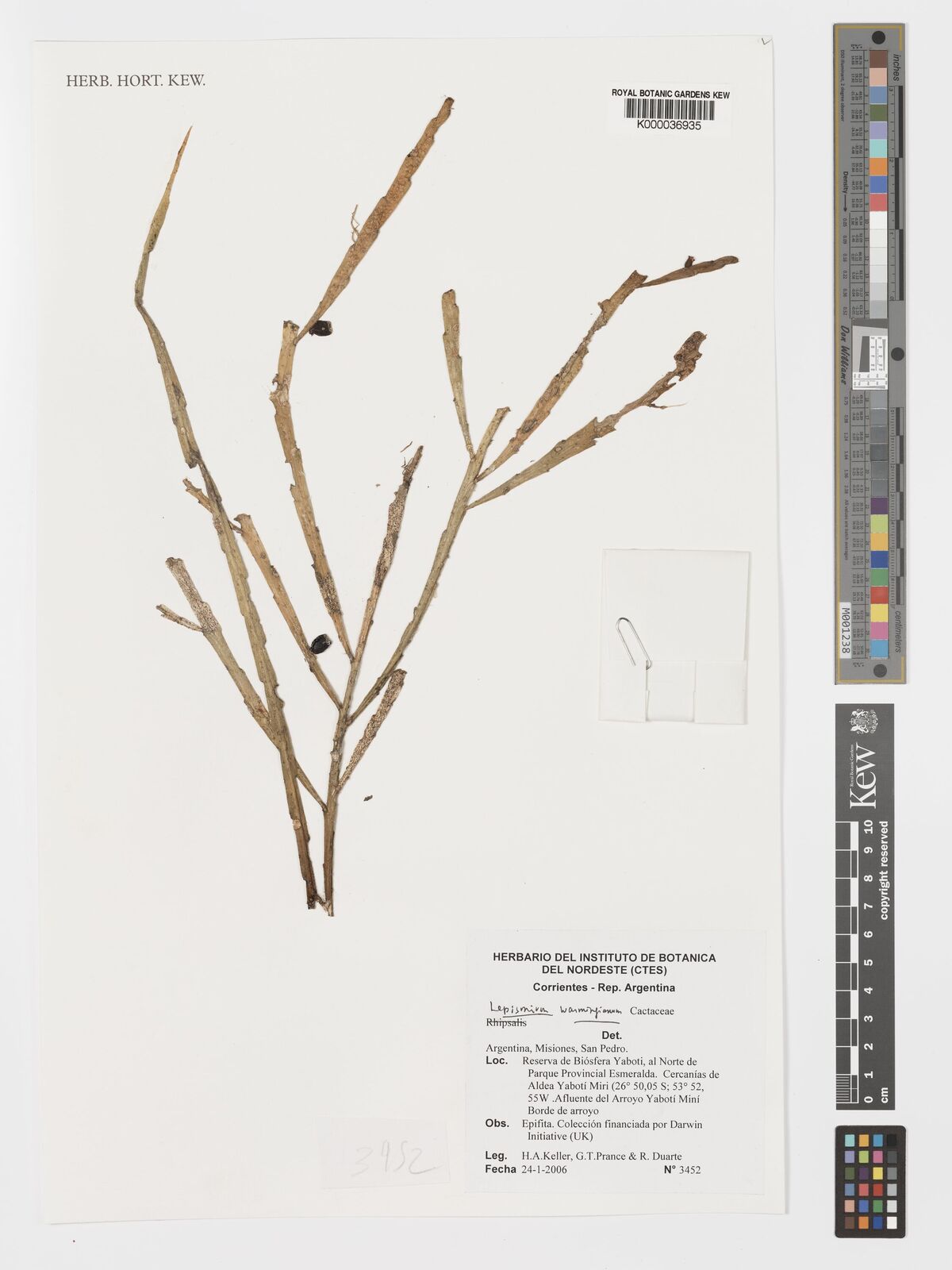 Reference image
Warming's Forest Cactus
Lepismium warmingianum is a cascading, epiphytic cactus species native to the tropical and subtropical forests of South America. Cultivated for its slender, angular stems and delicate spring blossoms, this species offers a unique jungle-dwelling aesthetic compared to arid desert cacti 1.
Named in honor of the Danish botanist Eugenius Warming, this species resides in the genus Lepismium within the family Cactaceae 2. It is closely related to and historically confused with Rhipsalis, but is distinguished by the specific structure of its areoles and its segmented, angled stems.
This species is widely distributed across Southern Brazil, parts of Paraguay, and northern Argentina. It primarily inhabits seasonally dry tropical forest biomes, growing as a semisucculent epiphyte anchored on tree branches where organic debris accumulates 1.
The stems are long, pendulous, branched, and multi-angled (often 3 to 4-ribbed or flat). They exhibit a deep green color that can take on reddish hues when exposed to cool temperatures or bright light. The numerous small, bell-shaped flowers are creamy-white or yellowish, emerging from the areoles along the margins. Following successful pollination, attractive dark purple-to-black berries appear 2.
In cultivation, Lepismium warmingianum thrives in bright, filtered light and moderate to high humidity. The growing medium must be highly porous and rich in organic matter. Water regularly once the top inch of the substrate dries out, and ensure a resting phase in winter with reduced moisture and cooler temperatures.
Treating this species like a desert cactus by letting it dry out completely for long periods will cause stem shriveling. Conversely, planting it in heavy, poorly-drained soil leads to rapid root rot and stem drop.
Prefers bright, indirect light or filtered sun; avoid harsh midday direct sunlight.
Water when the top of the soil is dry, but do not allow the root ball to dry out completely.
Thrives in a well-aerated, porous mix with orchid bark, peat, and perlite.
Non-toxic and spineless, making it completely safe for households with pets.
Easy to care for if its epiphytic watering needs and light preferences are met.
Found primarily in the Atlantic Forest and seasonally dry woodlands of southern and southeastern Brazil, growing naturally on tree canopies in moist, shaded environments.
