
Light
Full Sun
Prefers full, direct sunlight and bright, warm positions.
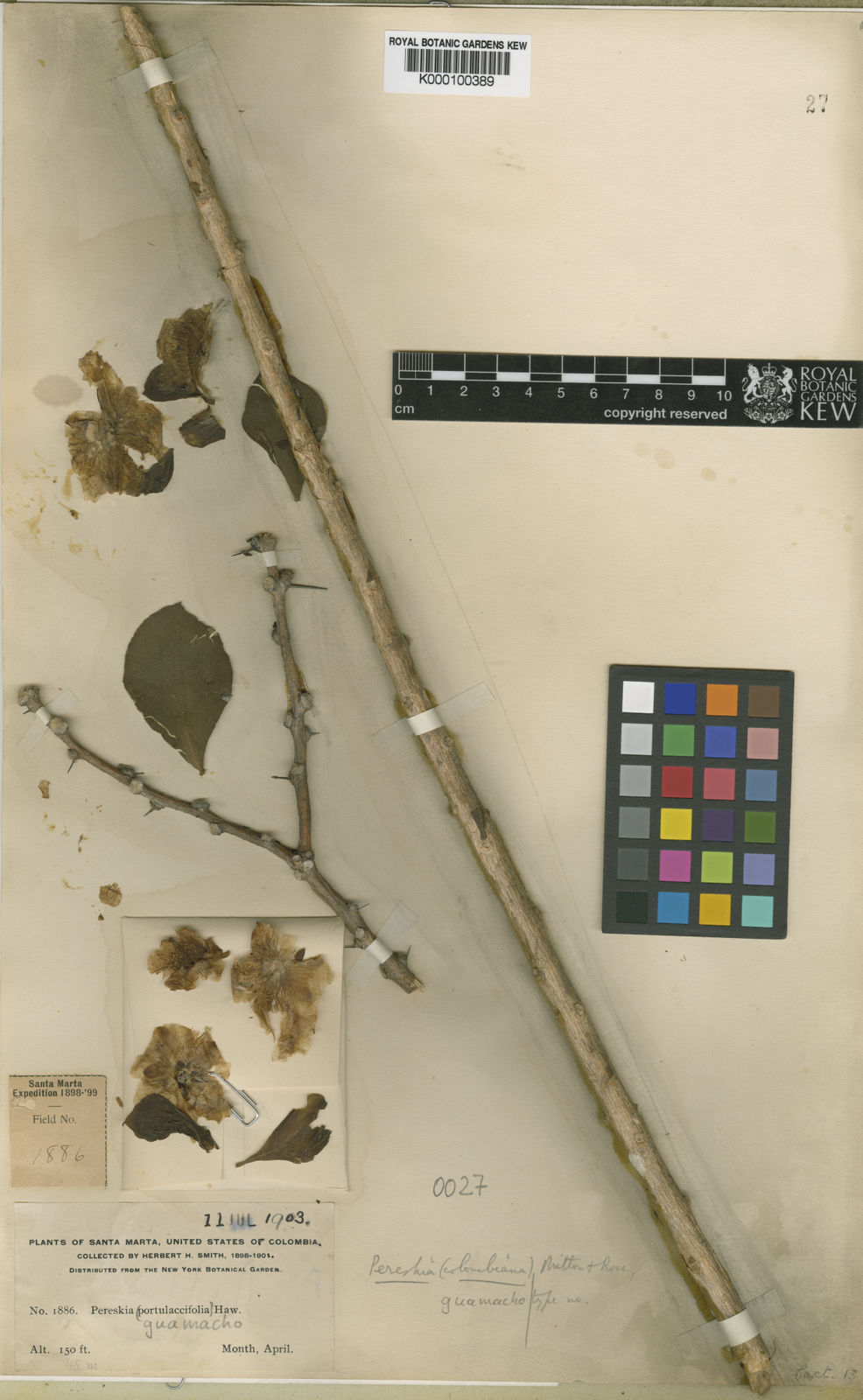 Reference image
Guamacho Tree Cactus
Leuenbergeria guamacho (formerly classified as Pereskia guamacho) is an extraordinary semi-succulent, leafy tree or shrub belonging to the Cactaceae family 1. Challenging the typical perception of cacti as leafless, ribbed desert plants, this species features prominent true leaves and a woody habit. It is highly valued in botanical collections and dry tropical landscaping for its resilience, fierce spines, and bright yellow blooms.
Originally described by Weber in 1897 as Pereskia guamacho, modern molecular and phylogenetic studies led to its relocation to the genus Leuenbergeria 2. This genus was established to separate North and Central American leafy clades from South American Pereskia species, named in honor of the renowned Swiss botanist Beat Ernst Leuenberger. Globally, it is commonly known by its vernacular names 'Guamacho' or 'Supí'.
This species is native to northern South America, Central America, and parts of the Caribbean, including Colombia, Venezuela, Panama, Aruba, and the Netherlands Antilles 3. It thrives predominantly in seasonally dry tropical forests, arid coastal scrublands, and savannas, where it has adapted to withstand prolonged dry seasons by dropping its leaves.
Leuenbergeria guamacho can grow into a small tree or large shrub reaching heights of 4 to 8 meters. Its woody trunk and branches are armed with sharp, needle-like spines measuring 2-4 cm, arising from woolly areoles. The leaves are ovate-elliptic, fleshy, and bright green. During the flowering season, it produces striking, solitary or clustered bright yellow flowers at the ends of branches, followed by globose, yellowish-green pear-shaped fruits 2.
In cultivation, it requires a position in full sun to bright filtered light. Soil must be exceptionally well-draining, preferably a sandy loam mixture enriched with organic compost. Water regularly during the hot summer months, allowing the substrate to dry completely between cycles. In winter, during its natural dormancy, keep watering to an absolute minimum and protect the plant from temperatures below 10°C.
Overwatering and poorly drained soils are the primary causes of root and stem rot. Placing the plant in heavy shade leads to weak, etiolated growth, severe leaf drop, and a complete lack of flowering. Excessive fertilization during its winter dormancy can also harm its structure.
Prefers full, direct sunlight and bright, warm positions.
Water thoroughly once the soil dries completely in summer; keep nearly dry in winter.
Sandy, well-draining, and loam-based mix enriched with organic matter.
Armed with very sharp, stiff spines. Keep out of reach of children and pets.
Moderate, as managing its leaf-drop cycles and moisture levels requires some experience.
Naturally distributed across the seasonally dry tropical forests, plains, and coastal scrublands of northern South America, Central America, and adjacent Caribbean islands.
