
Light
Full Sun
Thrives in full sun, requiring at least 6 hours of direct sunlight daily for compact growth.
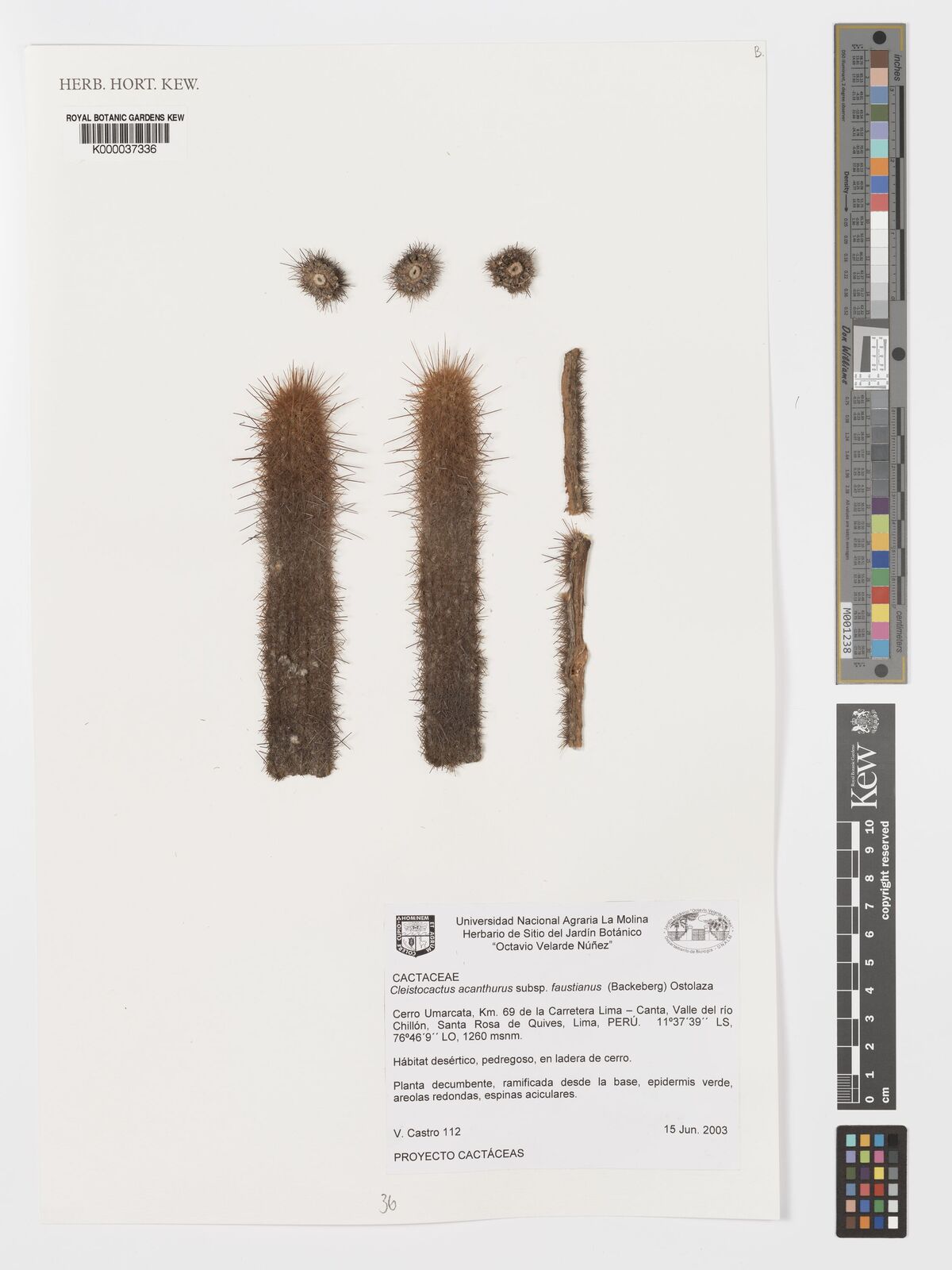 Reference image
Golden Spine Scrambling Cactus
Loxanthocereus acanthurus is a perennial succulent subshrub belonging to the Cactaceae family, native to Peru. It is characterized by its prostrate or sprawling stems, dense golden spines, and vibrant red tubular flowers 1.
Originally described by Friedrich Karl Johann Vaupel as Cereus acanthurus, it was later combined into the genus Loxanthocereus by Curt Backeberg. While some taxonomists historically grouped it under Cleistocactus, it remains recognized as Loxanthocereus in various specialized treatments due to unique floral structures 1.
This species is endemic to Peru, specifically the western slopes of the Andes and the dry coastal hills (lomas) of the Lima region. It thrives in seasonally dry tropical biomes, growing on steep, rocky, and gravelly slopes from near sea level up to 2500 meters 2.
The cylindrical stems are relatively thin, green, and grow up to 30 to 60 cm long, branching from the base. They feature 15 to 18 shallow ribs densely covered with needle-like, golden-yellow to brownish spines. The diurnal, zygomorphic flowers are narrow, tubular, slightly curved, and bright red or scarlet, adapted for hummingbird pollination.
Loxanthocereus acanthurus requires full sun exposure and a well-ventilated location to grow healthily. Water thoroughly during the hot summer months only after the soil has completely dried out. In winter, maintain dry conditions and keep the plant in a cool environment to encourage spring blooming.
The most frequent issue is root rot due to overwatering or poorly draining soil. Insufficient sunlight leads to etiolation (pale, thin, stretched growth) and inhibits the plant's ability to produce its characteristic red blooms.
Thrives in full sun, requiring at least 6 hours of direct sunlight daily for compact growth.
Allow soil to dry out completely between waterings. Reduce watering to absolute minimum in winter.
Use a very porous, mineral-based cactus mix containing pumice, grit, and very little peat.
Equipped with dense, sharp spines; keep out of reach of children and curious pets.
Moderate care difficulty. Key success factors are strong light and avoiding winter dampness.
Inhabits the dry rocky slopes of the Peruvian Andes and the coastal loma vegetation, adapted to intense solar radiation and minimal seasonal rainfall.
