
Light
Bright Indirect Light
Requires bright direct sun or very strong filtered light to maintain its robust spination.
 Reference image
Porcupine Pipe Cactus
Loxanthocereus hystrix is a unique, column-forming succulent subshrub belonging to the Cactaceae family, native to the arid and rocky terrains of Peru 1. It is well-regarded for its dense spination and spectacular tubular flowers 2.
Classified within the tribe Trichocereeae of the Cactaceae family, this species is placed in the genus Loxanthocereus 1. The specific epithet hystrix is derived from the Greek word for 'porcupine', referencing its highly protective and needle-like spines. It is often referred to under its synonym, Cleistocactus hystrix 2.
This species is naturally distributed in western South America, primarily endemic to Peru 1. It thrives in extreme desert biomes, growing on steep rocky slopes and dry shrublands where water is scarce and drainage is instantaneous 3.
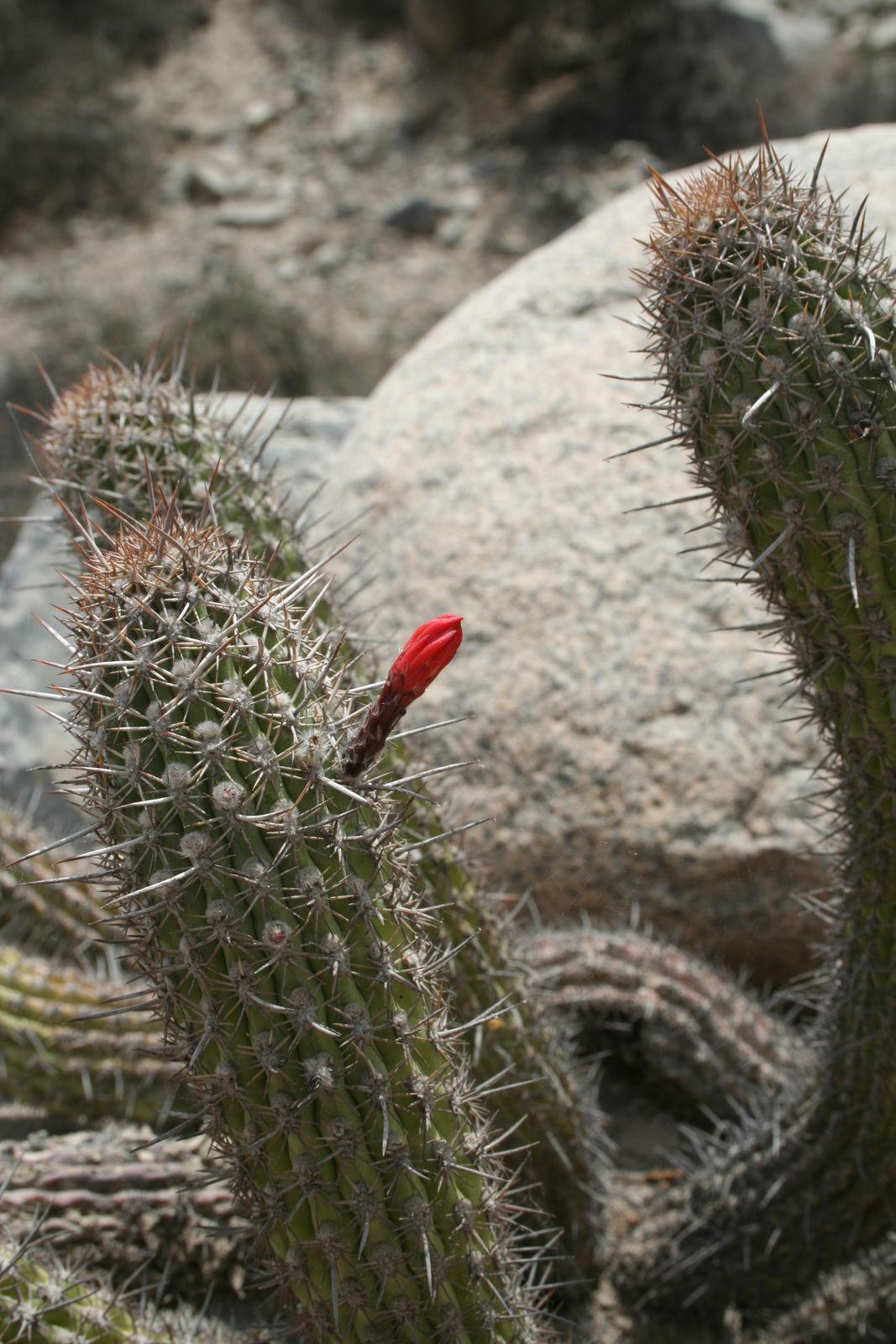
The plant develops gray-green cylindrical stems with numerous ribs. Each areole produces sharp, dense spines ranging from pale yellow to gray. Its distinctive, zygomorphic (asymmetrical) tubular flowers are bright red or orange, adapted for bird pollination 2.
In cultivation, Loxanthocereus hystrix demands high light levels, ideally mimicking its sun-drenched native habitat. It requires a highly mineral substrate with virtually no organic water retention. Watering must follow a strict soak-and-dry cycle 3.
The most frequent error is overwatering, which quickly causes root rot. Lack of adequate airflow combined with high relative humidity indoors can invite fungal pathogens and pests like mealybugs.
Requires bright direct sun or very strong filtered light to maintain its robust spination.
Water only when the soil is bone dry. Maintain complete dryness in winter.
Use a gravelly, sand-heavy substrate with high pumice content for fast drainage.
Features very sharp and dense spines. Keep away from pets and active children.
Moderately easy for growers who can manage moisture levels and provide high light.
Native to the dry slopes and valleys of Peru. It thrives in rocky pockets under high solar radiation and extremely low ambient humidity, requiring fast-draining substrate to survive heavy rainfall events.
