
Light
Full Sun
Requires full sun, ideally a south-facing window or outdoor position during summer.
 Reference image
Cone-shaped Maihueniopsis
Maihueniopsis conoidea is a highly specialized, cold-hardy succulent subshrub belonging to the Cactaceae family. Renowned for its tight, cushion-forming habit, this species is adapted to thrive in some of the most arid and high-altitude regions of South America.
Situated within the subfamily Opuntioideae, the genus Maihueniopsis was named to reflect its superficial resemblance to Maihuenia. The specific epithet 'conoidea' refers to the distinct, conical or obovoid shape of its individual stem segments 1. Taxonomic revisions have occasionally placed this species under various names, but modern genetic analysis secures its position in Maihueniopsis 2.
This species is native to the high-elevation montane regions of Southern South America, particularly in Argentina. It populates rocky slopes, gravel plains, and dry montane grasslands where it faces intense solar radiation, strong winds, and dramatic diurnal temperature swings 1.
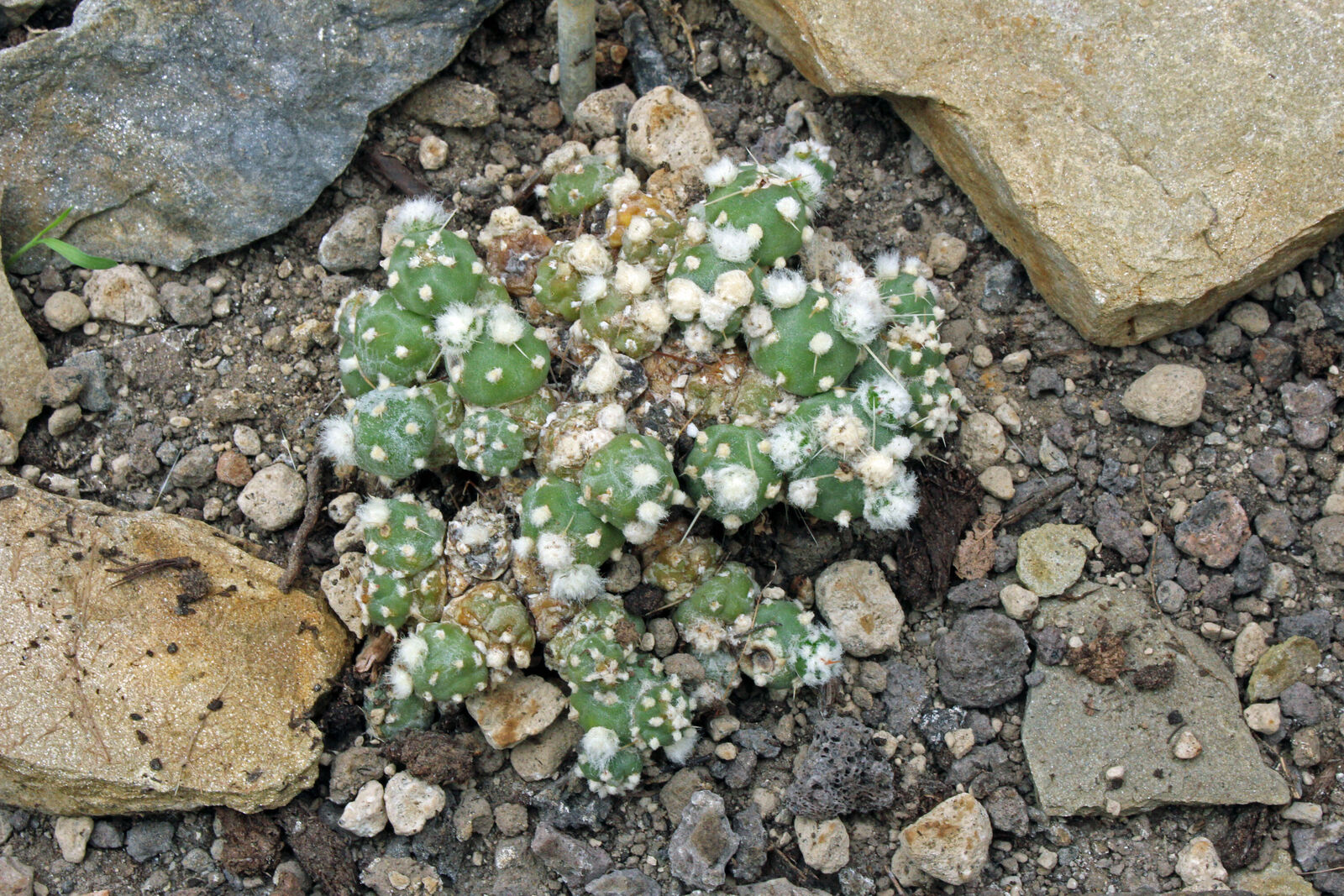
Maihueniopsis conoidea forms low, dense mats or cushions composed of small, jointed segments. These segments are typically pale green to olive-green and bear prominent areoles. The spines are sharp and accompanied by tiny, irritating glochids. Bright yellow, cup-shaped flowers appear at the tips of the segments in late spring.
In cultivation, replicating its high-altitude light levels and rapid-draining mineral substrate is essential. It requires full sun and excellent air movement. Under bone-dry winter conditions, this species is exceptionally frost-tolerant, surviving sub-zero temperatures 2.
The most prevalent issue is waterlogged soil due to organic-rich substrates or poor pot drainage, which leads to immediate root rot. Lack of adequate winter chill can also inhibit flowering and cause weak, etiolated growth.
Requires full sun, ideally a south-facing window or outdoor position during summer.
Water thoroughly only when the soil is dry. Suspend watering completely in winter.
Use a heavily mineral-based mix with pumice, perlite, and coarse sand.
Equipped with fine, irritating glochids; wear thick gloves during handling.
Moderate. Easy if kept dry, but highly intolerant of overwatering and high indoor humidity.
Native to the high Andes of Argentina, where it lives on rocky slopes exposed to freezing winter temperatures and intense summer mountain sun.
