
Light
Bright Indirect Light
Requires bright, filtered sunlight; too little light causes pale, stretched growth.
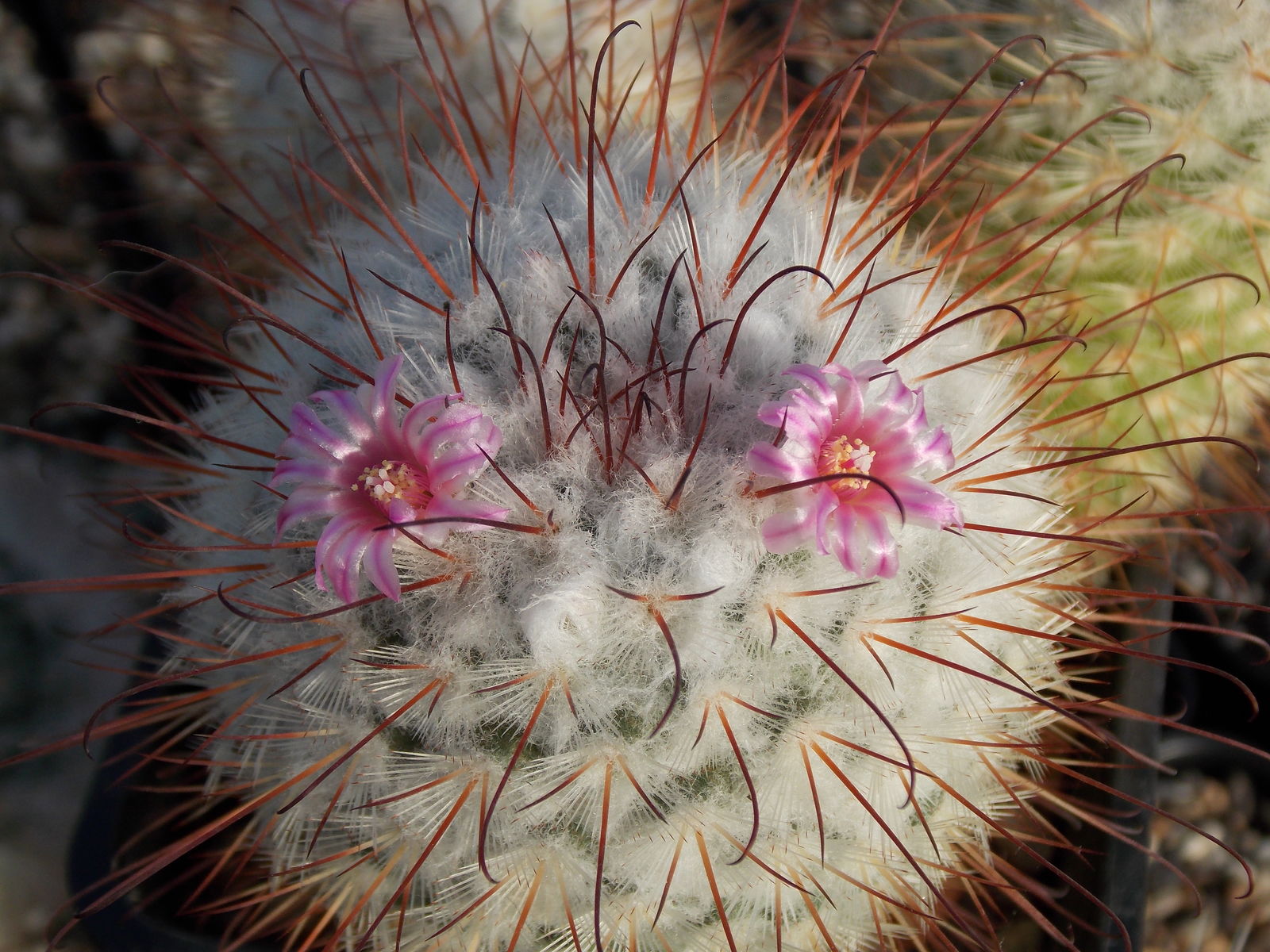 Reference image
Silken Pincushion Cactus
Mammillaria bombycina, commonly known as the Silken Pincushion, is a highly esteemed succulent subshrub in the cactus family. It is widely recognized for its beautiful contrast of dense white radial spines and prominent, hooked central spines.
Belonging to the genus Mammillaria within the family Cactaceae, this species was formally described by Ludwig Pfeiffer in 1838 1. The specific epithet "bombycina" is derived from Latin, meaning "silky" or "made of silk", referencing the plant's soft-looking radial spine cover 2.
Mammillaria bombycina is endemic to the Mexican states of Jalisco and Aguascalientes 1. It typically grows on steep limestone cliffs and rocky slopes in dry shrublands, occurring at elevations ranging from 1,500 to 2,500 meters above sea level 2.
The stems are globose to cylindrical, growing up to 20 cm tall and 6 cm in diameter. The body is densely covered with up to 40 white, pectinate radial spines per areole, contrasted by yellowish to reddish-brown central spines, the lower ones being strongly hooked. It produces vibrant pink to light purple flowers arranged in a ring near the crown during spring.
In cultivation, it requires bright, filtered sunlight to thrive and maintain its dense spination. Watering should be done thoroughly only when the potting medium has dried out completely. It prefers mineral-based, highly porous soils and must be kept dry and cool during winter.
Overwatering is the primary cause of failure, quickly leading to root rot. Insufficient light results in etiolation, where the plant loses its spherical form, stretching thin and weak towards the light source.
Requires bright, filtered sunlight; too little light causes pale, stretched growth.
Allow the potting mix to dry out completely between waterings; suspend watering in winter.
Needs a very porous grit-based mix with high mineral content and minimal organic matter.
Non-toxic, but the sharp hooked spines can easily catch on skin or clothing.
Easy to care for, making it an excellent choice for beginner cactus collectors.
Endemic to the high-altitude cliffs and rocky slopes of western-central Mexico, thriving in volcanic or limestone crevices under dry, semi-arid climatic conditions.
