
Light
Direct Sun
Choose south or west-facing windows that receive at least 4-6 hours of direct sunlight daily.
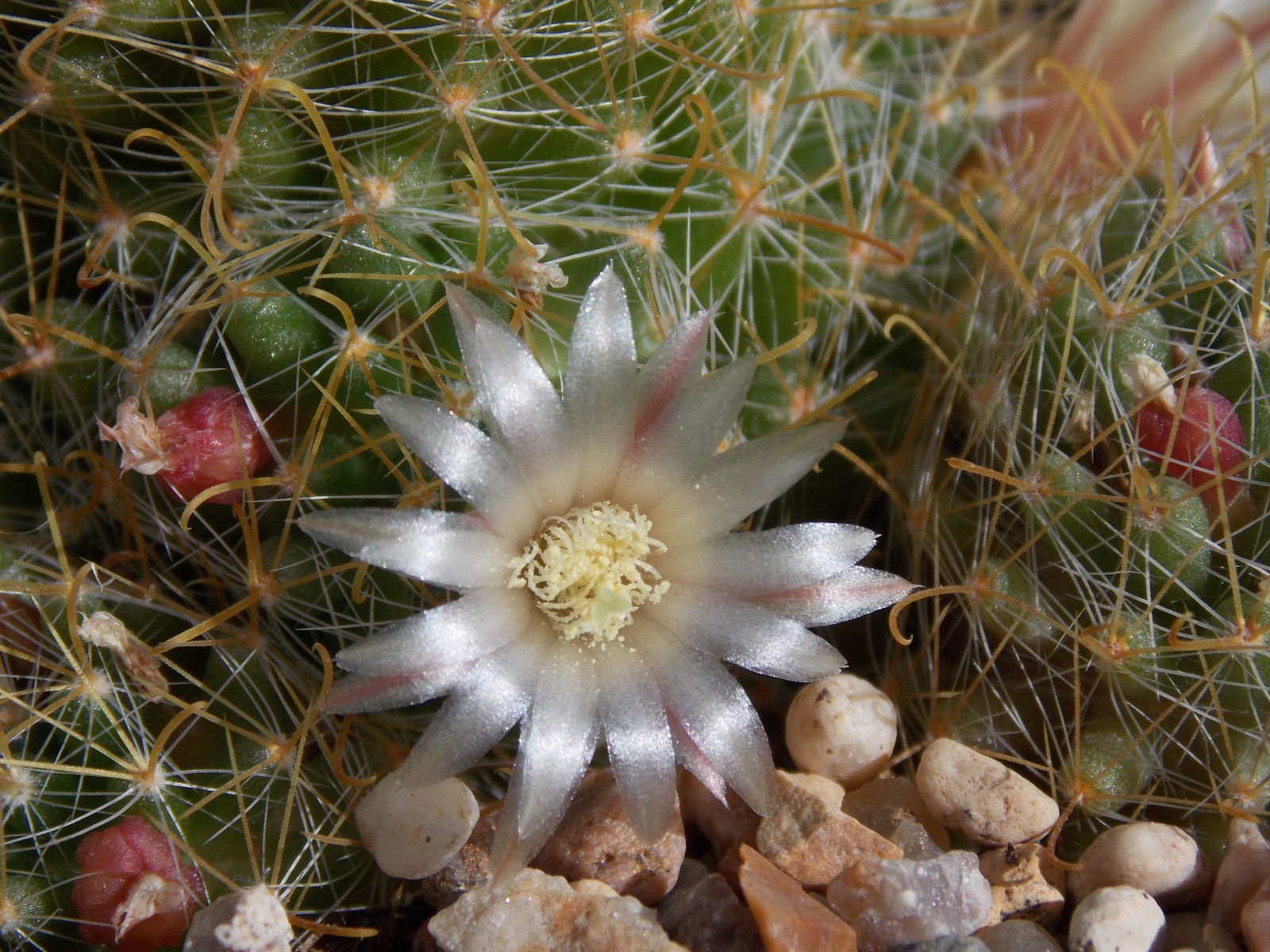 Reference image
Mammillaria crinita is a small, globose cactus species in the family Cactaceae, native to the dry shrublands and deserts of central Mexico 1. Well-known for forming dense, multi-headed clumps, this succulent subshrub is highly valued for its hooked central spines and delicate star-shaped cream-colored flowers.
Positioned within the genus Mammillaria, this variable taxon has historically encompassed multiple synonyms, such as M. wildii. The specific epithet "crinita" derives from Latin for "having long hair" or "crested," referencing the hair-like radial spines and woolly axils found on its areoles 1.
This species is widely distributed across Mexico, including states like Guanajuato, Jalisco, and San Luis Potosí 2. It typically populates dry scrublands and deciduous forests, growing on rocky limestone soils at elevations between 1,400 and 2,300 meters.
The stems are globose to short cylindrical, reach up to 8 cm in height, and sprout numerous offsets. Each tubercle holds radial spines and at least one hook-tipped central spine. Spring blooms arise in a ring near the apex, displaying pale yellow, white, or pinkish tones.
In cultivation, M. crinita thrives in bright, direct sunlight and requires exceptionally porous, mineral-based soil 2. Watering should follow the "soak and dry" method, ensuring the soil dries out completely between waterings.
Overwatering is the primary cause of root rot. Lack of sufficient light leads to etiolation, causing the cactus to stretch unnaturally and lose its compact, attractive shape.
Choose south or west-facing windows that receive at least 4-6 hours of direct sunlight daily.
Water only when the substrate is fully dry; keep virtually dry during the winter dormancy.
Use a highly porous cactus mix containing plenty of perlite, pumice, and coarse sand.
Non-toxic, but the sharp, hooked central spines can hook into skin or pet fur easily.
Excellent species for beginners due to its extreme drought tolerance.
Native to the high-elevation dry regions of central Mexico, predominantly in Guanajuato, San Luis Potosí, Jalisco, and Querétaro. It thrives on rocky limestone slopes, tucked within crevices or under the protective shade of sparse desert shrubs.
