
Light
Bright Indirect Light
Thrives in bright, filtered sunlight; protect from harsh, direct midday summer sun.
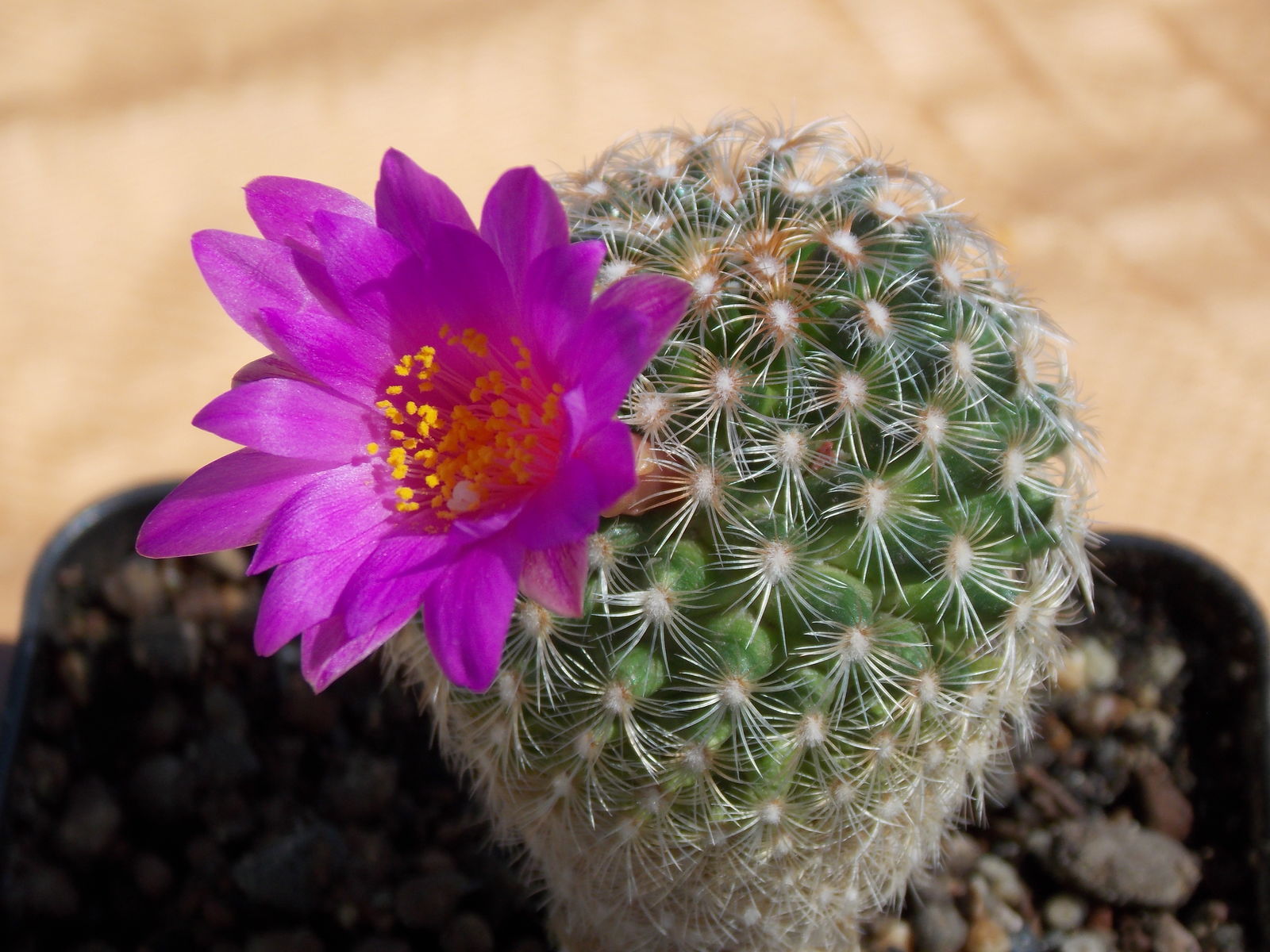 Reference image
De Herdt's Mammillaria
Mammillaria deherdtiana is a highly prized, globose cactus species belonging to the family Cactaceae, renowned among succulent enthusiasts for its remarkably large, showy pink-magenta flowers 1. Despite its small, spiny stem, this slow-growing plant produces some of the most vibrant floral displays within the Mammillaria genus.
This species was first described scientifically in 1969 by Farwig 2. The specific epithet 'deherdtiana' honors the prominent Belgian cactus nurseryman and collector De Herdt. It belongs to the series Ancistracanthae and is closely associated with its subspecies dodsonii.
Endemic to the state of Oaxaca in southern Mexico, Mammillaria deherdtiana is restricted to high-altitude montane tropical environments, primarily in the Sierra de Juárez mountains 1. It grows on rocky limestone outcrops and ledges amidst pine-oak forests at elevations exceeding 2,000 meters above sea level 2. These ecological conditions provide cool nights and frequent mist.
The stem is solitary or slowly clustering, globose to slightly flattened, typically reaching 4-5 cm in diameter. It is densely covered with radial spines that are needle-like, white to pale yellow. The funnelform flowers are disproportionately large compared to the plant body, measuring up to 5 cm in diameter, exhibiting a striking bright magenta color that emerges from the upper areoles in spring.
Due to its montane origin, this species is highly susceptible to root rot and requires an exceptionally porous, mineral-rich potting medium 2. It thrives in bright, filtered light with excellent ventilation. Watering should be deep but infrequent during the growing season, allowing the soil to dry completely, and kept strictly dry in winter.
Using standard organic-rich potting soils and overwatering during the dormant winter phase are the most common causes of failure. Lack of adequate air circulation combined with damp conditions will quickly lead to fungal rot and collapse of the plant.
Thrives in bright, filtered sunlight; protect from harsh, direct midday summer sun.
Allow the potting mix to dry out completely between waterings; keep dry in winter.
Highly porous, mineral-based substrate rich in pumice, gravel, and sand with minimal organic matter.
Has sharp, fine spines. Handle with gloves and keep out of reach of pets. Non-toxic.
Requires moderate care due to its sensitivity to overwatering and specific drainage needs.
Native to the high-elevation pine-oak forests of the Sierra de Juárez in Oaxaca, Mexico, where it grows on steep limestone cliffs and mossy rocky ledges.
