
Mammillaria densispina

Dense-spined Pincushion Cactus

Overview

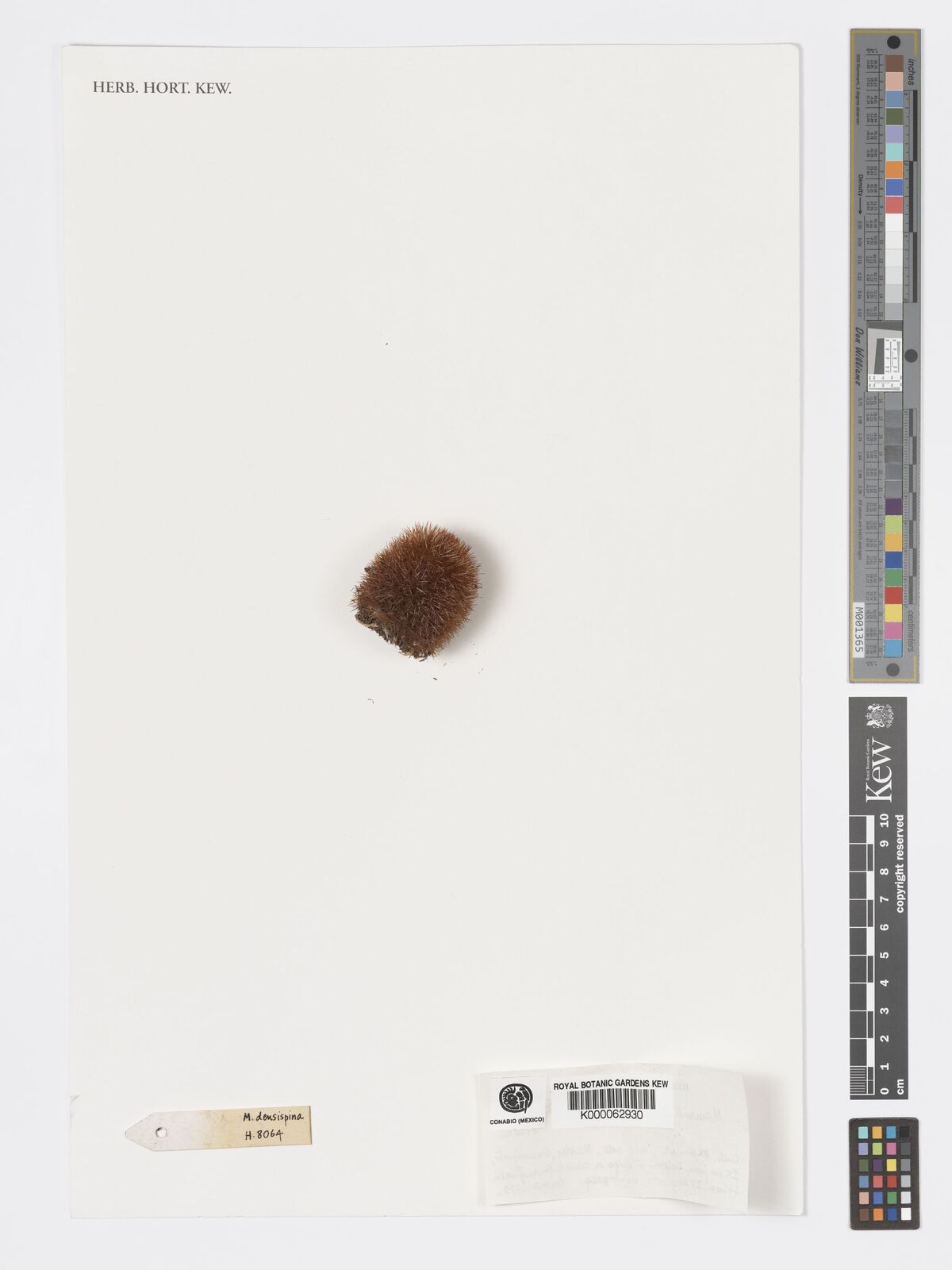
Mammillaria densispina is a highly attractive cactus prized for its dense, golden-yellow to brownish spine cover. This succulent subshrub initially grows globose before maturing into a short cylindrical shape, adapted to arid habitats 1.

Classification and Naming

Belonging to the Cactaceae family, it is a prominent member of the genus Mammillaria. The specific epithet densispina is Latin for "densely spined," describing the compact defense layer covering its stem 2.

Natural Range and Habitat

Native to central and southern Mexico, including states like Aguascalientes, Jalisco, San Luis Potosí, and Zacatecas 1. It thrives in dry shrublands and rocky slopes, typically at elevations between 1500 and 2400 meters above sea level 2.

Appearance

The stem grows up to 12 cm tall and 6 cm in diameter, solitary or clustering from the base. Conical tubercles support up to 25 radial spines and 1-6 stouter central spines. In late spring, it produces a ring of bell-shaped, pale yellow to cream flowers near the crown 3.

Cultivation and Care

This species requires bright, filtered sunlight and superb ventilation. It must be potted in a highly porous, mineral-rich substrate. Watering should follow the soak-and-dry method, allowing the soil to dry out completely between waterings 3.

Common Cultivation Mistakes

Overwatering is the primary cause of failure, quickly leading to root rot. Insufficient light results in etiolation, causing the stems to stretch abnormally and lose their dense golden spine color.

Bibliography

References

  1. Plants of the World Online (POWO), Royal Botanic Gardens, Kew.
  2. Anderson, E. F. (2001). The Cactus Family. Timber Press.
  3. Pilbeam, J. (1999). Mammillaria: The Cactus File Handbook. Cirio Publishing Services.
Light

Bright Indirect Light

Requires bright, filtered sunlight; direct midday summer sun can scorch the stem.
Watering

10-30 Days

Only water when the substrate is fully dry. Keep almost completely dry in winter.

Soil

Well-draining cactus mix enriched with pumice and coarse sand

Requires excellent drainage; use a mineral-rich cactus mix with plenty of pumice.

Safety

Pet Friendly

Non-toxic, but the dense, sharp spines can cause physical injury to curious pets or children.

Difficulty

Easy

Very easy to care for, making it ideal for beginners who can resist the urge to overwater.

Native Habitat

Mexico (Central and Southern regions)

Occurs naturally in high-altitude desert and dry shrubland biomes across central and southern Mexico, often growing in limestone crevices and rocky soils.

Frequently Asked Questions

How often should Mammillaria densispina be watered?
Water only when the soil is completely dry. Typically, once every 10 days in summer and once a month in winter is sufficient.
Is it toxic to pets?
No, it is non-toxic. However, keep it away from pets as the dense, sharp spines can physically injure paws or mouths.
How do I get this cactus to bloom?
Ensure it gets plenty of bright light and allow a dry, cool winter dormancy period (around 10°C) to stimulate flower bud formation.
What kind of pot and soil are best?
Use unglazed terracotta pots with drainage holes and a mineral-heavy soil mix containing plenty of pumice or grit.
Why is my cactus stretching and losing color?
This is called 'etiolation,' caused by insufficient light. The plant is stretching towards a light source. Move it to a brighter location.
How large does Mammillaria densispina grow?
It is a slow grower. In cultivation, it rarely exceeds 12-15 cm in height and about 6 cm in diameter.
Can I put it in direct summer sun?
Unless acclimated, harsh direct midday summer sun can cause permanent sunburn scars; bright indirect or filtered sun is safer.
How do I spot root rot and what should I do?
If the base of the stem becomes soft, dark, and mushy, it is rotting. Cut off the healthy top portion, let it callus, and repot to re-root.
Can I propagate it from offsets?
Yes, carefully remove offsets from the base using a sterile knife, allow the wound to dry/callus for a few days, then pot in gritty soil.
Should I completely stop watering in winter?
If kept in cool conditions (10-12°C), suspending water almost entirely in winter prevents rot and encourages spring flowering.