
Light
Bright Indirect Light
Requires bright, indirect light or filtered sun for at least 4 to 6 hours.
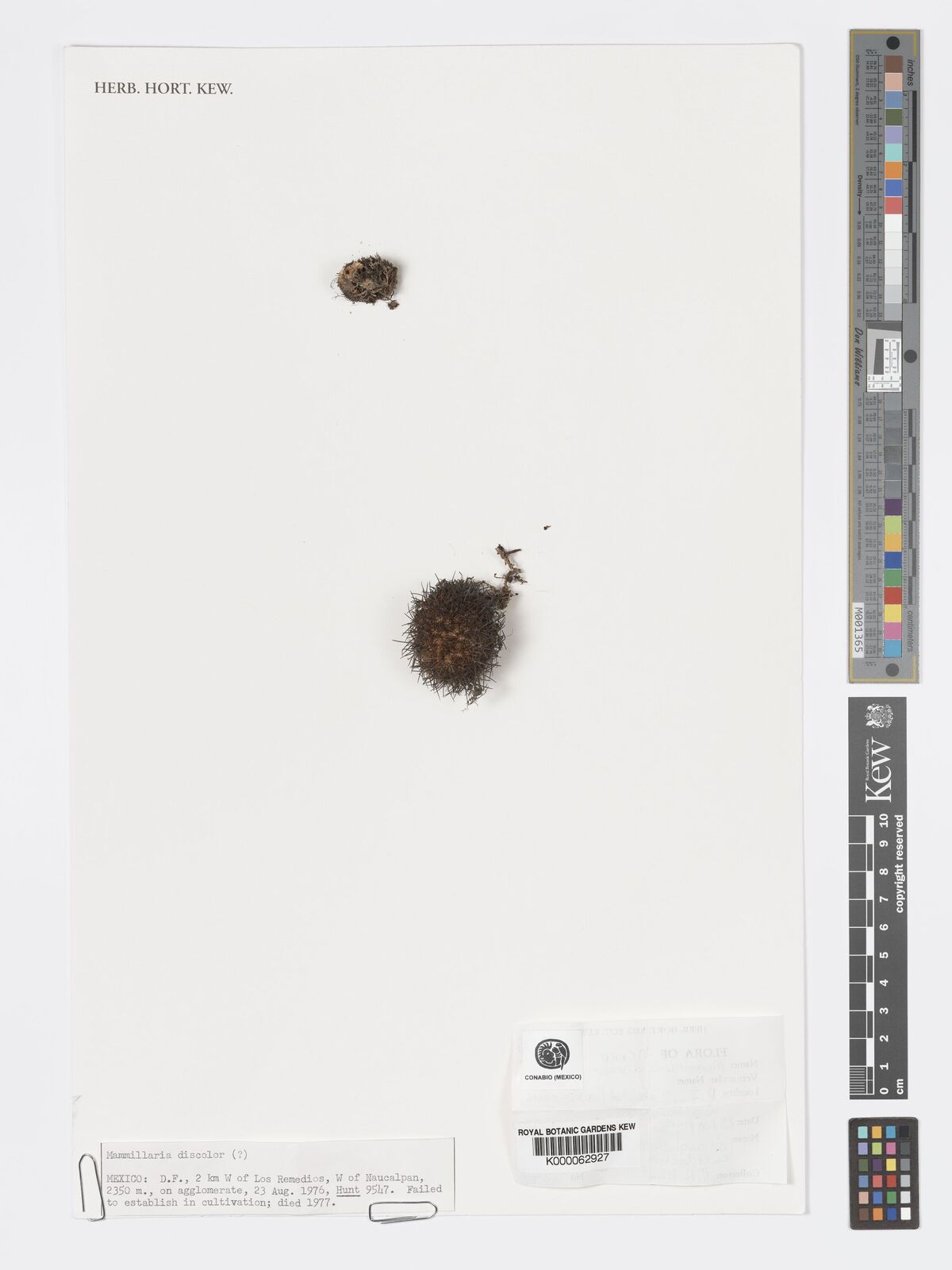 Reference image
Discolor Nipple Cactus
Mammillaria discolor is a captivating, small-growing globose cactus within the family Cactaceae. Highly appreciated for its ease of culture and symmetrical spine patterns, it makes an excellent addition to indoor succulent collections and rock gardens 1.
This species belongs to the diverse genus Mammillaria. The specific epithet "discolor" translates to "variegated" or "of different colors," referring to the contrasting hues of its central and radial spines which create a distinctive visual gradient 2.
Native to central and southern Mexico, this species has been documented in states like Aguascalientes, Jalisco, Michoacán, and Veracruz 1. It thrives in high-altitude dry shrublands and rocky grasslands, often growing tucked under larger shrubs or inside volcanic rock crevices that offer partial shade from intense afternoon sun 3.
The stem is usually solitary, globose to shortly cylindrical, green to dark green, growing up to 10 cm in diameter. Its surface is covered in spiraling tubercles. Radial spines are numerous and whitish, while the central spines are stouter, exhibiting gold, red, or dark brown colors. In early spring, it produces a crown of small, funnel-shaped flowers in shades of creamy yellow to pale pink 2.
In cultivation, it requires a very porous mineral substrate and bright, indirect sunlight. Watering should follow the 'soak and dry' method, keeping the medium completely dry during its winter dormancy to prevent root issues.
The most prevalent issue is root rot due to overwatering or heavy clay soils. Lack of light causes etiolation, where the spherical stem stretches unnaturally toward the nearest light source, losing its compact form.
Requires bright, indirect light or filtered sun for at least 4 to 6 hours.
Water only after the soil is bone dry; keep dry during winter months.
Requires extremely well-draining mineral soil with high pumice or perlite content.
Non-toxic to pets, but has sharp spines that can cause physical injury.
Very easy to maintain, ideal for beginners who avoid overwatering.
Native to high-elevation grasslands and dry scrub woodlands of central and southern Mexico, often growing alongside volcanic rocks and under sparse vegetation cover.
