
Light
Full Sun
Thrives in direct, intense sunlight; requires a south- or west-facing window for optimal growth.
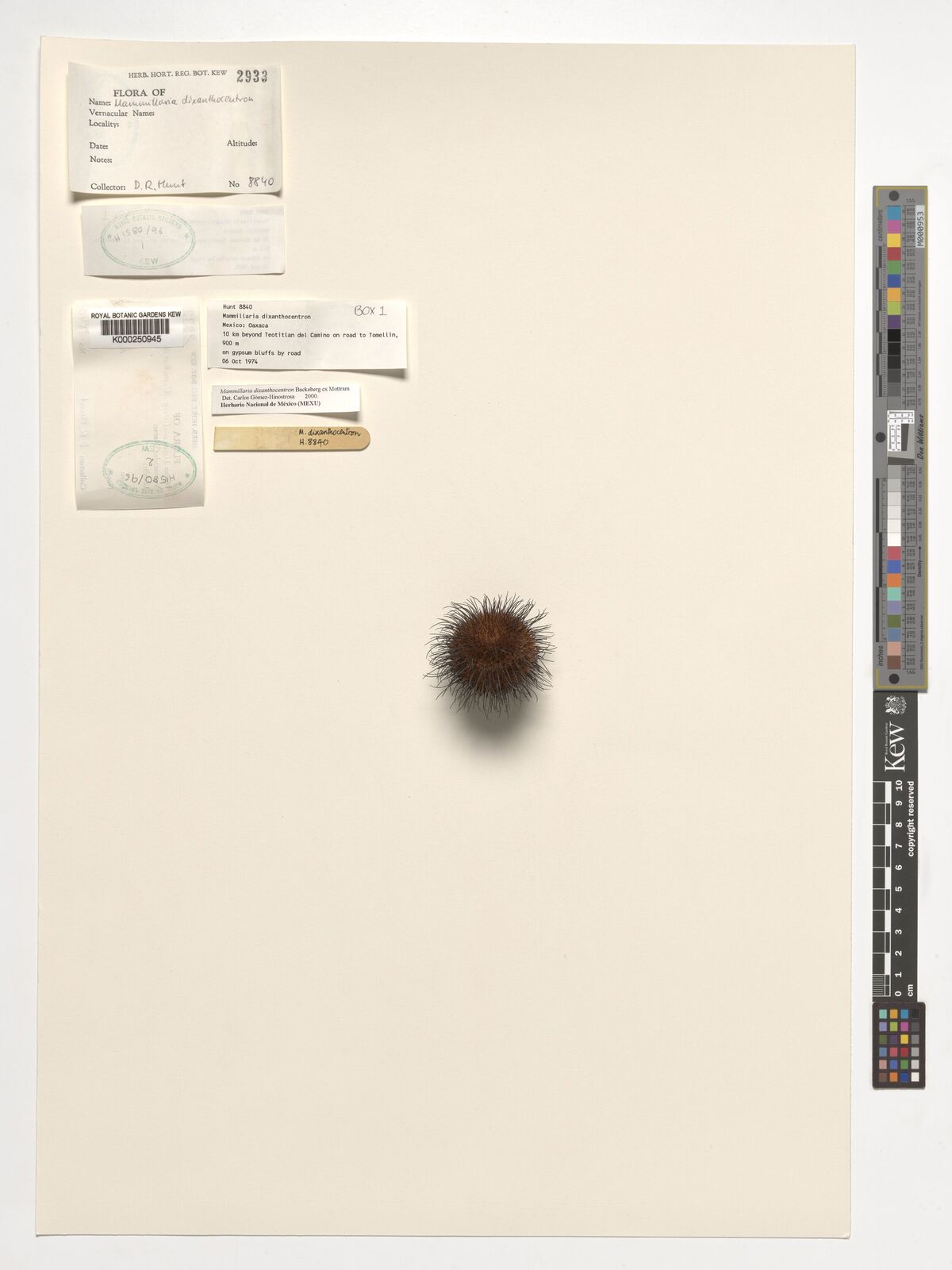 Reference image
Yellow-spined Mammillaria
Mammillaria dixanthocentron is a highly sought-after cactus species within the Cactaceae family, prized for its dense spination and cylindrical growth habit. The plant is celebrated by succulent collectors for its dramatic contrast between bright white radial spines and golden-yellow central spines 1.
Belonging to the megadiverse genus Mammillaria, this species was formally described during botanical expeditions in Mexico. The specific epithet dixanthocentron translates from Greek as 'two yellow centers', highlighting the prominent, paired golden central spines that rise from each areole 2.
This species is endemic to the dry, semi-arid regions of southern Mexico, particularly concentrated in the states of Puebla and Oaxaca. It thrives on steep limestone cliffs, rocky slopes, and deciduous dry shrublands at elevations ranging between 1,000 and 2,000 meters 1.
Mammillaria dixanthocentron typically grows as a solitary, columnar stem reaching up to 30 cm in height. The globose-to-cylindrical body is completely wrapped in a dense mesh of fine, snow-white radial spines. Breaking through this white coat are 2 to 4 stouter, amber to bright yellow central spines. During its blooming season in late spring, a ring of small, tubular, pinkish-red flowers forms near the crown 2.
In cultivation, this cactus requires intense, unfiltered sunlight to maintain its dense spination and compact shape. A very mineral-heavy, porous soil mix is essential to prevent water retention. Watering should strictly follow the soak-and-dry method.
The most prevalent issue is overwatering combined with poor ventilation, which rapidly induces stem rot. Insufficient sunlight will cause the plant to etiolate (stretch out) and lose its vibrant spine coloration 1.
Thrives in direct, intense sunlight; requires a south- or west-facing window for optimal growth.
Water thoroughly only when the soil is completely dry. Keep dry in winter.
Use a specialized, free-draining cactus mix amended with pumice, grit, or perlite.
Non-toxic to pets, but the stiff, sharp spines can cause physical injury. Handle with care.
Extremely easy for beginners, provided you avoid overwatering and heavy organic soils.
Native to the high-elevation, semi-arid dry shrublands of southern Mexico, where it grows anchored to rocky limestone crevices and gravelly slopes.
