
Light
Bright Indirect Light
Bright indirect light or filtered sun; shield from scorching afternoon sun.
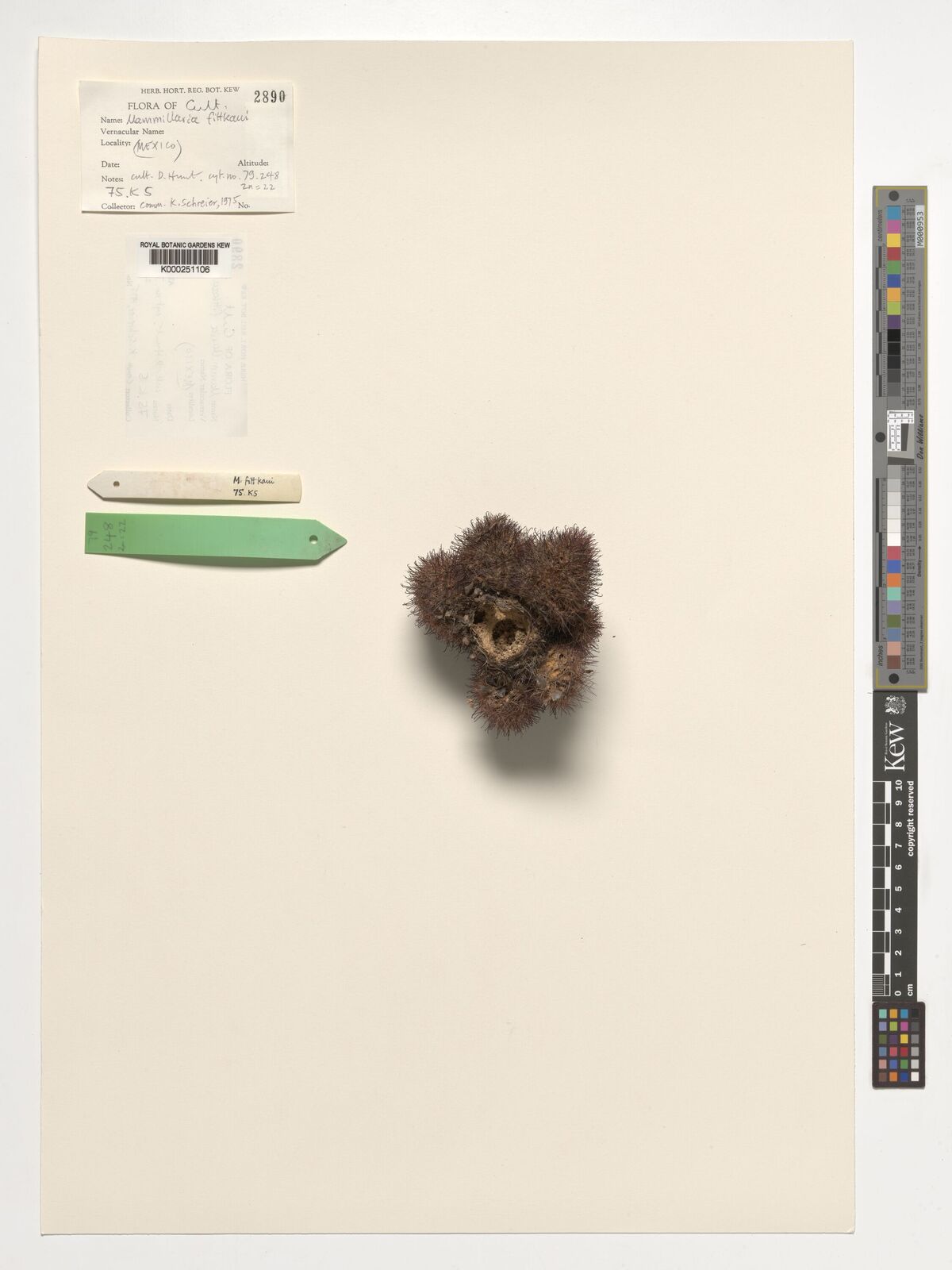 Reference image
Fittkau's Nipple Cactus
Mammillaria fittkaui is a delicate, clustering succulent subshrub belonging to the Cactaceae family. Native to Mexico, this miniature cactus is highly prized by collectors for its beautiful spination and attractive flowering habits.
The species was named in honor of Hans W. Fittkau, a notable cactus collector and researcher 1. The genus name Mammillaria derives from the Latin word for nipple, referring to the characteristic tubercle structures on the stem. It was formally described by Charles Edward Glass and Robert Alan Foster.
This species is native to central Mexico, with stable populations found in the states of Jalisco, Guanajuato, Michoacán, and San Luis Potosí 2. It typically thrives in dry shrublands, volcanic rock crevices, and semi-arid desert biomes at moderate elevations.
The stems are globose to cylindrical, bright green, and densely covered in woolly areoles. Each areole bears numerous fine, white radial spines and a few stronger, brownish central spines, which are often hooked. It produces small, bell-shaped, pinkish-white flowers in a ring near the growing tip during spring.
Mammillaria fittkaui is relatively easy to cultivate. It requires bright, indirect sunlight and a highly porous, mineral-rich substrate. Watering should be sparse, adhering to the 'soak and dry' method, and completely suspended during the cold winter dormancy.
The most frequent issue is root rot caused by overwatering or compacted soil. Additionally, insufficient light causes etiolation, where the cactus loses its compact shape and stretches weakly toward the light source.
Bright indirect light or filtered sun; shield from scorching afternoon sun.
Allow soil to dry out 100% before watering; keep dry in winter.
Excellent drainage is essential; use a mix high in pumice and grit.
Non-toxic, but features sharp hooked spines that can snag skin and fur.
Easy; perfect for beginners who can resist the urge to overwater.
Native to the central regions of Mexico, occurring on volcanic rocky outcrops and within arid shrublands in states like Jalisco and Guanajuato.
