
Light
Bright Indirect Light
Bright indirect light or filtered sun; avoid harsh, scorching afternoon summer sun.
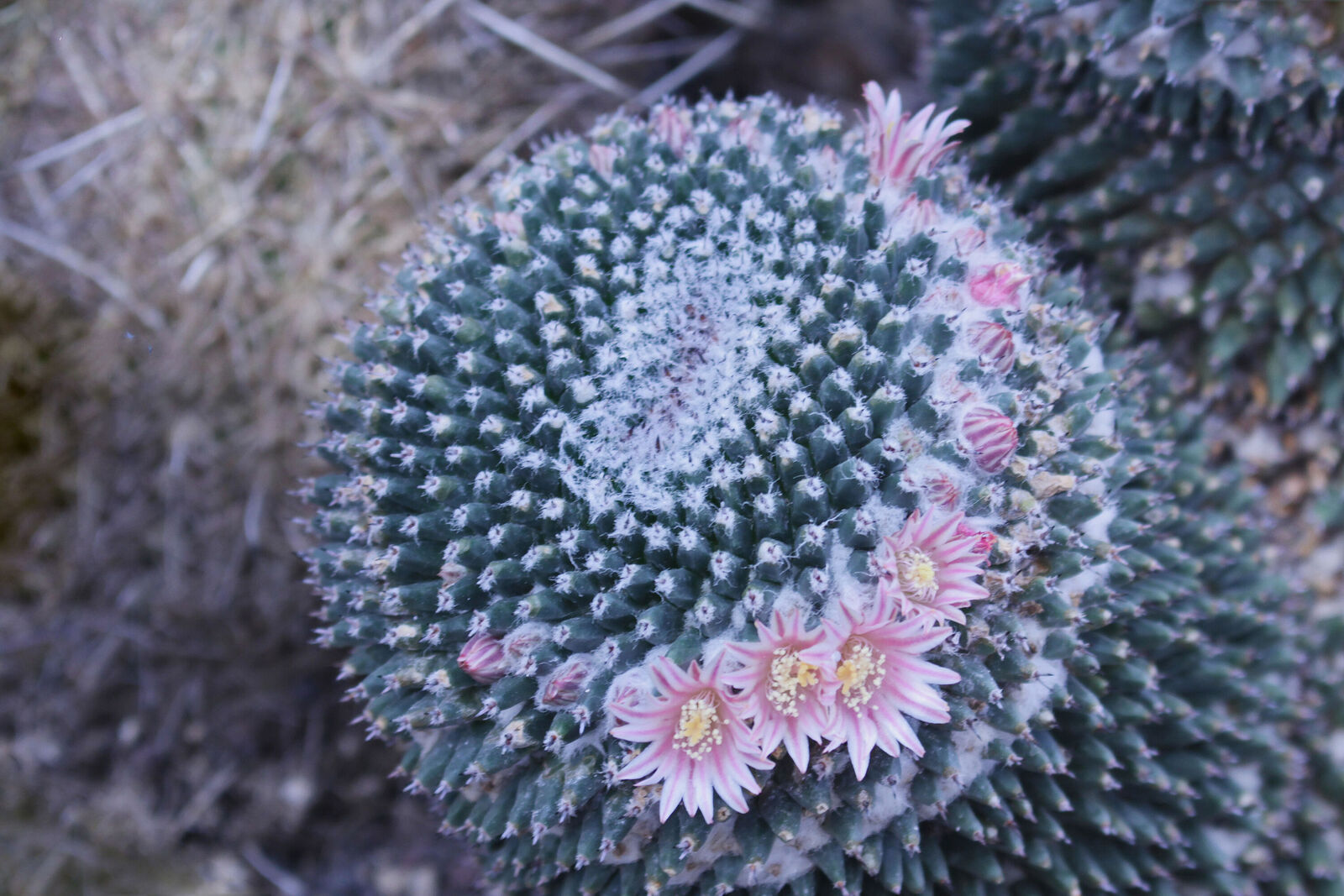 Reference image
Glass's Pincushion Cactus
Mammillaria glassii is a charming, clustering succulent subshrub beloved by collectors for its soft, snow-white appearance and delicate pink flowers. The dense, hair-like spines cover its globular bodies, creating a cushion-like effect 1.
Belonging to the Cactaceae family, the genus Mammillaria is one of the largest in the family. The specific epithet honors Charles Edward Glass, an eminent American botanist who dedicated much of his life to studying Mexican cacti 2.
Native to northeastern Mexico, specifically within the states of Nuevo León, Coahuila, and San Luis Potosí. It thrives in crevices of limestone rocks and on dry slopes in oak-pine forests at elevations between 1,400 and 2,250 meters 1.
The stems are globose to short cylindrical, reaching 3-10 cm in height, freely offsetting from the base to form dense mounds. The areoles bear 50-60 fine, white, silky radial spines. In spring, it produces small, funnel-shaped, pale pink blossoms 2.
It prefers bright, filtered sunlight and excellent air circulation. The potting medium must be highly porous. Water thoroughly during the growing season only when the soil is completely dry, and suspend watering in winter 1.
Overwatering is the primary cause of failure, quickly leading to root and stem rot. Using heavy, peat-rich soils that retain moisture or keeping the plant in poorly ventilated, dark areas will rapidly deteriorate its health.
Bright indirect light or filtered sun; avoid harsh, scorching afternoon summer sun.
Water only when the substrate is completely dry. Keep dry in winter.
Mineral-rich, free-draining cactus mix containing high amounts of pumice and grit.
Spines are fine and soft but can still irritate; non-toxic and safe for homes with pets.
Very easy to grow as long as strict dry-wet cycles and excellent drainage are provided.
Native to the mountainous regions of Coahuila, Nuevo León, Tamaulipas, and San Luis Potosí. It grows primarily on high-altitude limestone rock faces and within the dry understory of pine-oak woodland ecosystems.
