
Light
Filtered Sun
Enjoys bright, filtered sunlight or direct morning sun.
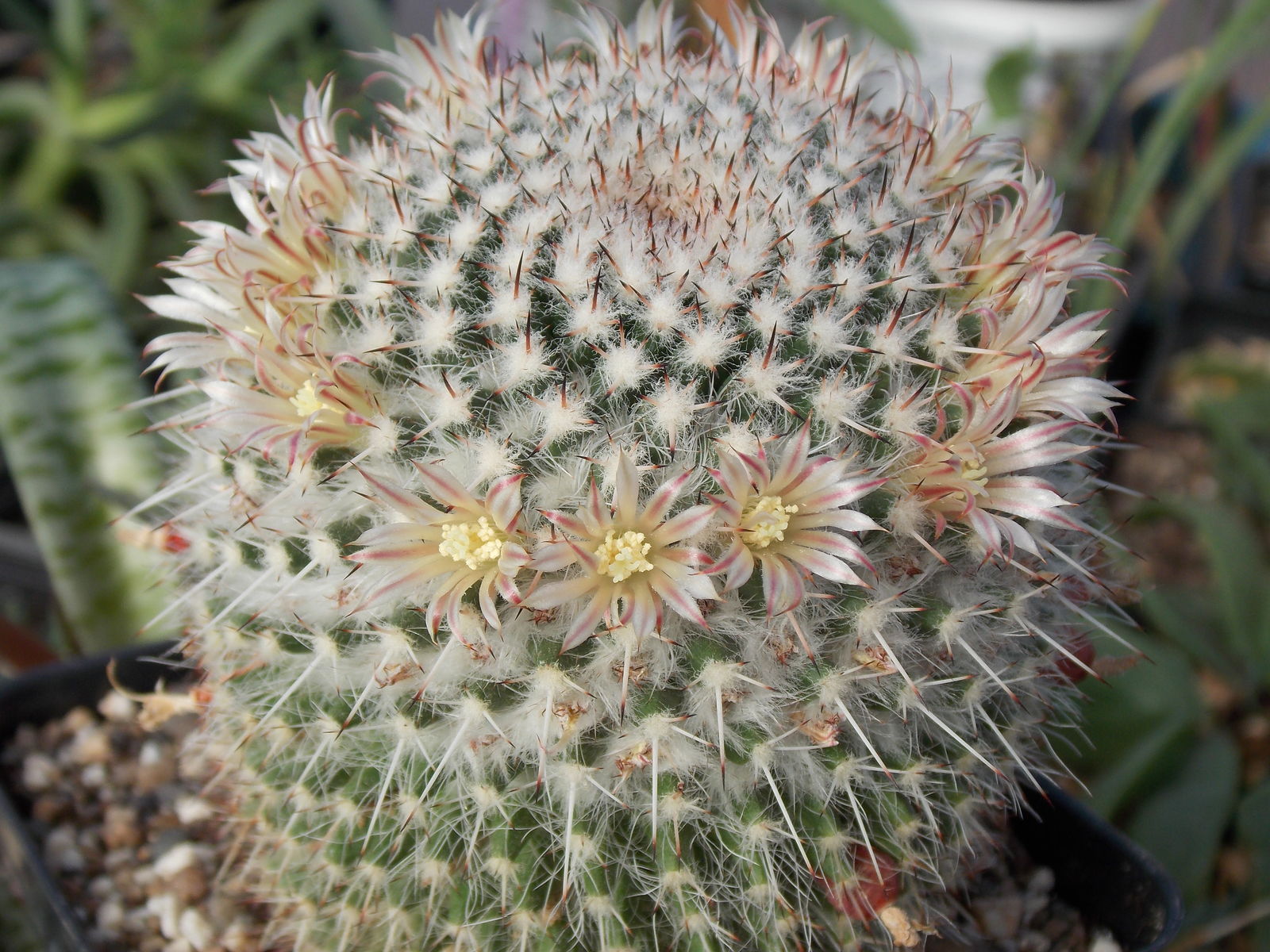 Reference image
Karwinsky's Pincushion Cactus
Mammillaria karwinskiana is a perennial succulent cactus belonging to the family Cactaceae, characterized by its globose to cylindrical growth habit. It is highly valued by collectors for its symmetrical spine arrangement and rings of diurnal flowers 1.
The species was first described in 1832 by the German botanist Joseph Gerhard Zuccarini. The specific epithet, karwinskiana, honors the Bavarian plant collector Wilhelm Friedrich von Karwinsky. It is commonly known as Karwinsky's pincushion or the Royal Cob Cactus 2.
Endemic to southern and western Mexico, its range spans states like Guerrero, Oaxaca, Colima, Michoacán, and Puebla. It thrives as a lithophyte or succulent subshrub in seasonally dry tropical biomes, often found on steep rocky slopes and limestone crevices 1.
The stem is dark green to blue-green, with woolly white axils near the crown. The spines are rigid, with dark tips, and can be straight or slightly curved. During spring and summer, it produces creamy yellow or pink-striped flowers arranged in a ring, followed by bright red, edible fruits 2.
It requires abundant filtered sunlight. Water thoroughly in summer only after the substrate has dried out completely. In winter, watering should be suspended entirely to prevent root rot. It thrives in mineral-rich, sandy, and sharply draining cactus soil mixes.
Overwatering is the most common pitfall. Prolonged moisture leads to root rot and fungal infections. Watering during cold winter dormancy can easily prove fatal 1.
Enjoys bright, filtered sunlight or direct morning sun.
Allow soil to dry out completely between waterings; keep dry in winter.
Requires sharply draining soil rich in pumice and coarse sand.
Non-toxic, but features sharp spines that require careful handling.
Very easy and resilient, perfect for beginners.
Native to the southern and western regions of Mexico, predominantly in Oaxaca, Guerrero, and Michoacán, where it grows on rocky slopes and limestone soils in dry tropical forests.
