
Light
Full Sun
Requires full sun to filtered bright light; insufficient light leads to pale, stretched stems.
 Reference image
Magnificent Nipple Cactus
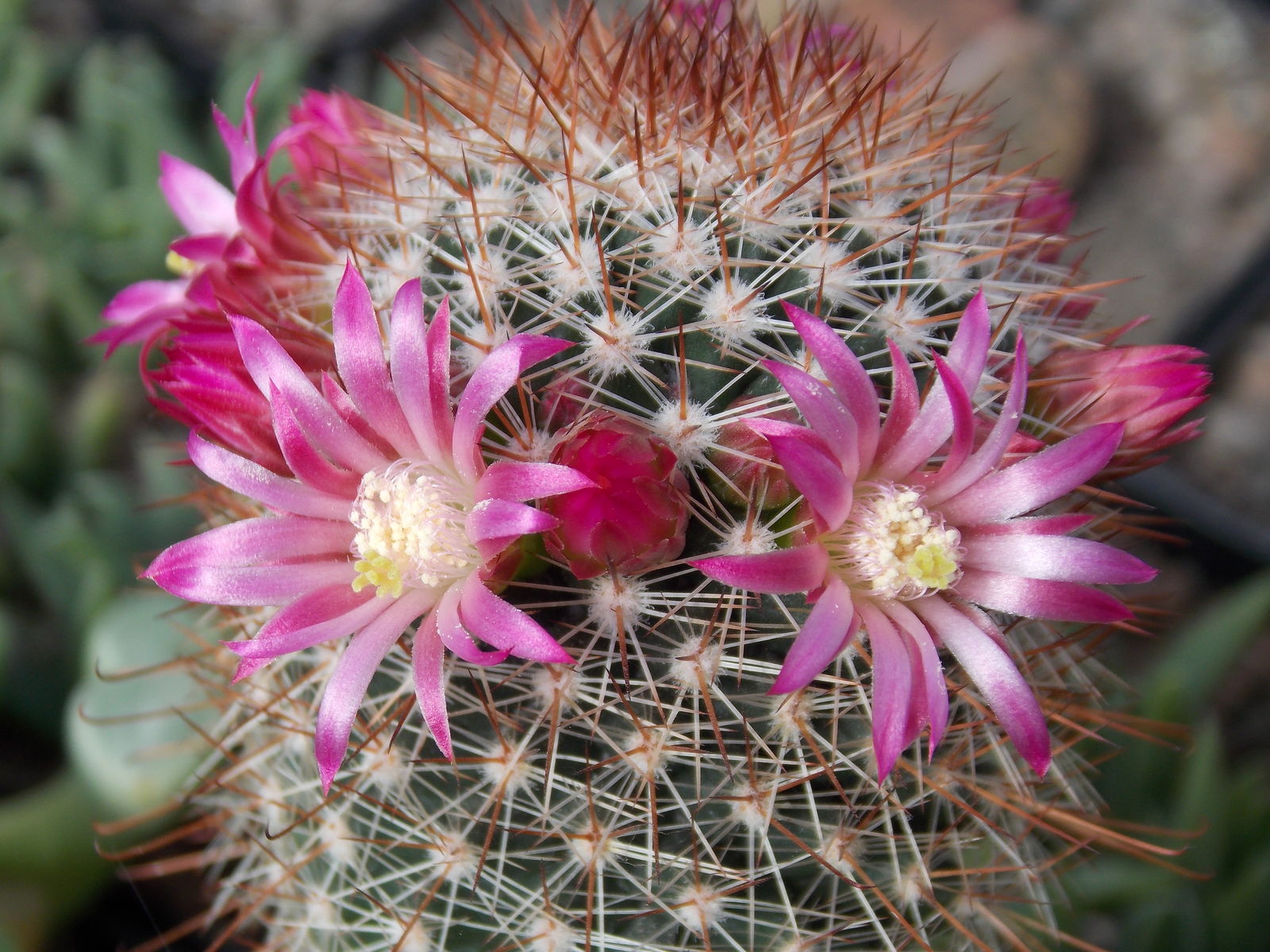
Mammillaria magnifica is one of the most striking columnar species within the Cactaceae family. Known for its dense, golden-brown spination and showy rings of purplish-red flowers, this succulent subshrub forms impressive clustering colonies over time, making it highly prized by cactus collectors globally.
Belonging to the diverse genus Mammillaria, this species is characterized by its distinct cylindrical growth and prominent tubercles. The specific epithet magnifica is Latin for "magnificent" or "splendid", highlighting the grand appearance of mature clustered specimens 1.
This species is native to central Mexico, particularly occurring in the states of Puebla, Morelos, Guerrero, and Mexico State. It thrives on steep volcanic cliffs, rocky outcrops, and dry shrublands, often growing in crevices where water drains away instantly 2.
Mammillaria magnifica develops cylindrical stems that can grow up to 40 cm tall and around 7-9 cm in diameter, branching freely from the base. The woolly aeroles support numerous radial spines and strong, hooked central spines ranging from yellow to reddish-brown. In late spring, it produces a beautiful ring of small, bell-shaped magenta blossoms near the crown.
In cultivation, it requires full sun to maintain its compact shape and dense spination. The soil must be highly porous and mineral-rich. Watering should follow the 'soak and dry' method during the active growing season and should be completely suspended during the cold winter months to prevent rot.
Excessive watering and heavy, organic-rich soils are the main causes of root rot. Additionally, placing the plant in low-light conditions leads to etiolation, causing the stems to stretch weakly and lose their vibrant spine coloration.
Requires full sun to filtered bright light; insufficient light leads to pale, stretched stems.
Allow the soil to dry out completely between waterings, and keep completely dry in winter.
Requires a gritty, highly porous mineral substrate with excellent drainage.
Features sharp, hooked spines that can easily snag skin and clothing; handle with tongs or thick gloves.
Very easy for beginners provided they avoid overwatering and supply enough sunlight.
Found in the semi-arid central regions of Mexico, typically adhering to volcanic rocks and steep cliffs in Puebla and Morelos.
