
Light
Direct Sun
Requires full, direct sun to maintain its compact shape and prevent stretching.
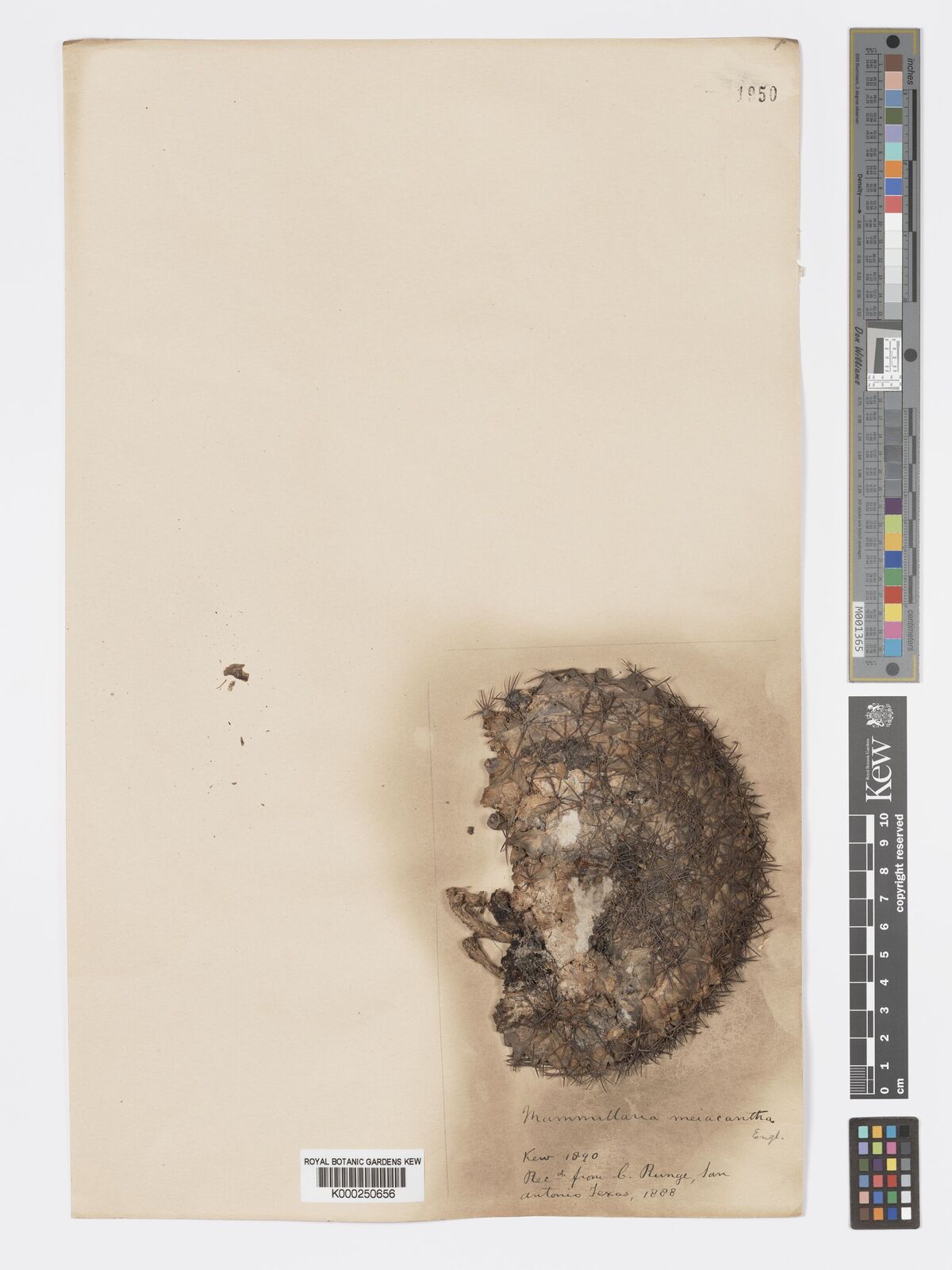 Reference image
Little Nipple Cactus
Mammillaria meiacantha, commonly known as the little nipple cactus, is a highly drought-tolerant, low-growing succulent species belonging to the family Cactaceae. It is well-known for its solitary, flattened globose habit, often retracting into the soil during dry periods.
The species was formally described by the botanist George Engelmann. The specific epithet "meiacantha" derives from Greek roots meaning "fewer or smaller spines," referencing the relatively short and sparse spines on its prominent, angled tubercles 1.
This cactus is native to the southwestern United States (predominantly Texas and New Mexico) and northern Mexico (including Chihuahua, Coahuila, Nuevo León, and San Luis Potosí). It thrives at elevations between 1000 and 2300 meters, typically growing on rocky limestone hills, grasslands, and desert shrublands 2.
The body is single, depressed-globose, reaching up to 15 cm in diameter. The dark green tubercles are conspicuously four-sided at the base. Axils are woolly, especially when young. It bears 5 to 9 radial spines that are reddish-brown fading to gray. The small, bell-shaped flowers are creamy-white to light pink with a brownish-red mid-stripe, followed by elongated, bright red edible fruits.
Mammillaria meiacantha requires an open, mineral-based potting substrate with excellent drainage. It demands bright, direct sunlight to maintain its compact form and heavy spination. Water should be applied sparingly, only after the substrate has dried out completely.
Excessive watering and organic-heavy soils are the primary causes of root rot. Lack of adequate sunlight leads to etiolation (stretching), making the plant weak and susceptible to pests like mealybugs.
Requires full, direct sun to maintain its compact shape and prevent stretching.
Allow soil to dry out fully between waterings; keep completely dry in winter.
Fast-draining, mineral-heavy substrate with plenty of pumice or perlite.
Non-toxic to pets, but has sharp spines that require careful handling.
Very easy; perfect for beginners who tend to underwater their plants.
Naturally distributed across the arid limestone slopes, rocky prairies, and desert grasslands of Texas, New Mexico, and various northern Mexican states.
