
Mammillaria orcuttii

Overview

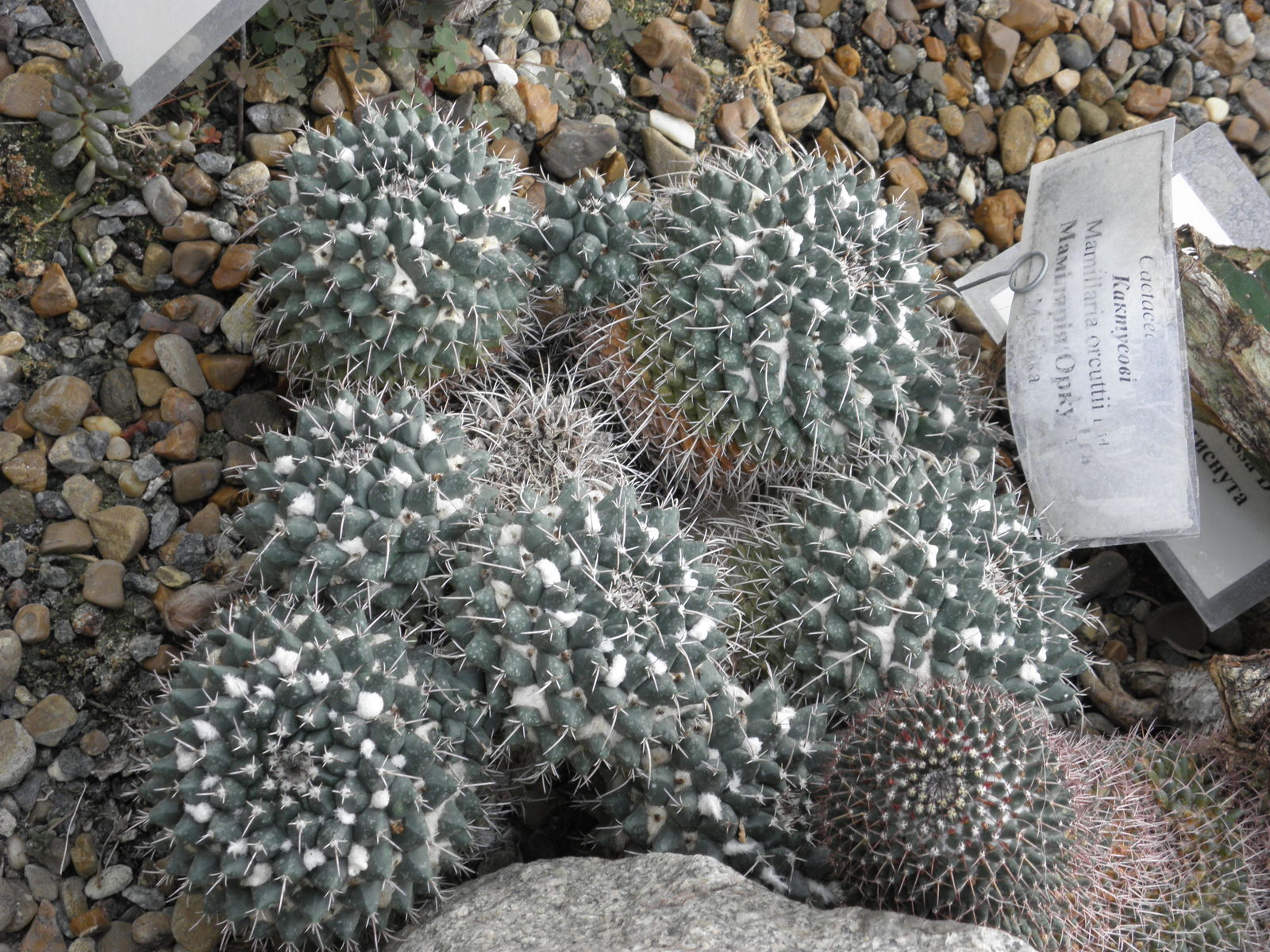
Mammillaria orcuttii is a charming succulent subshrub in the family Cactaceae, native to the arid highlands of Mexico 1. It is highly valued by collectors for its neat growth habit and beautiful flowering display.

Taxonomy and naming

The species was named in honor of Charles Russell Orcutt, a prominent American botanist. Like other members of the genus Mammillaria, it is characterized by having tubercles rather than continuous ribs, with flowers emerging from the axils 2.

Distribution and habitat

This cactus is endemic to Mexico, specifically found in states like San Luis Potosí, Querétaro, Guanajuato, and Zacatecas 1. It thrives in dry shrublands and rocky limestone slopes under harsh, sunny conditions 2.

Appearance

It features globose to short cylindrical stems, often solitary or forming small clumps over time. The apex is densely woolly, and the tubercles carry strong, reddish-brown radial and central spines. During spring, it produces a ring of bright pink to carmine flowers near the crown 1.

Cultivation and care

In cultivation, it requires full sun to maintain its compact form and dense spination. A highly mineral, porous potting medium with excellent drainage is crucial. Water thoroughly only when the soil has dried out completely.

Common cultivation mistakes

Overwatering is the primary cause of failure, leading to rapid root rot and stem decay 2. Lack of adequate sunlight causes the plant to stretch (etiolate), losing its beautiful spherical form and weakening its natural defense.

References

  1. Plants of the World Online (POWO), Royal Botanic Gardens, Kew.
  2. Anderson, E. F. (2001). The Cactus Family. Timber Press.
Light

Full Sun

Excellent for bright windows with direct sunlight.
Watering

10-30 Days

Water deeply only after the potting medium dries out completely.

Soil

Fast-draining, sandy and pumice-rich cactus mix

Porous, pumice-rich, and fast-draining soil mix is mandatory.

Safety

Contact/Ingestion Risk

Has sharp spines that can cause physical injury; handle with care.

Difficulty

Easy

Very easy to care for as long as you avoid overwatering.

Native Habitat

Mexico

Native to the rocky, limestone slopes of semi-arid regions across central and northern Mexico, including San Luis Potosí, Querétaro, and Guanajuato.

Frequently Asked Questions

How often should I water Mammillaria orcuttii?
In summer, water deeply once the soil is completely dry (approx. every 10 days). In winter, suspend watering almost entirely (once a month or not at all).
Is this cactus toxic to pets?
It is not chemically toxic; however, its sharp, stiff spines can cause physical injury to your pets' paws or mouths.
Does it need direct sunlight?
Yes, it requires at least 5-6 hours of direct sunlight daily. Insufficient light causes stretching (etiolation) and weak spine growth.
What type of pot and soil should be preferred?
Use terracotta pots with plenty of drainage holes and a mineral-heavy cactus soil mix containing over 50% pumice or perlite.
When does Mammillaria orcuttii bloom?
It typically blooms in late spring and early summer, producing a ring of pink to red flowers near the crown.
Is it cold hardy in winter?
It can tolerate brief drops down to -5°C (23°F) if kept completely dry, but keeping it above 5°C (41°F) indoors is recommended.
Why is the base of my cactus getting soft?
Softening at the base is usually a sign of root rot from overwatering. Stop watering immediately and check if the roots can be saved.
What is its growth rate?
It is a slow-growing cactus. It may take several years to reach its mature size and start clumping.
When should I repot it?
Due to its slow growth, repot only every 2-3 years in early spring, when the current pot becomes completely root-bound.
Should I fertilize my cactus in winter?
No, the plant is dormant in winter. Apply a half-strength cactus fertilizer only during the active growing season in spring and summer.