
Light
Bright Indirect Light
Requires at least 4-6 hours of bright, filtered or indirect sunlight daily.
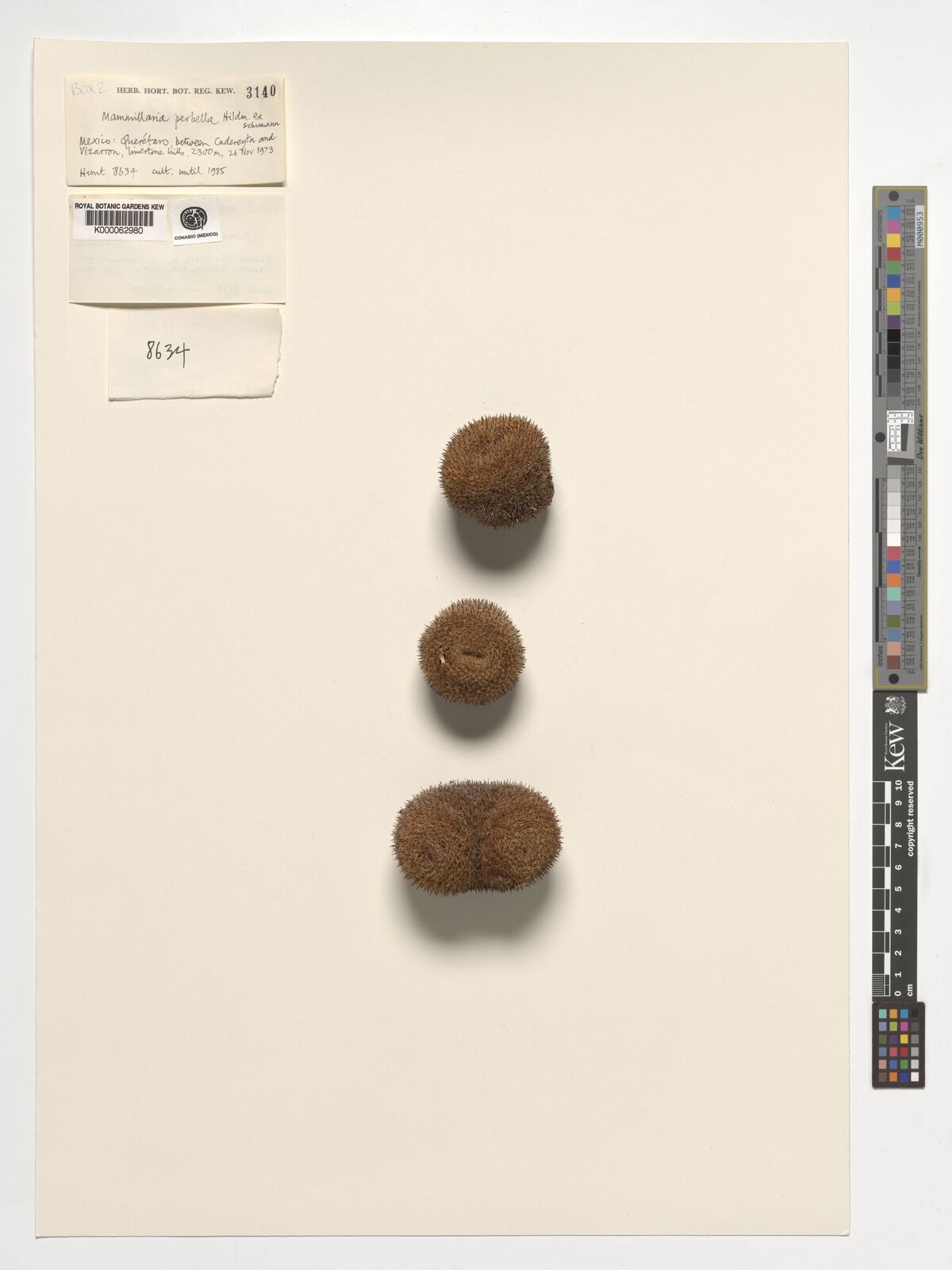 Reference image
Beautiful Nipple Cactus
Mammillaria perbella is a highly prized cactus species in the Cactaceae family, known for its small, exceptionally symmetrical, and spherical growth form. Its dense covering of white spines gives it a frosty, elegant appearance 1.
The species name "perbella" is derived from Latin, meaning "very beautiful," highlighting its neat and attractive spine arrangement 2. As a member of the diverse Mammillaria genus, it features the characteristic nipple-like tubercles along its stem rather than continuous ribs.
This species is endemic to the arid regions of central Mexico, particularly found in states like Querétaro, Guanajuato, and Hidalgo 1. It thrives on limestone hills, rocky outcrops, and dry shrublands at moderate to high elevations.
The stem is initially globose, solitary, and green, often dividing dichotomously (splitting into two heads) as it matures, eventually forming tight clumps. Tubercles are small and conical, bearing numerous fine, white radial spines and short, dark-tipped central spines. In late spring, it produces a beautiful ring of small, deep pink to magenta flowers near the crown 2.
Mammillaria perbella requires bright, filtered sunlight to retain its compact shape and dense spination. It prefers a mineral-heavy, well-draining soil mix and should only be watered when the substrate is completely dry. During the winter, it must be kept dry and cool to encourage spring blooms.
Overwatering and poorly draining soil are the leading causes of root and stem rot. Lack of light results in etiolation, causing the spherical stem to stretch and weaken.
Requires at least 4-6 hours of bright, filtered or indirect sunlight daily.
Water only when the soil is 100% dry; suspend watering in winter.
Use a mineral-rich, gritty cactus mix with excellent drainage.
Non-toxic to pets, but has sharp spines that require careful handling.
Very easy to care for, ideal for succulent beginners.
Native to the high-elevation rocky hillsides and semi-desert limestone slopes of central Mexico, primarily in Guanajuato, Hidalgo, and Querétaro.
