
Light
Full Sun
Requires full sun or intense direct sunlight. Low light leads to weak, stretched growth.
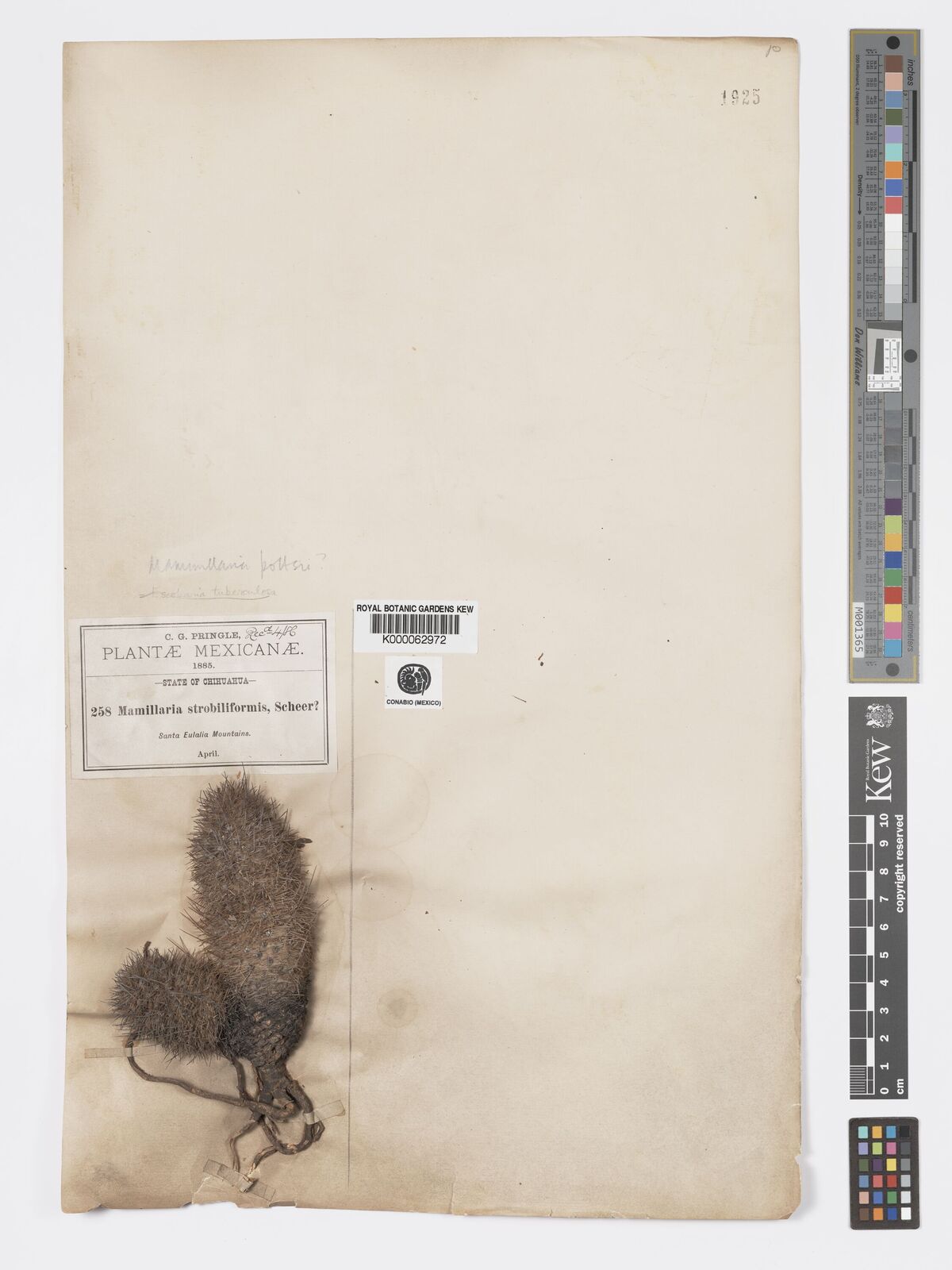 Reference image
Potts' Nipple Cactus
Mammillaria pottsii is a distinctive, heavily spined, cylindrical cactus belonging to the Cactaceae family. This succulent subshrub is highly adapted to arid desert conditions and is appreciated by collectors for its upright growth and reddish-purple flowers 1.
Named after John Potts, a mining manager and plant collector, this species belongs to the diverse genus Mammillaria. It is characterized by its cylindrical stems and dark, prominent central spines. Synonyms include Leptocladodia pottsii 2.
The species is native to the southwestern United States (Texas) and northern to central Mexico (including Chihuahua, Coahuila, Durango, and Zacatecas) 1. It typically thrives on limestone hills, rocky slopes, and desert scrublands at elevations of 800 to 2,100 meters.
Mammillaria pottsii forms clumps branching from the base, with individual cylindrical stems reaching up to 15-20 cm in height. The stems are densely covered in whitish or greyish radial spines, from which stouter, darker, upward-pointing central spines emerge. In spring, it produces small, funnel-shaped, deep red to purplish flowers arranged in a ring near the stem tips 2.
Cultivation requires full sun exposure and an extremely well-drained, mineral-heavy substrate. Overwatering is the primary cause of failure. If kept completely dry during the winter, the plant can tolerate brief periods of sub-zero temperatures.
The most frequent mistakes include placing the plant in low-light indoor environments, which leads to etiolation (stretching), and using organic soils that retain moisture, causing root rot.
Requires full sun or intense direct sunlight. Low light leads to weak, stretched growth.
Water thoroughly only when the soil is bone dry. Keep completely dry in winter.
Thrives in a highly porous, mineral-based substrate with pumice, grit, and limestone.
Non-toxic, but the sharp, dense spines pose a physical hazard to children and pets.
Easy to care for, provided it is not overwatered and receives sufficient sunlight.
It is naturally distributed across the limestone hills and desert flats of the Chihuahuan Desert, spanning northern Mexico and the southwestern regions of Texas.
