
Light
Filtered Sun
Requires at least 4-6 hours of bright indirect or filtered direct sunlight daily.
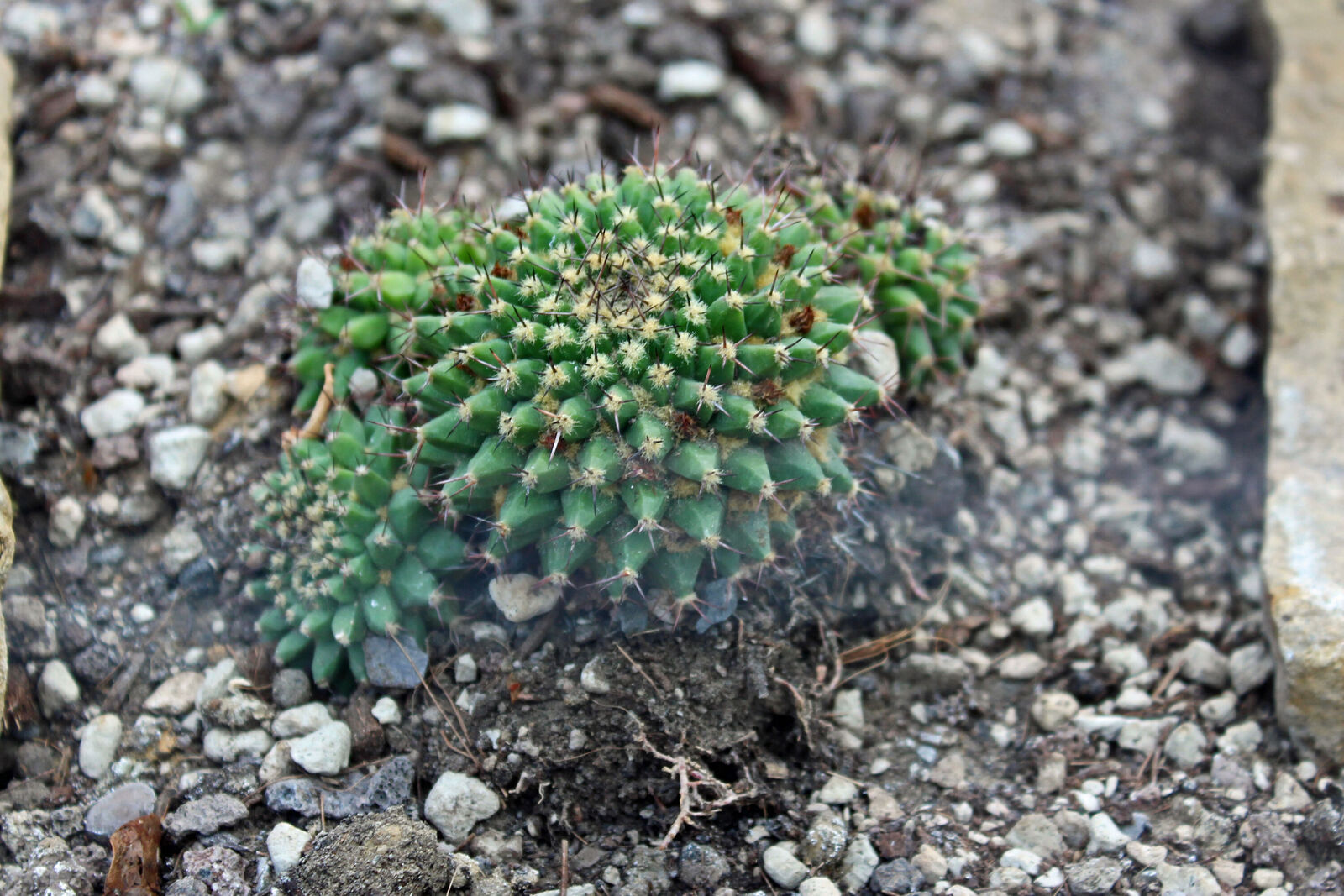 Reference image
Sartor's Nipple Cactus
Mammillaria sartorii is a clustering, perennial succulent subshrub in the family Cactaceae, native to the seasonally dry tropical environments of Mexico 1. It is well-loved for its charming pinkish-red flowers and dense, woolly areoles.
First described in 1911 by Joseph Anton Purpus, the species belongs to Mammillaria, one of the largest genera in the cactus family 2. The specific epithet honors Carl Sartorius, a prominent collector of Mexican plants.
Endemic to Veracruz, Mexico, Mammillaria sartorii thrives on steep limestone cliffs and outcrops within seasonally dry tropical forests 1. It establishes itself in rocky crevices that offer partial shade from the intense midday sun.
The stems are globose to short-cylindrical, branching from the base over time to form attractive, compact cushions. The dark green epidermis is covered in prominent tubercles, bearing short yellowish-brown spines and highly pronounced white wool in the axils. Small, bright pink to carmine flowers bloom in a neat ring near the apex during spring.
This species is exceptionally easy to grow indoors. It requires bright, filtered sunlight or high indirect light 2. Water thoroughly during the active growing season only when the potting medium has dried out completely, and keep it virtually dry throughout winter. A highly porous, mineral-rich substrate is vital to prevent root rot.
Overwatering, especially during the cold winter dormancy, is the primary cause of plant death. Insufficient light leads to etiolation, where the spherical stems stretch weakly toward the light source, losing their natural form.
Requires at least 4-6 hours of bright indirect or filtered direct sunlight daily.
Water only when the substrate is 100% dry; avoid overwatering at all costs.
Use a porous cactus mix high in pumice, perlite, and coarse sand.
Spines may cause mild mechanical irritation; non-toxic and pet-safe.
Highly durable and forgiving, making it perfect for beginner collectors.
Endemic to the state of Veracruz in Mexico, this species grows wild on limestone cliffs and rocky crevices in seasonally dry tropical forests.
