
Light
Bright Indirect Light
Requires bright, indirect light or filtered sun; shield from intense, scorching midday summer sun.
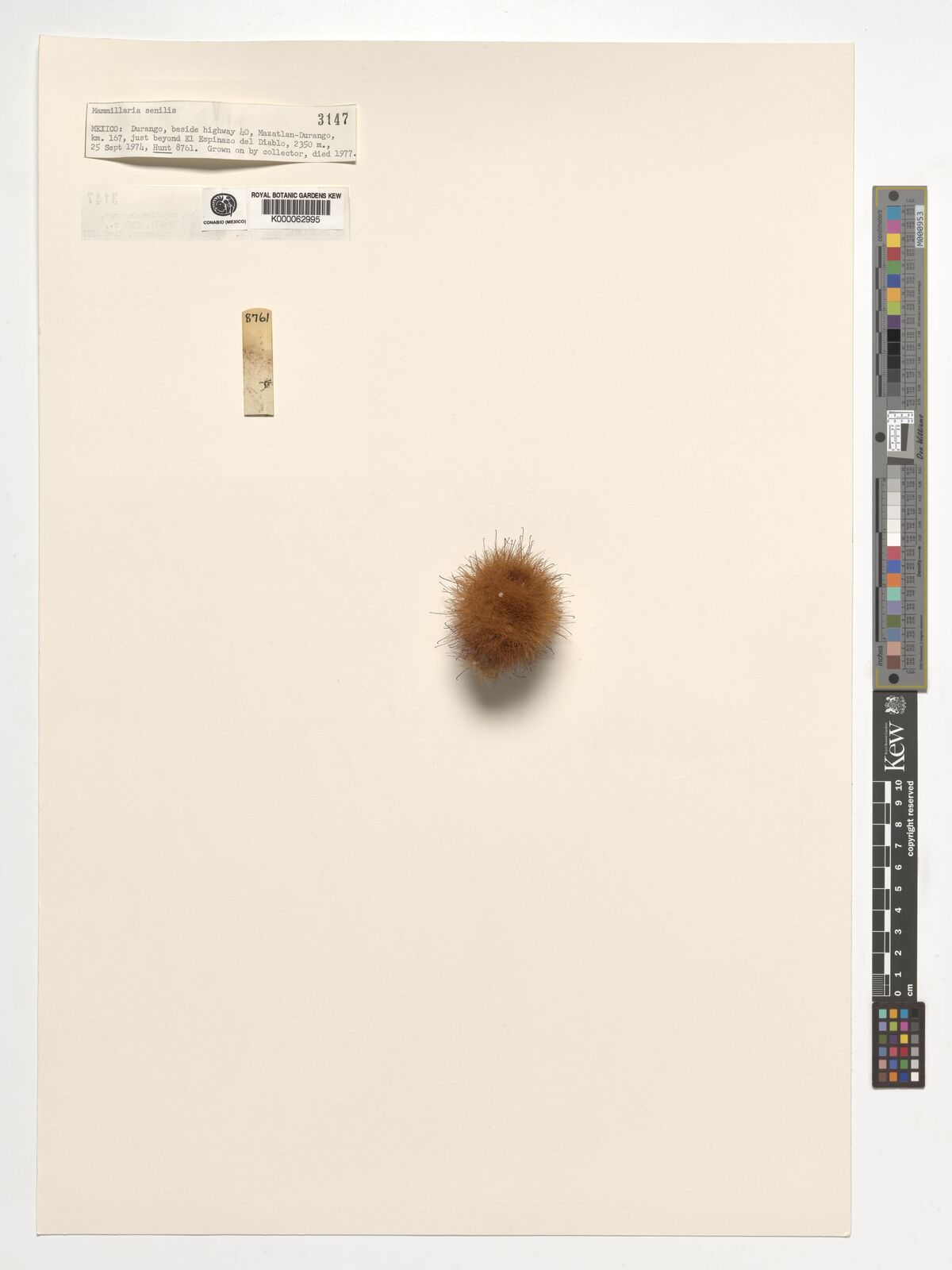 Reference image
Old Man Mammillaria
Mammillaria senilis is a highly sought-after cactus species in the family Cactaceae, renowned for its spectacular covering of white spines and large, brilliant scarlet flowers 1. Its dense, hair-like white spination gives it a striking woolly appearance.
First described by Prince Salm-Dyck in 1850, the specific epithet 'senilis' derives from the Latin word for 'elderly' or 'old man', referencing its dense white spines 2. It has also been classified under the genus Cochemiea by modern taxonomists (Cochemiea senilis).
This species is endemic to the high-altitude mountainous regions of northern and western Mexico, including Chihuahua, Durango, Jalisco, and Sinaloa 1. It thrives at elevations between 2,200 and 2,800 meters, typically growing in pine-oak forests nestled within volcanic rock crevices and steep cliffs.
The plant body is globose to short-cylindrical, reaching up to 15 cm in height and 10 cm in diameter. The stem is tightly packed with spirals of tubercles. Areoles bear 30-40 white, radiating radial spines and 4-6 hooked central spines. In spring and early summer, it produces exceptionally large, funnel-shaped orange-red to bright red flowers that can measure up to 7 cm across 2.
Mammillaria senilis is cold-hardy due to its alpine origin, tolerating temperatures down to -7°C if kept bone dry. It requires a strictly mineral-based, porous substrate to ensure rapid drainage. Water moderately during the warm growing season and withhold water entirely throughout the winter cold.
The most common issue is root rot due to overwatering, especially in compost-rich soils. Inadequate light results in etiolation (stretching of the stem) and sparse spine development.
Requires bright, indirect light or filtered sun; shield from intense, scorching midday summer sun.
Water only when the substrate has dried out completely in spring/summer, and keep entirely dry in winter.
Prefers a highly porous, purely mineral potting mix rich in pumice, gravel, and sand to ensure drainage.
Equipped with numerous sharp, hooked spines that can easily snag skin or clothing; keep away from children and pets.
Moderate care difficulty due to its high-elevation origin; sensitive to high humidity and poor soil drainage.
Native to the high-elevation zones of northern and western Mexico, particularly in states like Chihuahua, Durango, Jalisco, and Sinaloa. It is found in pine-oak forests at altitudes of 2,200 to 2,800 meters, growing primarily in steep volcanic rock crevices.
