
Light
Full Sun
Requires full sun or bright indirect light. Intense light promotes robust spine development and blooms.
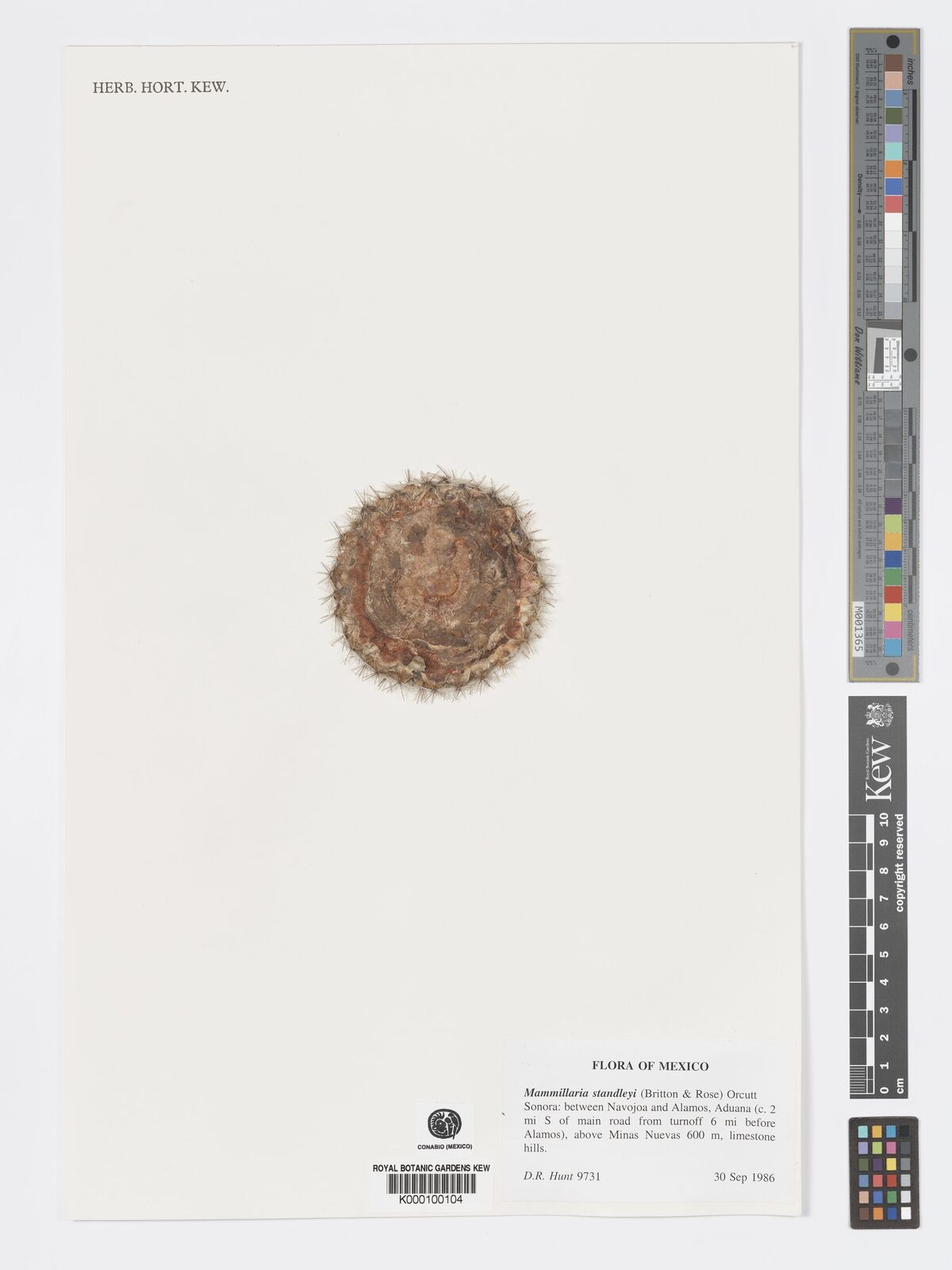 Reference image
Standley's Nipple Cactus
Mammillaria standleyi is a slow-growing, perennial succulent subshrub in the Cactaceae family. Characterized by its robust spine arrangement and woolly axils, it usually grows solitary but can clump from the base over many years, making it a highly sought-after specimen for cactus enthusiasts 1.
The species was named in honor of Paul Carpenter Standley, a prominent American botanist known for his work on the flora of Central America and Mexico. Within the genus Mammillaria, it belongs to the subgenus Mammillaria, characterized by its distinctive tubercles rather than ribs 2.
Native to northwestern Mexico (principally Chihuahua, Sonora, and Sinaloa), this species thrives at altitudes of 1000 to 2400 meters above sea level. It is typically found growing on steep rocky cliffs, volcanic outcrops, and dry oak forests, where it experiences long periods of drought 1.
The stem is globose to slightly cylindrical, deep green, and can reach up to 10 cm in diameter. The axils between the tubercles are filled with dense white wool and bristles. It features 12 to 16 radial spines that are whitish-gray with brown tips, and 4 central spines that are stouter and darker. Ring-shaped pinkish-red flowers bloom near the crown in late spring.
This cactus requires full sun exposure and an open, mineral-rich soil mix with excellent drainage. Watering should follow the 'soak and dry' method, allowing the substrate to dry out entirely between waterings. During winter dormancy, keeping the plant cool and completely dry is essential to prevent rot 2.
Overwatering and poor ventilation are the most common causes of failure, quickly leading to root and stem rot. Insufficient light causes the stem to lose its compact shape and stretch abnormally (etiolation).
Requires full sun or bright indirect light. Intense light promotes robust spine development and blooms.
Allow soil to dry out 100% between waterings. Keep nearly dry throughout the winter months.
Highly porous, mineral-rich cactus mix with pumice, perlite, and coarse sand.
Armed with sharp spines; keep away from pets and children. Handle with thick gardening gloves.
Very easy to maintain, provided overwatering is strictly avoided.
Found natively in the northwestern mountain ranges of Mexico, particularly in the states of Sonora, Sinaloa, and Chihuahua, clinging to rocky crevices and mountain slopes.
