
Light
Full Sun
Requires full sun to maintain its compact shape and rich reddish-purple stem coloration.
 Reference image
Woburn Pincushion Cactus
Mammillaria voburnensis is a slow-growing, perennial succulent subshrub or lithophyte belonging to the family Cactaceae. Known for forming large clumping colonies in its wild habitat, this robust cactus is highly valued by collectors for its architectural form and adaptability to arid environments.
The species was first formally described by Scheer in 1845. The specific epithet "voburnensis" honors the historic Woburn Abbey in England, reflecting early botanical collection history 1. It resides within the genus Mammillaria, characterized by its distinct tubercles and nipple-like structures.
Mammillaria voburnensis is native to Southern Mexico (including Chiapas, Oaxaca, and Yucatan), Guatemala, Honduras, and Nicaragua 2. It thrives in seasonally dry tropical biomes, often clinging to rocky cliffs as a lithophyte or growing in shallow, poor soils among low scrublands.
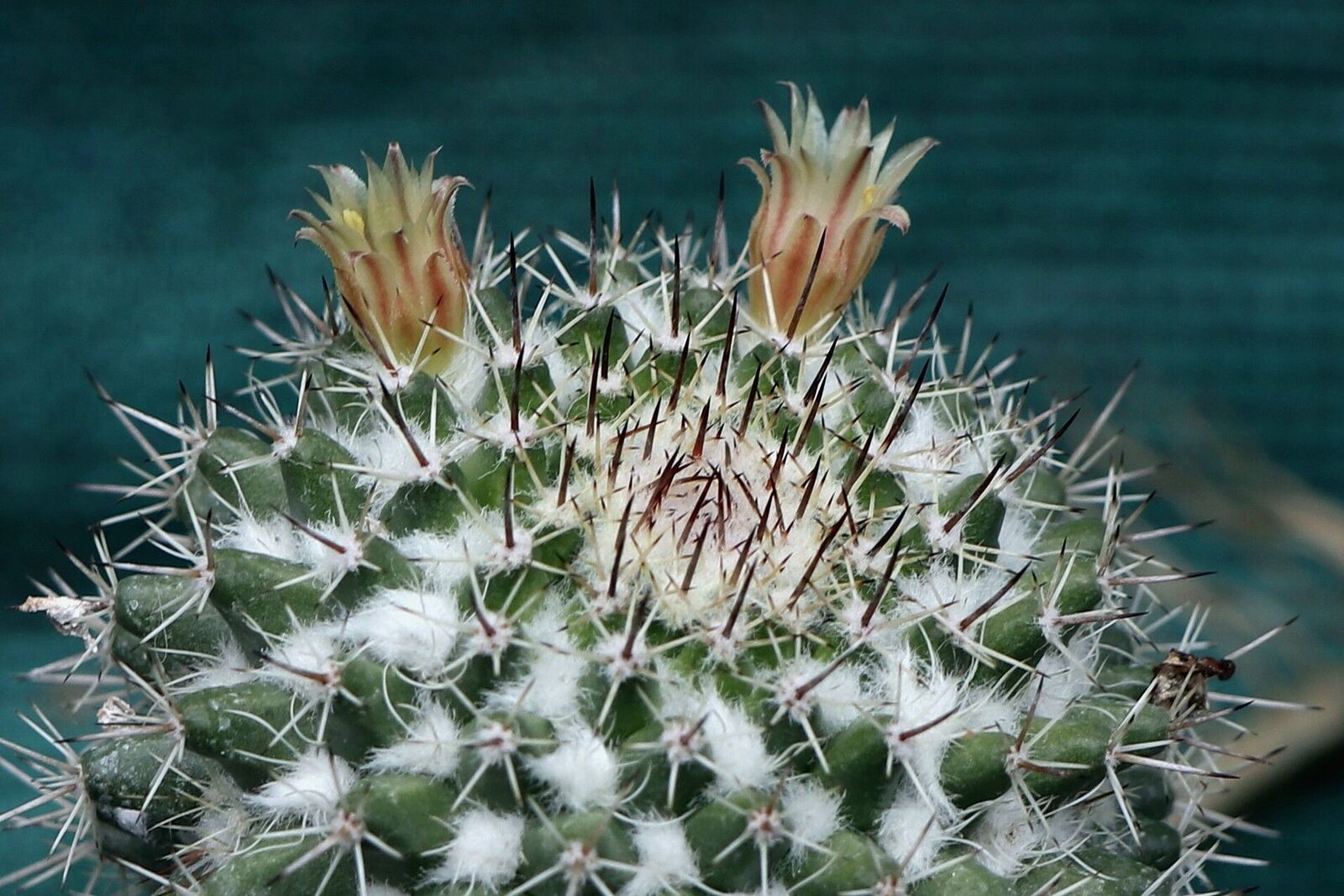
The stems are globose to cylindrical, dark green to reddish-purple, branching heavily from the base to form dense mounds. The tubercles exude a milky sap when damaged. Spines emerge from woolly areoles, displaying variable colors from yellow and brown to deep red. It produces small, funnel-shaped yellow to pale-yellow flowers, followed by small red, club-shaped ornamental fruits.
In cultivation, it requires maximum sunlight and exceptionally porous, mineral-based soil. Water should be applied sparingly, adopting the "soak and dry" method. Winter dormancy requires cool temperatures and almost completely dry soil conditions to prevent rot.
The most frequent cause of failure is overwatering or utilizing dense soil mixes that retain moisture, which quickly leads to root rot. Insufficient light causes etiolation, where the plant stretches abnormally toward the light source, weakening its structural integrity.
Requires full sun to maintain its compact shape and rich reddish-purple stem coloration.
Adopt a strict 'soak and dry' method. Reduce watering to a minimum during cold winter months.
Thrives in a highly porous mineral mix with minimal organic matter, such as pumice and coarse sand.
Features sharp spines. Non-toxic to pets, but physical contact can cause mechanical injury.
Very easy to care for, highly drought-tolerant, and perfect for beginner succulent enthusiasts.
Naturally distributed throughout Southern Mexico and extending south into Guatemala, Honduras, and Nicaragua, where it inhabits rocky outcroppings and seasonally dry tropical forests.
