
Light
Bright Indirect Light
At least 4-6 hours of filtered sun or very bright indirect light daily.
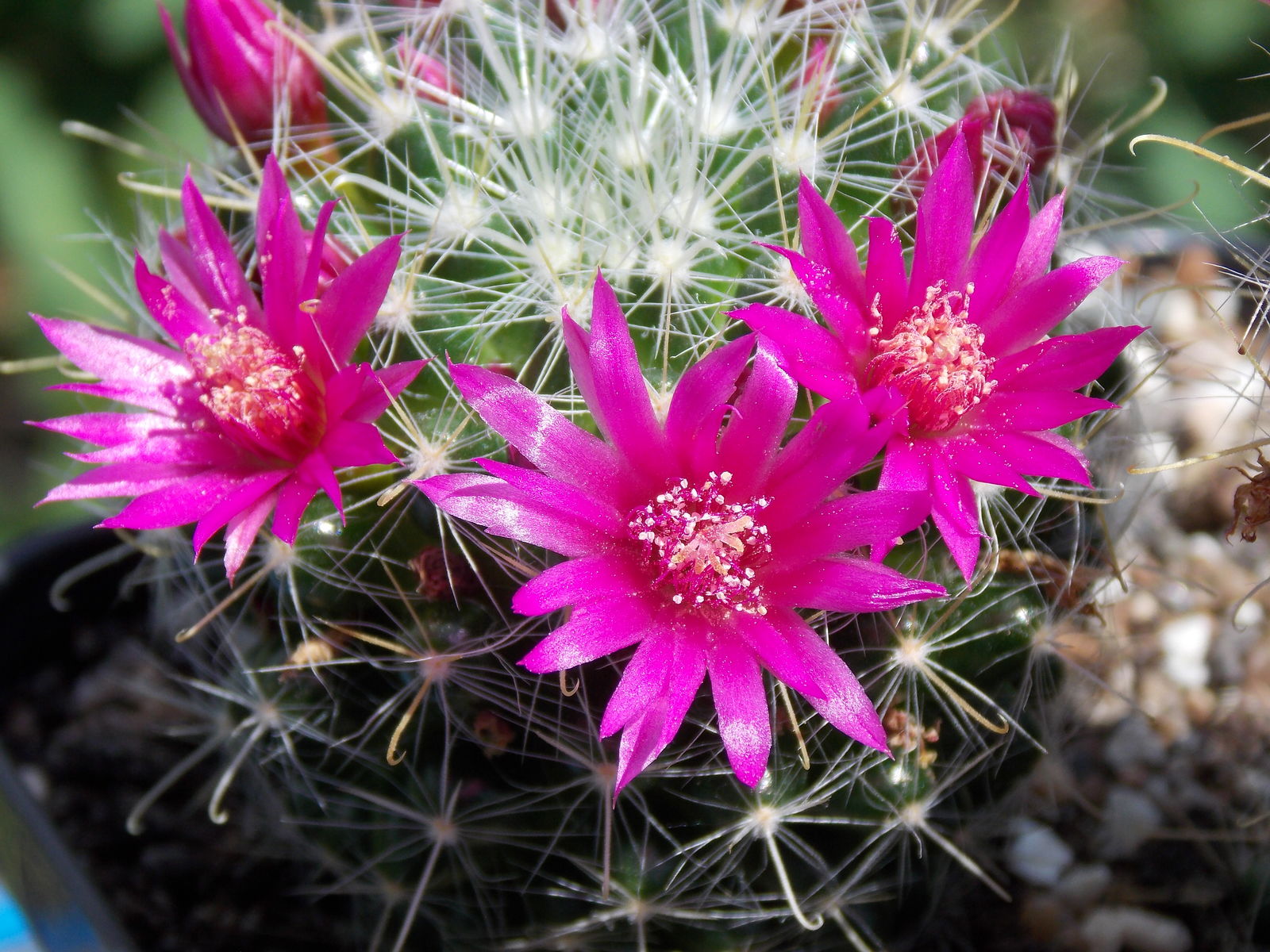 Reference image
Rose Pincushion Cactus
Mammillaria zeilmanniana is one of the most popular and reliable blooming cacti in cultivation. This miniature succulent, known for forming dense, multi-headed clumps, produces striking rings of vibrant pinkish-purple flowers around its crown from spring through late summer 1.
Described in 1931 by the German botanist Alwin Berger, the species belongs to the diverse genus Mammillaria 1. The specific epithet "zeilmanniana" honors Julius Zeilmann, a dedicated German cactus enthusiast. Its common name, Rose Pincushion, refers to its rounded, spiny shape and rose-colored blossoms.
This species is strictly endemic to Guanajuato, Mexico 2. It occurs in a very restricted area, growing on steep volcanic or limestone cliffs and in dry shrublands. Due to agricultural expansion and illegal poaching, wild populations are extremely depleted, placing it on the IUCN Red List as Critically Endangered (CR) 2.
The plant starts as a solitary globose stem, eventually clustering from the base to form cylindrical mounds. Stems are dark green, reaching up to 12 cm in height. Each areole bears 15 to 18 fine, white radial spines and 4 reddish-brown central spines, with at least one of the central spines being sharply hooked. The bell-shaped flowers are around 2 cm in diameter, exhibiting a rich magenta hue.
It thrives in bright, filtered sunlight and requires highly porous, mineral-rich soil with excellent drainage. Watering should follow the 'soak and dry' method, allowing the substrate to dry out completely before the next application. During winter, keeping the plant dry and cool encourages the next season's bloom.
Overwatering, especially during the winter dormancy, is the primary cause of root rot. Lack of adequate light results in etiolation, where the stems stretch and lose their dense spine configuration and flowering capability 1.
At least 4-6 hours of filtered sun or very bright indirect light daily.
Soak thoroughly only when soil is 100% dry; suspend watering in winter.
Coarse, well-draining mineral mix with pumice, grit, and minimal peat.
Non-toxic to pets, but the hooked central spines can easily snag skin and clothes.
Highly recommended for beginners due to its resilience and easy flowering habit.
Endemic to a localized canyon system in Guanajuato, Mexico, where it clings to vertical limestone rock faces and rocky outcrops within dry, semi-arid scrublands.
