
Light
Full Sun
Requires maximum direct sunlight and high light intensity to maintain compact growth.
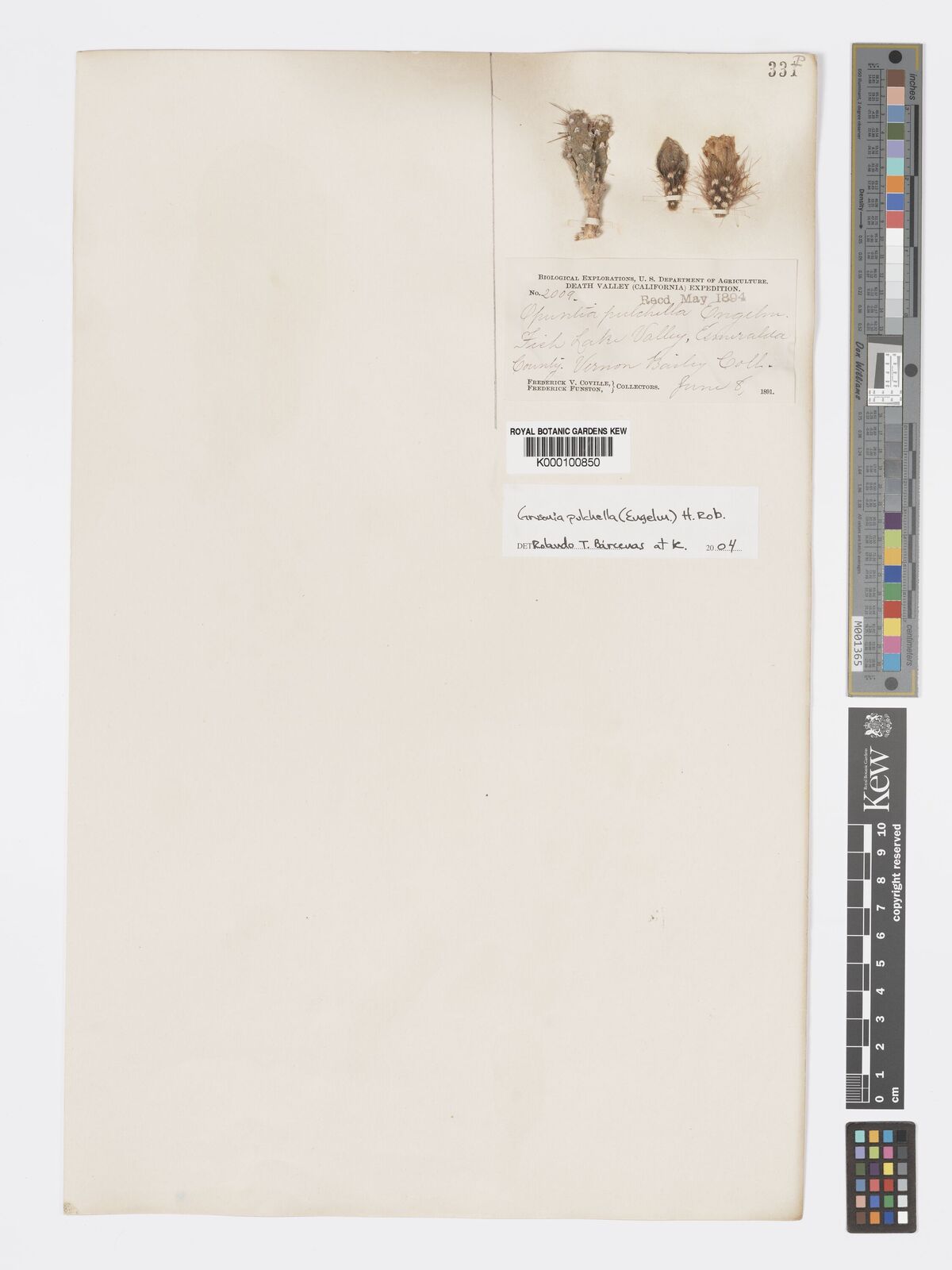 Reference image
Beautiful Pygmy Cholla
Micropuntia pulchella is a miniature, geophytic cactus species belonging to the family Cactaceae, highly specialized to survive the extreme climatic conditions of North American deserts 1. It is highly prized by cactus connoisseurs for its impressive tuberous root system and striking diurnal flowers.
Originally described by George Engelmann in 1863 as Opuntia pulchella, it has been subject to taxonomic reclassifications, placed in Grusonia and ultimately recognized under Micropuntia by modern specialists 2. The specific epithet pulchella translates from Latin as "beautiful" or "little pretty."
This species is native to the southwestern United States, primarily within Nevada, Utah, and eastern California 1. It thrives in sandy desert flats, gravelly slopes, and dry shrublands of the Great Basin Desert, occurring at elevations between 1,000 and 2,000 meters.
Micropuntia pulchella features an extensive, fleshy, turnip-like underground tuberous root. The aerial parts consist of small, cylindrical, jointed segments armed with flattened, paper-like spines. In late spring, it produces large, showy, bright rose-pink to purple flowers that contrast beautifully with its rugged habit 2.
In cultivation, it requires an extremely porous, mineral-dominant substrate. When kept completely dry during winter dormancy, it exhibits remarkable frost tolerance, surviving temperatures well below freezing. Water should be supplied cautiously during the spring and summer active growth phase.
Excessive watering and the use of organic, moisture-retentive potting soils are the most common mistakes, which inevitably lead to the rapid decay of the sensitive tuberous root system.
Requires maximum direct sunlight and high light intensity to maintain compact growth.
Water only during the active growing season when the soil is dry. Keep completely dry in winter.
Requires a highly porous, purely mineral mix containing pumice, gravel, and coarse sand.
Non-toxic, but possesses sharp, irritating spines. Handle with thick gloves or tongs.
Hard/Expert level due to extreme sensitivity to overwatering and specialized soil requirements.
Naturally distributed across the Great Basin Desert in sandy, gravelly flats and slopes, adapted to high altitudes with dramatic daily temperature fluctuations.
