
Light
Full Sun
Requires full, direct sunlight; inadequate light causes thin, weak growth.
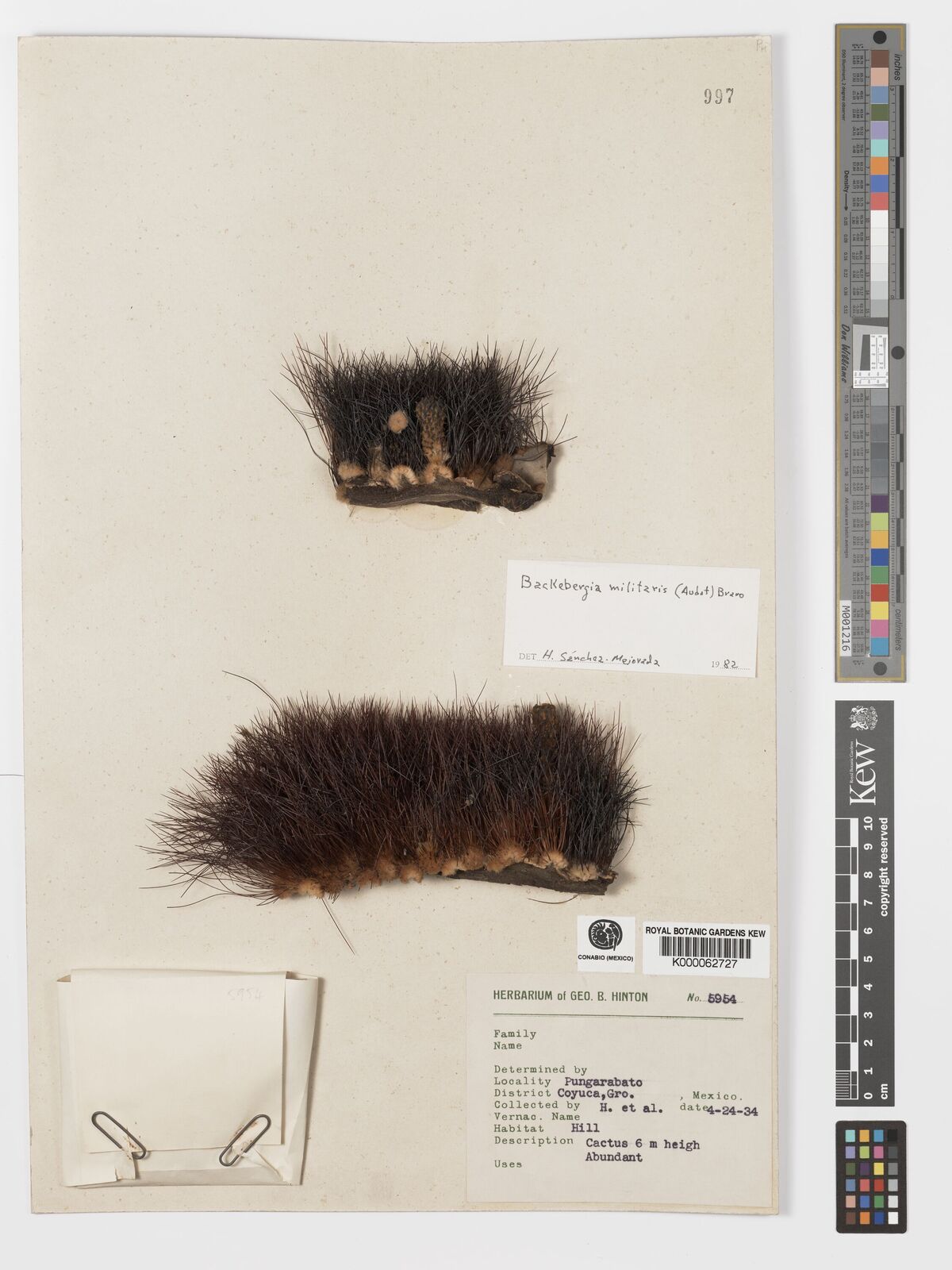 Reference image
Military Cap Cactus
Mitrocereus militaris is an extraordinary, arborescent columnar cactus species native to the seasonally dry tropical forests of Mexico and Honduras. Capable of reaching heights of up to 12-15 meters in its natural habitat, this rare cactus is famous for developing a striking, woolly golden-brown structure called a 'pseudocephalium' at the crown of its mature branches. This unique structure, resembling a military cap, inspired the specific epithet 'militaris' 1.
First described taxonomically by Backeberg, the species is widely known in botanical literature under synonyms such as Pachycereus militaris and Backebergia militaris. According to the latest phylogenetic classifications accepted by Kew (POWO), it is placed in the genus Mitrocereus 2. Common local names include "Chico" and "Capucha de Oro" (Golden Hood).
This species is native to Mexico, spanning the states of Guerrero, Michoacán, Jalisco, Colima, and Oaxaca, as well as parts of Honduras. It thrives in seasonally dry deciduous tropical forests and rocky cliffs at elevations between 100 to 800 meters above sea level 2. Due to habitat loss and clearing for agriculture, it is listed as Vulnerable (VU) on the IUCN Red List.
The plant grows as a massive, woody, branched tree with dull green to greyish-green columnar stems featuring 11 to 14 sharp ribs. The areoles carry clusters of robust, greyish spines. When a stem reaches 3 to 4 meters in height, it stops vegetative growth and develops a dense, golden-orange woolly cephalium at the tip. Funnel-shaped, cream-colored flowers emerge directly from this woolly cap.
In cultivation, Mitrocereus militaris is a slow-growing specimen that requires full sun and exceptionally free-draining mineral soil. Water thoroughly during the hot summer months only after the substrate has dried completely. In winter, maintain a strict dry regime to mimic its native dormant season. It is cold-sensitive and must be overwintered above 8°C.
The most prevalent issue is root rot triggered by overwatering, particularly in heavy organic soils or pots lacking drainage. Insufficient light exposure leads to etiolation, weak stem structure, and prevents the plant from ever forming its iconic golden cephalium.
Requires full, direct sunlight; inadequate light causes thin, weak growth.
Allow soil to dry out completely before watering. Keep completely dry in winter.
Requires extremely porous, mineral-rich cactus soil with plenty of pumice.
Armed with sharp spines; keep out of reach of children and domestic pets.
Moderate difficulty due to slow growth and strict winter dry period requirements.
Found in the dry tropical deciduous forests of western Mexico along the Pacific slopes, particularly in Guerrero, Michoacán, Jalisco, Colima, and Oaxaca, as well as dry valleys in Honduras, growing on steep rocky hillsides.
