
Light
Filtered Sun
Requires plenty of bright, filtered sunlight; protect from intense midday direct sun.
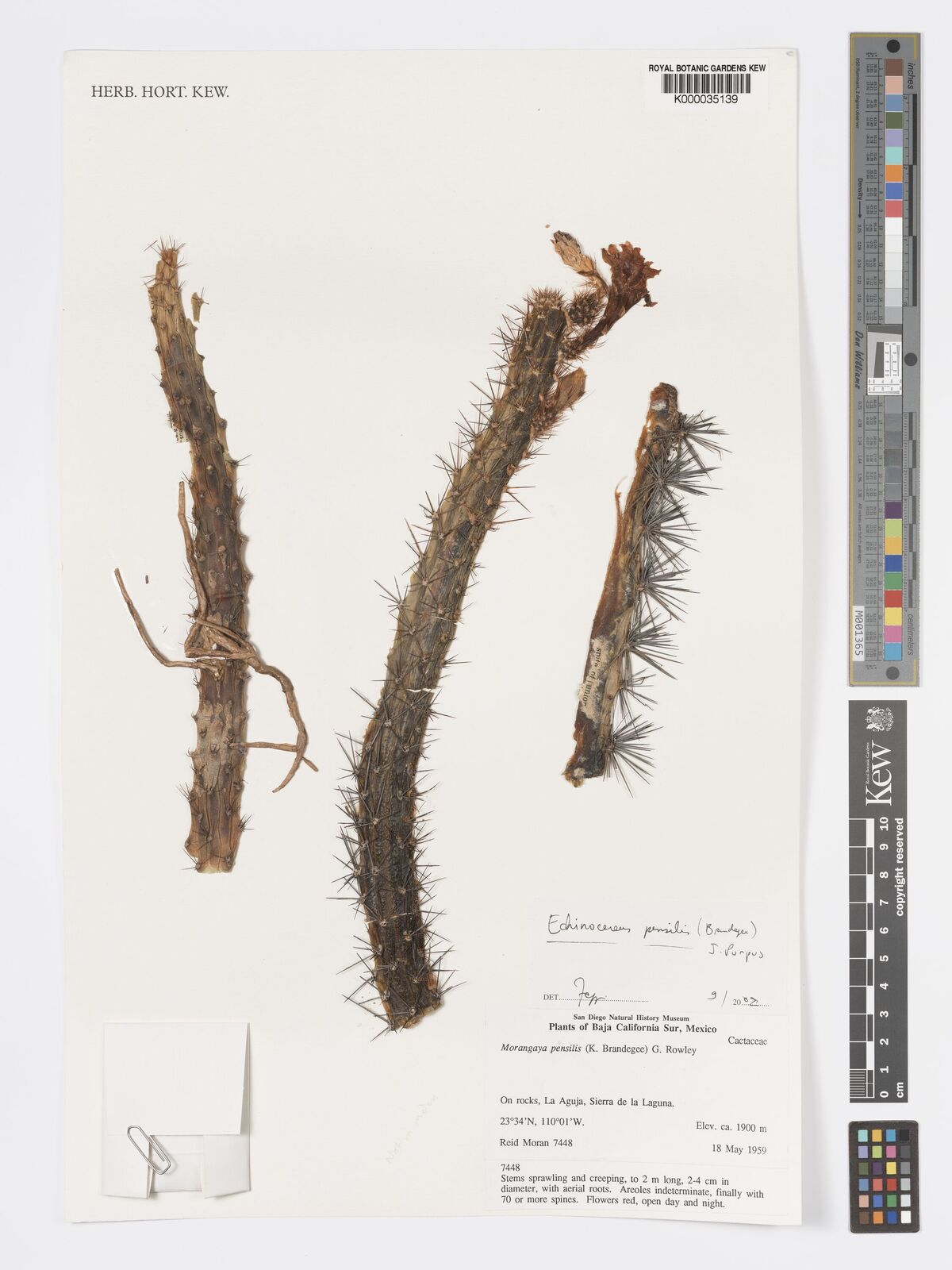 Reference image
Trailing Cactus
Morangaya pensilis (syn. Echinocereus pensilis) is a unique, pendulous cactus species belonging to the family Cactaceae 1. It is highly prized in cultivation for its cascading growth habit, making it ideal for hanging baskets and rockeries.
Originally described by Katharine Brandegee as Cereus pensilis, it was later placed in its own genus Morangaya by Gordon Rowley 2. While some taxonomists treat it within Echinocereus, its distinct morphological traits often support its classification as a monotypic genus.
This species is endemic to Baja California Sur, Mexico 1. It thrives in arid shrublands, growing decumbent or hanging down rocky cliffs and steep canyon walls. This harsh, semi-desert habitat has adapted the plant to endure prolonged droughts.
The stems are slender, cylindrical, and can grow up to 2 meters long, dangling gracefully. They feature 8 to 10 low ribs covered with yellowish-brown spines. During late spring, it produces striking, tubular orange-red flowers that are highly attractive to pollinators 2.
It requires exceptionally well-draining, mineral-rich cactus soil. Growing it in hanging containers allows the stems to cascade naturally. Watering should be thorough but infrequent, allowing the substrate to dry completely between sessions, and kept dry in winter.
The most common mistake is overwatering or using heavy, poorly-draining soil, which quickly causes root rot. Lack of sufficient sunlight leads to weak, etiolated stems and prevents the formation of its beautiful blooms.
Requires plenty of bright, filtered sunlight; protect from intense midday direct sun.
Water only when the substrate is fully dry. Reduce watering to a minimum in winter.
Prefers porous, mineral-rich cactus soil mixed with plenty of pumice and coarse sand.
Spiny stems mean it should be kept in hanging pots out of reach of children and pets.
Requires moderate care due to its trailing growth and specific moisture sensitivity.
Naturally occurs dangling from steep rocky cliffs and canyon walls within dry shrublands of the Baja California peninsula in Mexico, thriving in well-aerated, dry microclimates.
